MATHEMATICAL FINANCE
metrics 2024
Empowering Researchers in the World of Finance
Introduction
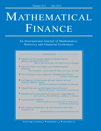
MATHEMATICAL FINANCE is a prestigious journal published by Wiley, focusing on the interdisciplinary fields of finance, applied mathematics, accounting, and economics. With its ISSN 0960-1627 and E-ISSN 1467-9965, this journal has earned its place in the top tier of academic publications, reflected by its Q1 rankings across multiple categories in 2023, including Accounting, Applied Mathematics, Economics and Econometrics, Finance, and Social Sciences. MATHEMATICAL FINANCE, which commenced publishing in 1991, is recognized for its rigorous peer-review process and its significant contribution to the advancement of knowledge in quantitative finance methodologies and risk management practices. Although it does not currently offer open access, the journal remains an invaluable resource for researchers, professionals, and students seeking to stay abreast of the latest theoretical advancements and empirical studies in mathematical finance. Its impact factor and Scopus rankings further illustrate its high standing within the academic community, making it an essential platform for impactful research and scholarly discourse.
Metrics 2024
 1.621.602.2086
Metrics History
Rank 2024
Scopus
IF (Web Of Science)
JCI (Web Of Science)
Quartile History
Similar Journals
JOURNAL OF FINANCE
Leading the way in financial theory and practice.JOURNAL OF FINANCE, published by Wiley, stands as a premier academic journal in the fields of finance, economics, and accounting. With a history dating back to 1946, the journal has consistently delivered impactful research that shapes financial theory and practice, boasting an impressive impact factor reflective of its high citation rate. Its Quartile 1 ranking in Accounting, Economics and Econometrics, and Finance illustrates its leading position within these disciplines. Although not an open access publication, the journal continues to be indispensable for researchers, professionals, and students seeking to advance their understanding and knowledge through rigorous empirical analysis and comprehensive reviews. With an esteemed global readership, the JOURNAL OF FINANCE remains committed to fostering the dissemination of innovative financial research well into 2024 and beyond.

Journal of Investment Strategies
Unlocking New Perspectives in Economics and FinanceThe Journal of Investment Strategies, published by INCISIVE MEDIA, is a distinguished periodical focusing on pivotal issues within the realms of economics, finance, and management. With the ISSN 2047-1238 and E-ISSN 2047-1246, this journal has been making strides since its inception, presenting innovative research from 2018 to 2024. Designated in the Q2 category for both Economics, Econometrics and Finance and Strategy and Management as of 2023, it exemplifies its role as a crucial platform for scholars and practitioners who aim to disseminate knowledge and innovative strategies in investment. Although currently not open access, it provides robust insights into finance advocacy, economic dynamics, and strategic management practices. Researchers, professionals, and students alike can benefit from the journal's high-quality contributions that stimulate discussions and advance the understanding of complex investment landscapes, making it an essential resource in the pursuit of excellence in these competitive fields.
JOURNAL OF FUTURES MARKETS
Connecting Theory and Practice in Financial MarketsThe JOURNAL OF FUTURES MARKETS, published by WILEY, stands at the forefront of research in the fields of accounting, economics, finance, and business management. With an ISSN of 0270-7314 and E-ISSN 1096-9934, the journal has been a key academic resource since its inception in 1981, with content converging up to 2024. It is recognized for its rigorous peer-review process and maintains a strong presence in the academic community, holding a Q2 ranking in multiple categories such as accounting and finance, according to the latest 2023 evaluations. With a reputable Scopus ranking, where it ranks in the 65th percentile for economics and econometrics, this journal is essential reading for researchers, professionals, and students alike who seek to explore the complexities of future markets. While not an open-access publication, it offers various subscription options that make cutting-edge research accessible to a broad audience, fostering a deeper understanding of market dynamics and trends.
JOURNAL OF COMPUTATIONAL AND APPLIED MATHEMATICS
Exploring the Depths of Mathematical ApplicationsJOURNAL OF COMPUTATIONAL AND APPLIED MATHEMATICS, published by Elsevier, stands as a premier platform for researchers and practitioners in the fields of applied and computational mathematics. With an impressive convergence history from 1975 to 2025, this journal has established itself as a crucial reference point for innovative mathematical theories, methodologies, and applications. Holding a distinguished position in Scopus rankings—#85 out of 635 in Applied Mathematics and #36 out of 189 in Computational Mathematics—it operates in the highly competitive Q2 quartile for both disciplines as of 2023. Although currently not designated as an open-access journal, it remains widely respected for its rigorous peer-review process and high-quality research contributions. Researchers and professionals seeking to advance their work and engage with cutting-edge developments will find this journal an invaluable resource, fostering a deeper understanding and collaboration within the mathematical community.

Annual Review of Financial Economics
Navigating the Complexities of Market BehaviorAnnual Review of Financial Economics, published by Annual Reviews, stands as a pivotal journal in the fields of Economics and Finance, recognized for its rigorous analysis and comprehensive reviews since its inception in 2010. With an impressive impact factor reflected in its Q1 ranking in both Economics and Econometrics and Finance for 2023, this journal serves as an essential resource for researchers, professionals, and students keen on understanding the dynamic interplay of financial theories and practices. The ISSN 1941-1367 and E-ISSN 1941-1375 signal its commitment to accessibility and dissemination of cutting-edge research within the community. Addressing crucial topics from market behavior to economic modeling, each annual volume synthesizes the latest findings and theoretical advancements, thus contributing significantly to the global discourse within financial economics. With its high Scopus rankings, including a finance rank of #75 out of 317, the journal continues to foster a deep understanding of financial systems and their implications, serving as an invaluable tool for anyone engaged in the broader economic landscape.
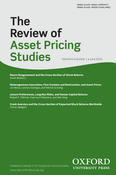
Review of Asset Pricing Studies
Elevating Investment Strategies through Rigorous ResearchThe Review of Asset Pricing Studies, published by Oxford University Press, stands as a leading journal in the fields of Economics and Finance, recognized for its rigorous analyses and innovative research since its inception in 2011. This esteemed publication maintains an impressive impact factor and ranks in the Q1 category for both Economics and Finance as of 2023, consistently occupying top positions in Scopus rankings across its relevant categories. With a clear focus on advancing knowledge in asset pricing and investment strategies, the journal serves as a vital platform for researchers, professionals, and students seeking to contribute to and stay informed on the latest developments in these dynamic fields. Despite its lack of open access, the journal ensures wide circulation and accessibility through its reputable publisher, thereby fostering an engaged academic community.

Probability Uncertainty and Quantitative Risk
Exploring the Nexus of Risk and UncertaintyProbability Uncertainty and Quantitative Risk, published by the American Institute of Mathematical Sciences (AIMS), is a distinguished open-access journal that has been contributing to the academic community since its inception in 2016. With a focus on the crucial interplay between probability, uncertainty, and quantitative risk assessment, this journal serves as a vital platform for researchers, practitioners, and students engaged in the fields of Applied Mathematics and Statistics. The journal's ranking in the Q2 category for both Applied Mathematics and Statistics and Probability reflects its growing influence and relevance, while its diverse scope encourages interdisciplinary studies. As a part of the Scopus database and maintaining a consistent publication pace through 2024, Probability Uncertainty and Quantitative Risk is essential for anyone looking to remain at the forefront of research in risk analysis and uncertainty modeling. Its commitment to open access since 2016 further enhances accessibility to cutting-edge findings, making it an indispensable resource for academics and industry professionals alike.
Review of Derivatives Research
Connecting Theory and Practice in Derivatives AnalysisThe Review of Derivatives Research, published by SPRINGER, stands as a pivotal platform for the dissemination of innovative research in the fields of derivatives, finance, and economics. Established in 1996, this journal provides deep insights into the theoretical and practical aspects of derivatives markets, catering to a diverse audience comprising researchers, practitioners, and academics. With an impact factor that reflects its significance in the scholarly community, it currently holds a Q2 ranking in the Economics, Econometrics and Finance (miscellaneous) category and a Q3 ranking in Finance, demonstrating its relevance and influence within these fields. Although it does not offer an open-access model, the Review of Derivatives Research remains an essential resource for those seeking to advance their understanding of complex financial instruments and market dynamics from 2002 to 2024. The journal's dedicated focus on the intricacies of derivatives paves the way for significant contributions to both academic research and practical applications in finance.

Journal of Risk
Advancing Knowledge in Finance and StrategyJournal of Risk, published by INCISIVE MEDIA, serves as an essential platform for scholars and practitioners in the fields of finance and strategic management. With an ISSN of 1465-1211 and an E-ISSN of 1755-2842, this journal explores the multifaceted nature of risk, encompassing theoretical frameworks, empirical investigations, and practical applications. Although currently classified in Q4 for both Finance and Strategy and Management categories as per 2023 standards, it provides a crucial forum for innovative research and thought leadership, addressing the challenges faced in understanding and managing risk in today’s dynamic environment. The journal, based in the United States, is committed to advancing knowledge and offering a platform for debate and dialogue in its convergence years from 2011 to 2024. Researchers, professionals, and students are encouraged to contribute their insights to enhance the academic discourse surrounding risk management.
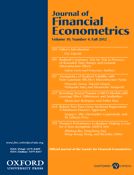
Journal of Financial Econometrics
Bridging theory and practice in financial econometrics.Journal of Financial Econometrics, published by Oxford University Press, stands as a leading academic journal in the fields of financial economics and econometrics. With an impressive impact factor and a ranking in the Q1 quartile for both Economics and Finance categories in 2023, this journal is recognized for its contribution to advancing theoretical and applied methodologies in financial econometric analysis. It publishes high-quality research that addresses critical issues in finance, aiming to foster a deeper understanding of the economic factors influencing financial markets and instruments. Researchers and practitioners alike benefit from its rigorous peer-reviewed articles, which are invaluable resources for both academic scholars and finance professionals. The journal’s content typically spans pioneering techniques in econometric modeling, empirical analysis of financial instruments, and innovative applications of econometric theory in real-world scenarios. Operating out of the United Kingdom, the journal continues to serve as a vital platform for disseminating significant research findings from 2005 to 2024, ensuring that the latest advancements in the field are accessible to its audience.