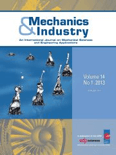
Mechanics & Industry
Scope & Guideline
Unleashing Potential in Industrial Research
Introduction
Aims and Scopes
- Finite Element Analysis (FEA) and Computational Mechanics:
The journal emphasizes research on finite element methods and numerical simulations to analyze mechanical systems, including dynamic behavior, thermal effects, and optimization techniques. - Manufacturing Processes and Optimization:
A core area of focus is on the optimization of manufacturing processes, exploring novel techniques to enhance efficiency, reduce costs, and improve product quality. - Mechanical Design and Reliability Engineering:
The journal covers advancements in mechanical design, particularly in reliability-based design optimization, ensuring that mechanical systems perform reliably under various conditions. - Control Systems and Automation:
Research on control strategies for mechanical systems, including adaptive control and fuzzy logic approaches, is a significant theme, reflecting the importance of automation in modern engineering. - Material Science and Mechanics:
The study of mechanical properties and behavior of materials, including functionally graded materials and composites, is a consistent focus, highlighting the interplay between material science and mechanical engineering. - Dynamics and Vibration Analysis:
The analysis of dynamic behavior and vibration in mechanical systems, including studies on gear systems, pumps, and other machinery, is prevalent, contributing to the understanding of system stability and performance.
Trending and Emerging
- Sustainable Manufacturing and Energy Efficiency:
There is a growing trend towards research focused on sustainable manufacturing processes and energy efficiency in mechanical systems, driven by the industry's need to reduce environmental impact and enhance resource utilization. - Smart Materials and Adaptive Systems:
Emerging themes include the use of smart materials and adaptive systems that respond dynamically to environmental changes, indicating a shift towards more innovative and responsive engineering solutions. - Advanced Control Algorithms and Robotics:
The application of sophisticated control algorithms, particularly in robotics and automation systems, is gaining prominence, reflecting advancements in artificial intelligence and machine learning integration into mechanical systems. - Additive Manufacturing and 3D Printing Technologies:
Research on additive manufacturing technologies continues to grow, emphasizing innovations in materials and processes that enable more complex geometries and customized solutions. - Multiscale and Multiphysics Modeling:
There is an increasing focus on multiscale and multiphysics modeling approaches that integrate various physical phenomena, enhancing the predictive capabilities and accuracy of mechanical simulations.
Declining or Waning
- Traditional Material Processing Techniques:
Research on conventional material processing methods, such as basic machining and casting, appears to be declining as newer, more advanced techniques gain traction, reflecting industry trends towards automation and advanced manufacturing. - Low-Dimensional Models for Complex Systems:
There seems to be a waning interest in simplistic low-dimensional models for complex mechanical systems, as researchers increasingly favor high-fidelity simulations that can capture the intricacies of real-world applications. - Basic Mechanical Testing Methods:
The frequency of publications focusing on basic mechanical testing methodologies, such as tensile and compression testing, has decreased, possibly due to a shift towards more sophisticated and nuanced approaches to material characterization.
Similar Journals

Forces in Mechanics
Exploring the Dynamics of Mechanical ForcesForces in Mechanics is a premier open access journal published by ELSEVIER that has carved out a significant niche in the realms of Mechanical Engineering and Mechanics of Materials. Established in 2020 and based in the Netherlands, this journal aims to disseminate high-quality research that explores the fundamental principles and applications of forces within mechanical systems. It operates under the ISSN 2666-3597, showcasing a dedication to transparent and accessible research for scholars around the globe. With a 2023 impact factor ranking placing it in the Q2 quartile for both Mechanical Engineering and Mechanics of Materials, the journal is recognized for its contributions to the field, evidenced by its Scopus ranking—285th in Mechanical Engineering and 184th in Mechanics of Materials, placing it in the 57th and 53rd percentiles, respectively. The journal publishes original research articles, reviews, and technical notes, catering to a diverse audience including researchers, practitioners, and students who are keen to advance their knowledge on the dynamics of forces in mechanical contexts. As it converges from 2021 to 2024, Forces in Mechanics remains committed to providing a platform for innovative research and critical discourse, ensuring that all published work is freely available to the global community.

STROJNISKI VESTNIK-JOURNAL OF MECHANICAL ENGINEERING
Fostering Innovation Through Rigorous ResearchSTROJNISKI VESTNIK-JOURNAL OF MECHANICAL ENGINEERING is a prestigious publication that has been disseminating cutting-edge research in the field of mechanical engineering since 1974. Published by the Association of Mechanical Engineers Technicians Slovenia, this journal serves as a critical platform for professionals, researchers, and students aiming to explore advancements in mechanical engineering and mechanics of materials. With a category ranking in the Q3 quartile for both Mechanical Engineering and Mechanics of Materials, the journal reflects a robust engagement with contemporary research and practices, contributing to the ongoing discourse within these vital disciplines. Although currently not open access, the journal is committed to providing high-quality, peer-reviewed articles that facilitate knowledge sharing and innovation. It is indexed in Scopus, maintaining respectable standings within its categories, thereby underlining its importance and impact in the global academic community.

Journal of Computational Applied Mechanics
Empowering Global Collaboration in Mechanics of MaterialsJournal of Computational Applied Mechanics, published by UNIV TEHRAN, DANISHGAH-I TIHRAN, is an influential open-access journal that has been disseminating significant research findings since its inception in 2012. With a dedicated focus on the fields of Computational Mechanics, Mechanical Engineering, and Mechanics of Materials, this journal has garnered a Q3 ranking in multiple relevant categories as of 2023, indicating its burgeoning impact within the academic community. Although precise HIndex scores are currently unavailable, the journal's recognition is underscored by its Scopus rankings, placing it in the middle tier among its peers. The journal invites researchers, professionals, and students to contribute to and engage with the continually evolving discourse in applied mechanics, fostering innovation through the dissemination of quality research. As an open-access journal, it ensures that findings are readily accessible to a global audience, thereby enhancing collaboration and knowledge sharing in the scientific community.
Archive of Mechanical Engineering
Bridging History and Innovation in EngineeringThe Archive of Mechanical Engineering, published by Polska Akademia Nauk (Polish Academy of Sciences), is a distinguished platform for disseminating cutting-edge research in the fields of Mechanical Engineering and Mechanics of Materials. Since its inception, the journal has evolved and embraced an Open Access model since 2010, thereby enhancing accessibility and fostering wider dissemination of knowledge among researchers, professionals, and students globally. The journal covers a broad spectrum of topics, ensuring that vital advancements in mechanical engineering are communicated effectively. Recognized as a Q3 category journal in both its relevant categories as of 2023, the Archive continues to establish itself with a competitive Scopus Rank, aiming to elevate the standard of research and innovation. By merging historical insights with contemporary advancements, the journal serves as an essential resource for those seeking to delve into the evolution and future of mechanical engineering.

MECHANICAL ENGINEERING
Advancing the Frontiers of Mechanical Engineering ResearchMECHANICAL ENGINEERING, published by the esteemed American Society of Mechanical Engineers (ASME), is a vital resource for professionals and researchers in the field of mechanical engineering. With a rich history that spans several decades, this journal has been pivotal in disseminating innovative research and advancements from 1968 to 1998 and from 2002 to 2024, fostering a deeper understanding of complex engineering principles. Although currently not an open access journal, it offers subscription-based access to its high-quality articles, enhancing the field's scholarship. As evidenced by its Q4 ranking in mechanical engineering and a current Scopus rank of #580 out of 672, MECHANICAL ENGINEERING serves as a platform for valuable contributions, albeit it is positioned among its peers within the 13th percentile. This journal is a beacon for those committed to staying at the forefront of mechanical engineering research and practice, encouraging discourse that shapes the future of the discipline.
ACTA MECHANICA
Fostering Dialogue in Computational MechanicsACTA MECHANICA, published by Springer Wien, is a reputable journal that has been an integral part of the fields of Computational Mechanics and Mechanical Engineering since its inception in 1965. With a strong emphasis on innovative research and advanced methodologies, the journal has established itself in the academic community, currently holding a distinguished Q2 ranking in both categories for 2023. The journal’s ISSN is 0001-5970, with an E-ISSN of 1619-6937. Furthermore, it proudly ranks #26 out of 89 in Computational Mechanics and #217 out of 672 in Mechanical Engineering in the Scopus database, placing it in the top percentiles of its respective fields. Researchers, professionals, and students can access cutting-edge articles that cover a wide range of topics, contributing significantly to ongoing dialogues and discoveries within mechanical disciplines. Though not an open-access journal, ACTA MECHANICA offers a platform for highly qualified researchers to disseminate their work, ensuring that significant findings advance the field's boundaries. For more information, visit the journal’s address at Prinz-Eugen-Strasse 8-10, A-1040 Vienna, AUSTRIA.

Machines
Pioneering advancements in mechanical and electrical engineering.Machines is a leading journal in the fields of engineering and computer science, published by MDPI in Switzerland since 2013. As an Open Access publication, it ensures that researchers, professionals, and students can freely access high-quality peer-reviewed research. The journal covers a diverse range of topics, including control and optimization, mechanical engineering, electrical engineering, and industrial manufacturing, boasting impressive rankings in various Scopus categories, such as Q2 in Computer Science and Control Systems Engineering. With a commitment to advancing knowledge and innovation in these critical areas, Machines serves as an essential platform for disseminating research findings and fostering collaboration within the academic community. By contributing to the ongoing dialogue in these dynamic fields, the journal plays a pivotal role in shaping the future of technology and engineering practices.
Journal of Machinery Manufacture and Reliability
Elevating knowledge in industrial engineering and quality assurance.The Journal of Machinery Manufacture and Reliability, published by PLEIADES PUBLISHING INC, serves as a pivotal platform for advancing knowledge in the fields of Industrial and Manufacturing Engineering, Mechanical Engineering, and Safety, Risk, Reliability, and Quality. Having adopted an Open Access model since 2015, this journal facilitates global dissemination of research findings and innovations, ensuring that critical developments in machinery manufacture resonate across the academic and professional spectrum. With its ISSN 1052-6188 and E-ISSN 1934-9394, it has established itself within established quartiles, notably Q3 in key engineering categories according to the 2023 metrics. Its Scopus rankings underscore its emerging impact, though it remains an area for growth, making it an excellent venue for early-career researchers aiming to contribute to a growing body of literature. The journal's commitment to high-quality, accessible research positions it as a must-read for academics and practitioners alike, fostering innovation and collaboration in the machinery manufacturing sector.
International Journal of Applied Mechanics
Driving Excellence in Mechanics of MaterialsThe International Journal of Applied Mechanics, published by World Scientific Publishing Co Pte Ltd, is a premier platform that serves the fields of materials science, mechanical engineering, and mechanics of materials. Located in Singapore, this journal has established itself as a crucial resource for researchers, professionals, and students, with its convergence of scholarly work from 2009 to 2024. Ranked in the Q2 category across notable disciplines, including Materials Science, Mechanical Engineering, and Mechanics of Materials, it reflects a strong commitment to publishing high-quality research that pushes the boundaries of knowledge in applied mechanics. Despite being a non-open access journal, its successful Scopus rankings, including an impressive rank of #151 in Mechanical Engineering, signify its substantial impact and recognition within the academic community. This journal not only aims to disseminate pioneering research but also to foster collaboration and innovation in the rapidly evolving landscape of applied mechanics.

Advances in Industrial and Manufacturing Engineering
Exploring the forefront of industrial engineering research.Advances in Industrial and Manufacturing Engineering is a leading academic journal published by Elsevier, dedicated to the dissemination of cutting-edge research in the fields of industrial and manufacturing engineering, mechanical engineering, and the mechanics of materials. Since its inception as an Open Access journal in 2020, it has fostered a global community of scholars committed to advancing theoretical and practical applications in these dynamic areas. With a prestigious Q1 ranking in multiple engineering disciplines and impressive Scopus standings, the journal provides a platform for innovative research that bridges the gap between theory and practice. Based in the Netherlands, the journal encourages the submission of high-quality papers that explore the latest advancements and challenges in the engineering sector. Its open access model ensures that research contributions reach a broad audience, making a significant impact in academia and industry alike. As it converges from 2020 to 2024, the journal aspires to continue setting the benchmark for excellence in engineering research.