Monatsschrift fur Kriminologie und Strafrechtsreform
Scope & Guideline
Exploring the Intersection of Crime and Reform.
Introduction
Aims and Scopes
- Criminological Research and Theory:
The journal publishes empirical studies and theoretical discussions that advance the understanding of criminal behavior, victimology, and the societal impacts of crime. - Criminal Justice System Analysis:
It examines various components of the criminal justice system, including police practices, judicial proceedings, sentencing, and corrections, often with a focus on reform and improvement. - Interdisciplinary Approaches:
The journal encourages interdisciplinary research that integrates insights from sociology, psychology, law, and public policy to address complex issues related to crime and justice. - Policy and Legal Reform:
A significant aim is to influence policy-making and legal reform through evidence-based research, particularly in areas such as sentencing laws, rehabilitation practices, and the treatment of offenders. - Digital and Cyber Crime:
With the rise of technology, there is a consistent focus on the implications of digitalization and cybercrime, analyzing how these phenomena affect traditional criminological theories and practices.
Trending and Emerging
- Cybercrime and Digitalization:
There is a significant increase in research on cybercrime, emphasizing the need for updated methodologies and legal frameworks to address crimes committed in digital spaces. - Radicalization and Extremism:
Papers focusing on radicalization processes, especially among youth, are on the rise, indicating a growing concern about extremism and its implications for public safety and policy. - Intersectionality in Crime Studies:
Emerging work increasingly considers intersectional factors (e.g., race, gender, socioeconomic status) in understanding criminal behavior and victimization, reflecting a broader societal discourse on inequality. - Impact of COVID-19 on Criminal Justice:
The pandemic has prompted an increase in research examining its effects on crime rates, law enforcement practices, and the penal system, highlighting the need for adaptive strategies in unprecedented situations. - Mental Health and Criminal Justice:
There is a growing body of work exploring the intersection of mental health issues and criminal behavior, advocating for reforms in how the justice system addresses mental health concerns among offenders.
Declining or Waning
- Traditional Crime Statistics Analysis:
There is a noticeable decline in papers solely focused on traditional crime statistics, as the field shifts towards more nuanced analyses that consider socio-structural factors and digital crime. - Single-Factor Explanations of Criminal Behavior:
Research that primarily attributes criminal behavior to single factors (e.g., socioeconomic status alone) is becoming less common, with a growing emphasis on multifactorial analyses that incorporate psychological and contextual variables. - Focus on Rehabilitation Alone:
While rehabilitation remains important, the exclusive focus on rehabilitation without consideration of societal reintegration and systemic reform is less frequent in recent publications. - General Deterrence Theory:
Papers concentrating solely on general deterrence as a theoretical framework are decreasing, as researchers increasingly explore more complex interactions between individual, social, and legal factors. - Historical Perspectives on Crime:
Research that solely focuses on historical perspectives of crime without connecting to contemporary issues is becoming less prevalent, as the journal aims to remain relevant to current criminal justice challenges.
Similar Journals

Trends and Issues in Crime and Criminal Justice
Connecting research to real-world justice challenges.Trends and Issues in Crime and Criminal Justice is a leading journal in the field of criminology, published by the Australian Institute of Criminology. This esteemed journal, recognized with an H-index that reflects its influence and contribution to the social sciences, particularly law, spans from 2011 to 2024 and is ranked in the Q1 category within its discipline according to the 2023 data. With a Scopus ranking of #123 out of 1025 in the Social Sciences - Law category, placing it in the 88th percentile, it serves as a critical resource for researchers, practitioners, and students alike.
Focused on innovative research and emerging issues within crime and criminal justice, the journal seeks to foster scholarly collaboration and discourse, making it an essential hub for new ideas and evidence-based practices in the field. The journal’s commitment to advancing knowledge and influencing policy ensures that it remains an influential voice in criminological studies, aiming to address pressing issues facing societies globally.
Journal of Contemporary Criminal Justice
Pioneering Research for a Just Tomorrow.Journal of Contemporary Criminal Justice is a leading academic publication within the field of criminal justice, published by SAGE Publications Inc. This esteemed journal, bearing the ISSN 1043-9862 and E-ISSN 1552-5406, has been contributing significantly to the discourse on contemporary issues in justice systems since its inception in 1978. Renowned for its rigorous peer-reviewed articles, the journal holds an impressive 2023 ranking within the Q1 quartile in Law, further affirmed by its Scopus rank of #110 out of 1025 in the field of Social Sciences - Law, placing it in the 89th percentile. Though not an open access journal, it provides a vital platform for scholars, practitioners, and students seeking to explore and disseminate pioneering research and practical insights into the evolving criminal justice landscape. The journal covers a wide array of topics, from policy analysis to sociological perspectives, ensuring its relevance across multiple disciplines. With a commitment to advancing the understanding of justice in contemporary society, the Journal of Contemporary Criminal Justice is an essential resource for anyone engaged in the fields of criminology, criminal law, and social policy.
Journal of Criminal Psychology
Pioneering interdisciplinary research at the intersection of psychology and law.Journal of Criminal Psychology, an esteemed publication by EMERALD GROUP PUBLISHING LTD, serves as a pivotal resource in the interdisciplinary study of criminal behavior through the lenses of psychology and law. Since its inception in 2011, this journal has significantly contributed to the understanding of psychological principles as they apply to crime, law enforcement, and social justice, making it a vital source for both researchers and practitioners. With a commendable ranking of Q1 in Law and Q3 in Applied and Social Psychology for 2023, the journal guarantees high-quality research findings that can influence policy and practice across these domains. Although it does not offer open access, its rigorous peer-review process ensures that every published article adheres to the highest academic standards. The Journal of Criminal Psychology not only fosters academic discourse but also drives innovation in criminal justice practices, making it essential reading for anyone dedicated to the enhancement of ethical standards in legislation and law enforcement.
American Journal of Criminal Justice
Exploring Innovative Solutions in Law and JusticeAmerican Journal of Criminal Justice is an esteemed publication within the realm of law and criminal justice, recognized for its significant contributions to the understanding and advancement of this vital field. Published by Springer, the journal has established itself as a leading platform for rigorous academic research and scholarly discourse since its inception in 1975. With its impressive 2023 Q1 ranking in the Law category and its 98th percentile ranking in Scopus among social sciences, the journal showcases cutting-edge research that addresses pivotal issues in criminal justice. Though it does not offer open access, its wealth of content is accessible to academic institutions and professionals seeking to deepen their knowledge. The journal aims to foster interdisciplinary collaboration and to provide a forum for innovative methodologies, policy evaluations, and theoretical perspectives, making it a critical resource for researchers, practitioners, and students dedicated to the evolution of criminal justice.
CRIMINOLOGY
Exploring the Complexities of Law and Forensic Medicine.CRIMINOLOGY, published by WILEY, stands as a leading journal in the fields of Law and Forensic Medicine, with an impressive impact factor that places it in the Q1 quartile for both categories. With its ISSN 0011-1384 and E-ISSN 1745-9125, this esteemed journal has been at the forefront of advancing knowledge and understanding in criminological theories and practices since its inception in 1963, and continues to be relevant through 2024. As of 2023, CRIMINOLOGY is ranked #19 in Social Sciences_ Law and #19 in Medicine_ Pathology and Forensic Medicine, positioning it within the top 2% of its field, making it an essential resource for researchers and professionals alike. Despite not offering open access, it provides invaluable insights into the complexities of crime, law enforcement, and societal impacts, thus shaping the future of criminological research and policy.

Russian Journal of Criminology
Bridging cultural perspectives in the study of criminology.Russian Journal of Criminology (ISSN: 2500-4255, E-ISSN: 2500-1442) is an esteemed academic publication hosted by Baikal State University, dedicated to advancing the field of criminology. As a pivotal resource within the domains of law and social sciences, this journal offers a platform for scholars to disseminate innovative research, critical analyses, and comprehensive studies relevant to contemporary criminological issues. Although coverage has been discontinued in Scopus from 2020, the journal continues to provide valuable insights essential for professionals and researchers alike, with a focus on sociological and political perspectives on crime and justice systems. With its unique Russian context, the journal encourages a diverse array of submissions, facilitating a cross-cultural dialogue on criminology that contributes to global scholarship. Despite its current ranking of 478 out of 685 in law and 908 out of 1243 in sociology and political science, the Russian Journal of Criminology remains a vital resource for those seeking to explore the complexities of criminological phenomena and to further the academic discourse in this critical area of study.
International Journal of Comparative and Applied Criminal Justice
Championing rigorous scholarship in applied criminal justice.International Journal of Comparative and Applied Criminal Justice, published by ROUTLEDGE JOURNALS, TAYLOR & FRANCIS LTD, stands at the forefront of interdisciplinary research in the fields of law, sociology, and social psychology. With an ISSN of 0192-4036 and an E-ISSN of 2157-6475, this esteemed journal has been disseminating pivotal research since its inception in 1977. Recognized for its rigorous scholarship, it boasts a Q1 ranking in Law and positions itself within the top 85th percentile in Social Sciences - Law, emphasizing its impact on the academic community. Although primarily subscription-based, its accessibility ensures that critical findings reach a wide audience, supporting the advancement of knowledge across various disciplines. The journal's scope encompasses significant developments in applied criminal justice, making it an invaluable resource for researchers, policymakers, and students dedicated to understanding and improving justice systems globally. In its commitment to academic excellence, the journal continues to foster innovative dialogue and promote knowledge exchange, contributing significantly to current debates within the social sciences.
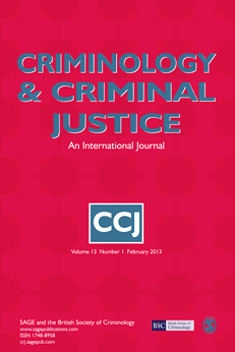
Criminology & Criminal Justice
Navigating Trends and Challenges in Crime and JusticeCriminology & Criminal Justice is a leading academic journal published by SAGE Publications Ltd that serves as an essential resource for scholars, practitioners, and students in the field of criminology and legal studies. With its ISSN 1748-8958 and E-ISSN 1748-8966, this journal has established itself as a crucial platform for innovative research, analysis, and discourse, consistently maintaining a prestigious Q1 ranking in Law. Spanning a diverse range of topics within criminology and criminal justice, it promotes interdisciplinary perspectives that reflect current trends and challenges within the domain. With a notable 93rd percentile ranking in Scopus, the journal ensures that its publications meet rigorous academic standards, fostering the advancement of knowledge and practice in the field. Based in the United Kingdom and catering to a global audience, this journal enhances scholarly communication and collaboration, making it an indispensable tool for those dedicated to unraveling the complexities of crime and justice.

Annual Review of Criminology
Exploring the Nexus of Crime and Justice.The Annual Review of Criminology is a premier academic journal dedicated to advancing the field of criminology through comprehensive reviews of the latest research and emerging trends. Published by Annual Reviews, this journal is highly regarded within the legal realm, boasting a prestigious Q1 ranking in the Law category and an impressive Scopus rank of #13 out of 1025, indicating its significant influence with a 98th percentile standing. The journal focuses on synthesizing key developments from various branches of criminology, making it an essential resource for researchers, professionals, and students alike. Although it does not offer open access, readers can engage with high-quality, peer-reviewed articles that not only address contemporary issues but also provide foundational knowledge for future inquiries. With volumes converging from 2018 to 2021 and 2023 to 2024, the Annual Review of Criminology underscores its commitment to scholarly excellence and the dissemination of critical insights in the evolving landscape of criminal justice.

Revista Criminalidad
Exploring the Intersection of Crime and SocietyRevista Criminalidad, published by POLICIA NAC COLOMBIA, is a distinguished academic journal that has been open access since 1958, making critical research in the field of criminology readily available to the global scholarly community. Based in Colombia, this journal serves as a prominent platform for the dissemination of high-quality research on crime, law, and social sciences. Notably categorized in various quartiles for 2023, including Q2 in Arts and Humanities (miscellaneous) and Q3 in Law, it holds respectable rankings in the Scopus database, reflecting its significance and contribution to both academic and practical discourse. The journal invites researchers, professionals, and students to explore its comprehensive scope, spanning vital themes relevant to criminology and public safety, making it an essential resource for those invested in the interplay between society, law, and criminal behavior. For up-to-date research and insights, the journal is accessible at the CENTRO INVESTIGACIONES CRIMINOLOGICAS DIJIN, AVE EL DORADO 75-25, BOGOTA.