
JOURNAL OF CRIMINAL LAW & CRIMINOLOGY
Scope & Guideline
Deepening Insights into Legal and Criminological Theories
Introduction
Aims and Scopes
- Interdisciplinary Approaches to Criminal Law:
The journal emphasizes interdisciplinary research that integrates perspectives from sociology, psychology, law, and public policy to address complex legal issues and societal impacts. - Victimology and Social Justice:
There is a consistent focus on victimology, examining the experiences and rights of victims, including race and gender considerations in victimization and criminal justice responses. - Legal Reforms and Policy Analysis:
The journal often publishes studies that critique current legal frameworks and propose reforms aimed at enhancing justice, equity, and accountability within the criminal justice system. - Restorative Justice and Alternative Sentencing:
A notable area of interest is restorative justice, exploring its applications and efficacy as an alternative to traditional punitive measures, particularly in addressing systemic inequalities. - Empirical Research on Crime Trends:
The journal publishes empirical studies that analyze crime trends, contributing valuable data and insights that inform both academic and policy discussions. - Criminal Justice System Accountability:
There is a strong emphasis on accountability mechanisms within the criminal justice system, including discussions on police conduct, judicial practices, and systemic biases.
Trending and Emerging
- Police Accountability and Reform:
Recent publications emphasize the need for police accountability, examining systemic issues and proposing reforms to ensure fair and just policing practices. - Intersectionality in Criminal Justice:
There is a growing focus on intersectionality, particularly how race, gender, and socioeconomic status intersect to affect individuals' experiences within the criminal justice system. - Impact of Technology on Crime and Justice:
Emerging themes include the influence of technology, such as surveillance and data collection, on crime prevention and the implications for civil liberties and privacy rights. - Criminalization of Social Issues:
An increasing number of papers explore the criminalization of social issues, such as mental health and substance abuse, advocating for more humane and supportive responses rather than punitive measures. - Restorative Justice Practices:
The rise of restorative justice practices is a prominent trend, with research examining their effectiveness in promoting rehabilitation and community healing. - Public Health Approaches to Crime Prevention:
There is an emerging interest in public health approaches to crime prevention, advocating for a shift from punitive responses to addressing the underlying social determinants of crime.
Declining or Waning
- Traditional Punishment Models:
There appears to be a diminishing focus on traditional punitive models of punishment, as contemporary scholarship increasingly advocates for rehabilitative and restorative approaches to justice. - Strict Legal Formalism:
The trend towards strict legal formalism in criminal law seems to be waning, with a growing critique of rigid legal interpretations that neglect the social realities and human experiences involved in criminal cases. - Focus on Incarceration Rates:
While incarceration rates were a significant concern in prior years, recent publications indicate a shift towards exploring alternatives to incarceration and the implications of such alternatives for justice and rehabilitation. - Conventional Deterrence Theory:
The long-standing emphasis on conventional deterrence theory is decreasing as newer models and theories that encompass broader social and psychological factors gain traction. - International Criminal Law:
The focus on international criminal law issues appears to be less frequent, as more attention is being directed towards domestic reforms and community-based justice solutions.
Similar Journals

IOWA LAW REVIEW
Exploring the frontiers of contemporary law.IOWA LAW REVIEW is a prestigious legal journal published by the University of Iowa College of Law, dedicated to advancing the discourse in the field of law. Since its inception, this journal has become a vital resource for legal scholars, practitioners, and students, committed to publishing rigorous and thought-provoking articles that address contemporary legal challenges. With a strong emphasis on contributions from a diverse range of legal fields, including constitutional law, criminal justice, and property law, the IOWA LAW REVIEW maintains a Q1 ranking in law, reflecting its significance and influence on legal scholarship globally. While the journal is not currently open access, it provides critical insights and perspectives that are essential for understanding the evolving landscape of law. Additionally, with its ranking of #314 out of 1025 in the Scopus database, the journal demonstrates a high impact within the legal community. Scholars and practitioners alike are encouraged to engage with its scholarly articles, as they not only highlight key legal issues but also propose innovative solutions to complex societal problems.
International Criminal Justice Review
Connecting theory and practice in criminal justice.International Criminal Justice Review is a premier journal in the field of law, published by SAGE Publications Inc, renowned for its commitment to advancing the understanding of criminal justice issues on a global scale. With an ISSN of 1057-5677, this journal spans a rich history from its inception in 1991 to its ongoing contributions into 2024, supporting a diverse array of research that addresses both theoretical and practical concerns in international criminal law. The journal holds a prestigious Q1 ranking in the Law category for 2023, reflecting its influence and relevance, as evidenced by its impressive Scopus rank of #68 out of 1025 in the Social Sciences Law field, placing it in the 93rd percentile. Though not an open-access journal, it provides vital access options for institutions and individuals alike. International Criminal Justice Review serves as a critical resource for researchers, practitioners, and students dedicated to exploring the complexities of international criminal justice systems, offering a platform for innovative scholarship that informs policy and practice worldwide.
Journal of Criminal Law
Navigating Contemporary Challenges in JusticeWelcome to the Journal of Criminal Law, a prestigious publication in the field of legal studies, expertly published by SAGE Publications Ltd. With a rich history that dates back to 1937, this journal has been a vital platform for disseminating innovative research and critical analyses pertaining to criminal law and justice issues. The journal boasts a commendable Q2 ranking in the Law category for 2023, placing it among the top tier of legal publications. It is recognized for its impactful contributions, as indicated by its impressive Scopus Rank of #346 out of 1025 in the Social Sciences - Law category, positioning it within the 66th percentile. Although it does not currently offer open access options, researchers, professionals, and students will find a wealth of rigorously peer-reviewed articles that address contemporary challenges and developments in criminal law. Based in the United States, the journal is committed to fostering scholarly dialogue and advancing understanding in an ever-evolving legal landscape.
Journal of Contemporary Criminal Justice
Shaping the Future of Criminal Justice Scholarship.Journal of Contemporary Criminal Justice is a leading academic publication within the field of criminal justice, published by SAGE Publications Inc. This esteemed journal, bearing the ISSN 1043-9862 and E-ISSN 1552-5406, has been contributing significantly to the discourse on contemporary issues in justice systems since its inception in 1978. Renowned for its rigorous peer-reviewed articles, the journal holds an impressive 2023 ranking within the Q1 quartile in Law, further affirmed by its Scopus rank of #110 out of 1025 in the field of Social Sciences - Law, placing it in the 89th percentile. Though not an open access journal, it provides a vital platform for scholars, practitioners, and students seeking to explore and disseminate pioneering research and practical insights into the evolving criminal justice landscape. The journal covers a wide array of topics, from policy analysis to sociological perspectives, ensuring its relevance across multiple disciplines. With a commitment to advancing the understanding of justice in contemporary society, the Journal of Contemporary Criminal Justice is an essential resource for anyone engaged in the fields of criminology, criminal law, and social policy.

CRIMINAL JUSTICE STUDIES
Exploring the complexities of law and policy.CRIMINAL JUSTICE STUDIES, published by Routledge Journals, Taylor & Francis Ltd, is a leading journal in the field of criminal justice and law, boasting an impressive 2023 Q1 category ranking. With an ISSN of 1478-601X and an E-ISSN of 1478-6028, this journal serves as a pivotal platform for disseminating high-quality research that spans various dimensions of criminal justice, including policy, theory, and practice. Since its inception in 2007, CRIMINAL JUSTICE STUDIES has become a vital resource for scholars, practitioners, and students, addressing contemporary challenges and developments within the field. With a remarkable Scopus rank of #157 out of 1025 in Law, positioning it within the 84th percentile, this journal is dedicated to advancing knowledge and fostering critical discourse. Although it does not offer open access, the insights shared within its pages are invaluable to those seeking to deepen their understanding of criminal justice systems worldwide. Based in the United Kingdom and running through 2024, CRIMINAL JUSTICE STUDIES is essential for those engaged in research and practice, pushing the boundaries of knowledge and contributing to the evolution of criminal justice scholarship.

NORTHWESTERN UNIVERSITY LAW REVIEW
Innovating Perspectives in Legal Thought.NORTHWESTERN UNIVERSITY LAW REVIEW, published by NORTHWESTERN UNIVERSITY, stands as a distinguished journal in the field of law, and it has earned a prominent position within Q1 of the 2023 category quartiles. With its ISSN 0029-3571, this journal serves as a critical platform for legal scholarship, illuminating contemporary legal issues and advocating scholarly discourse. The journal, which has been periodically converged since 1973, aims to provide in-depth analysis and innovative perspectives that are essential for researchers, legal professionals, and students alike. Its impactful contributions are reflected in its robust Scopus ranking of Rank #308/1025 within the Social Sciences - Law category, placing it in the 70th percentile. While it does not offer open access, the journal's curated collection of articles continues to be a relevant resource for those engaged in legal studies and practice. With a commitment to advancing legal thought and investigation, NORTHWESTERN UNIVERSITY LAW REVIEW is an invaluable asset for anyone seeking to enrich their understanding of law and its evolving landscape.

Russian Journal of Criminology
Exploring the complexities of crime and justice systems.Russian Journal of Criminology (ISSN: 2500-4255, E-ISSN: 2500-1442) is an esteemed academic publication hosted by Baikal State University, dedicated to advancing the field of criminology. As a pivotal resource within the domains of law and social sciences, this journal offers a platform for scholars to disseminate innovative research, critical analyses, and comprehensive studies relevant to contemporary criminological issues. Although coverage has been discontinued in Scopus from 2020, the journal continues to provide valuable insights essential for professionals and researchers alike, with a focus on sociological and political perspectives on crime and justice systems. With its unique Russian context, the journal encourages a diverse array of submissions, facilitating a cross-cultural dialogue on criminology that contributes to global scholarship. Despite its current ranking of 478 out of 685 in law and 908 out of 1243 in sociology and political science, the Russian Journal of Criminology remains a vital resource for those seeking to explore the complexities of criminological phenomena and to further the academic discourse in this critical area of study.
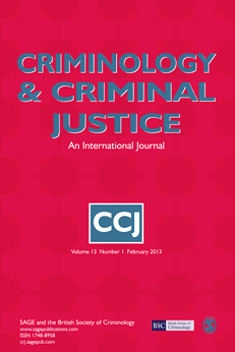
Criminology & Criminal Justice
Empowering Knowledge for a Just SocietyCriminology & Criminal Justice is a leading academic journal published by SAGE Publications Ltd that serves as an essential resource for scholars, practitioners, and students in the field of criminology and legal studies. With its ISSN 1748-8958 and E-ISSN 1748-8966, this journal has established itself as a crucial platform for innovative research, analysis, and discourse, consistently maintaining a prestigious Q1 ranking in Law. Spanning a diverse range of topics within criminology and criminal justice, it promotes interdisciplinary perspectives that reflect current trends and challenges within the domain. With a notable 93rd percentile ranking in Scopus, the journal ensures that its publications meet rigorous academic standards, fostering the advancement of knowledge and practice in the field. Based in the United Kingdom and catering to a global audience, this journal enhances scholarly communication and collaboration, making it an indispensable tool for those dedicated to unraveling the complexities of crime and justice.

Revija za Kriminalistiko in Kriminologijo
Unveiling Innovations in Crime and Social PsychologyRevija za Kriminalistiko in Kriminologijo is a prominent academic journal dedicated to the fields of criminalistics, criminology, law, and forensic medicine, published by the Ministry of Interior Republic Slovenia. With its inception in 1981, the journal has served as a pivotal platform for disseminating research findings and innovative ideas relevant to crime and justice issues, particularly in the context of Slovenia and the wider region. Despite its current Q4 ranking in various categories, including Law and Pathology & Forensic Medicine, Revija za Kriminalistiko in Kriminologijo remains essential for emerging scholars and professionals seeking to contribute to the discourse in forensic science and social psychology. Although the journal does not offer open access options, it continues to publish rigorous peer-reviewed articles that significantly impact the field, making it a valuable resource for researchers, practitioners, and students alike. Scholars can access the research at the journal's address in Ljubljana, Slovenia, thereby fostering interdisciplinary collaboration and knowledge sharing.

International Journal of Criminal Justice Sciences
Bridging theory and practice in criminal law.The International Journal of Criminal Justice Sciences is a premier academic publication dedicated to advancing the field of criminal justice through rigorous research and innovative scholarship. Published by MANONMANIAM SUNDARANAR UNIVERSITY in India, this Open Access journal has been a vital platform for researchers since 2006, promoting unrestricted access to critical knowledge and insights in the realm of law and criminal justice. With a commendable Scopus ranking of #379 out of 1025 in the Social Sciences - Law category, placing it in the 63rd percentile, it holds an essential position for those engaged in legal studies. The journal is particularly beneficial for academics, practitioners, and students aiming to explore contemporary issues, innovative practices, and theoretical advancements in the discipline. Its commitment to quality research is reflected in its Q3 Quartile designation and the continuous convergence of research contributions anticipated from 2017 to 2024. Whether you are looking to publish your findings or seek valuable insights from peer-reviewed articles, the International Journal of Criminal Justice Sciences remains an indispensable resource for fostering knowledge and dialogue in this critical field.