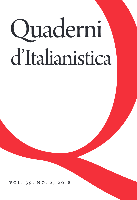
QUADERNI D ITALIANISTICA
Scope & Guideline
Illuminating Themes in Italian Cultural Narratives
Introduction
Aims and Scopes
- Interdisciplinary Approaches to Italian Studies:
The journal encourages contributions that intersect various disciplines such as literature, history, cultural studies, and philosophy, fostering a rich dialogue among different fields. - Focus on Historical and Contemporary Contexts:
Research published in the journal often examines both historical texts and contemporary issues, providing a comprehensive view of Italian culture and literature through time. - Exploration of Gender and Identity:
A significant emphasis is placed on themes of gender, identity, and representation, particularly in relation to women’s roles in literature and society, reflecting ongoing social transformations. - Cultural and Literary Criticism:
The journal features critical analyses of literary works, exploring themes, narratives, and the socio-political contexts in which they were produced, contributing to a broader understanding of Italian literature. - Engagement with Italian Intellectual Traditions:
There is a consistent focus on the exploration of Italian intellectual traditions, including the works of classical authors and their influence on contemporary thought.
Trending and Emerging
- Ecocriticism and Environmental Studies:
There is an increasing focus on ecocriticism, particularly regarding Italian literature's engagement with environmental issues, reflecting a broader global concern for ecological awareness. - Globalization and Transnationalism:
Emerging themes related to globalization and transnational identities are becoming prominent, as scholars examine Italian literature's place within the global literary landscape. - Migration and Identity:
Research centered on migration narratives and the complexities of identity in contemporary Italian literature is on the rise, addressing pressing social issues relevant to modern Italy. - Feminist and Gender Studies:
There is a significant increase in feminist analyses and studies of gender representation, particularly concerning contemporary authors and their contributions to the discourse on gender in literature. - Intermediality and Adaptation Studies:
The exploration of intermediality, including adaptations of literary texts into film and other media, is becoming more prevalent, highlighting the dynamic interactions between different cultural forms.
Declining or Waning
- Traditional Literary Canon:
There seems to be a waning interest in exclusively traditional literary analyses that focus solely on canonical texts without considering contemporary relevance or interdisciplinary connections. - Focus on Purely Historical Narratives:
Research that strictly adheres to historical narratives without integrating modern theoretical frameworks or contemporary significance has become less frequent, indicating a shift towards more dynamic approaches. - Limited Exploration of Regional Literatures:
There is a noticeable decrease in studies focusing on regional Italian literatures or dialects, as the journal increasingly prioritizes broader thematic analyses and national narratives. - Reduction in Studies on Classical Texts:
The journal has seen a decline in the number of articles dedicated to classical texts, suggesting a shift towards more modern and contemporary works that resonate with current societal issues. - Diminished Focus on Theatrical Studies:
The exploration of Italian theatre, particularly historical or classical forms, appears to be less prominent, reflecting a broader trend towards literature and cultural studies.
Similar Journals
Italianist
Connecting Scholars Through the Lens of Italian StudiesItalianist is a distinguished peer-reviewed journal published by Routledge Journals, Taylor & Francis Ltd, focusing on the multifaceted aspects of Italian culture, history, and anthropology. With a proud history spanning from 1981 to 2001 and then again from 2003 to 2024, this journal caters to a global audience of scholars, professionals, and students seeking to deepen their understanding of Italian studies. Although it currently operates without an open access option, it provides invaluable insights that contribute to critical discourse in the field, evidenced by its rankings in Scopus: Q4 in Anthropology and Q3 in History, demonstrating its growing influence among academics. The journal is based in the United Kingdom and strives to promote high-quality research that explores historical narratives, cultural practices, and anthropological themes related to Italy, making it an essential resource for anyone interested in this rich and vibrant area of study.
Critical Survey
Engaging with the Pulse of Cultural DiscourseCritical Survey, published by BERGHAHN JOURNALS, is a distinguished academic journal that focuses on the dynamic intersections of Cultural Studies and Literature and Literary Theory within the arts and humanities landscape. With an ISSN of 0011-1570 and E-ISSN 1752-2293, this journal serves as a crucial platform for scholars, offering original research and critical essays that delve into contemporary cultural and literary debates. Based in the United Kingdom, it enjoys a solid reputation as evidenced by its 2023 Scopus rankings, placing it in the Q3 category for Cultural Studies and Q2 for Literature and Literary Theory. While it does not currently offer open access options, the journal is committed to maintaining high academic standards and fostering intellectual exchange through its published content, inclusive of articles that span a range of topics relevant to critical survey methodologies. As it continues to converge from 2012 to 2024, Critical Survey remains an invaluable resource for researchers, professionals, and students engaged in the evolving discourse of cultural and literary analysis.

Complutense Journal of English Studies
Empowering Voices in English Language and LiteratureThe Complutense Journal of English Studies, published by the Universidad Complutense de Madrid, is a prominent Open Access journal dedicated to advancing the field of English language and literature studies. Established in 2014, this journal provides a vital platform for researchers, educators, and students to disseminate original research, critical analyses, and creative works that contribute to the understanding of English studies in a global context. With its commitment to quality scholarship, the journal seeks to enhance interdisciplinary dialogues and foster new insights into contemporary linguistic and literary issues. Although it currently does not have a designated HIndex or Scopus Rank, its accessibility ensures that a wide audience can engage with a diverse range of scholarly contributions. Located in the heart of Madrid, the journal embraces an inclusive approach to the study of English, inviting submissions that reflect both traditional paradigms and innovative perspectives.
Modern Italy
Diving into Italy's Rich Historical and Cultural LandscapeModern Italy, published by Cambridge University Press, stands as a vital academic journal dedicated to the rich tapestry of Italian culture, history, and societal dynamics. With an ISSN of 1353-2944 and an E-ISSN of 1469-9877, this journal not only reflects on Italy's historical narratives but also engages with contemporary issues pertinent to various fields including Anthropology, Cultural Studies, History, and Sociology and Political Science. As of 2023, it has achieved commendable rankings, falling within the Q1 category in Cultural Studies and History, along with a Q2 ranking in both Anthropology and Sociology. These accolades highlight its influence and commitment to scholarly excellence, making it an essential resource for academics, researchers, and students seeking to deepen their understanding of Italy's past and present. Although the journal does not adopt an open access model, its impactful research and vibrant discussions are accessible through academic institutions and libraries, ensuring that critical insights into Italian studies continue to reach a broad audience.

RIVISTA DI STORIA DELLA FILOSOFIA
Uncovering the Evolution of Philosophical ThoughtRIVISTA DI STORIA DELLA FILOSOFIA is a distinguished academic journal published by FRANCO ANGELI, focusing on the rich tapestry of philosophical thought throughout history. With an ISSN of 0393-2516 and an E-ISSN of 1972-5558, this journal serves as a vital platform for researchers and scholars in the field of philosophy, contributing to the ongoing discourse and exploration of philosophical ideas. Indexed in Scopus, it currently holds a Q4 quartile ranking in Philosophy, highlighting its commitment to disseminating scholarly work despite being positioned in the lower percentile of arts and humanities rankings. Since its inception in 1984, the journal has aimed to publish high-quality research articles, reviews, and critical essays that delve into various philosophical themes and historical analyses, spanning from the early discussions to contemporary debates within the discipline. Although it does not offer open access, it maintains a strong presence in academic libraries and institutions, facilitating access to its content for students, professionals, and researchers interested in deepening their understanding of philosophical history and theory. Located in Milan, Italy, at VIALE MONZA 106, MILAN 20127, RIVISTA DI STORIA DELLA FILOSOFIA is an essential resource for those engaged in the philosophical dialogue and looking to contribute to the evolving narrative of philosophical scholarship.

Ermeneutica Letteraria-Rivista Internazionale
Illuminating the Intersection of Art and LanguageErmeneutica Letteraria-Rivista Internazionale, published by FABRIZIO SERRA EDITORE, serves as a notable platform for the ongoing discourse in the fields of Arts and Humanities, Linguistics, Literature, and Literary Theory. Since its inception in 2019, this scholarly journal has become a significant reference point for innovative research while critically engaging with various literary paradigms and linguistic phenomena. Although currently classified in the Q4 quartile across its respective categories by Scopus, its commitment to open discourse invites submissions that challenge existing norms and broaden the horizons of contemporary literary critique. The journal's holistic approach not only supports the scholarly community in Italy but also aims to foster international dialogue among researchers, professionals, and students in the humanities. The journal is located in Pisa, Italy, and due to its open access policy, it seeks to ensure that knowledge is accessible to a wider audience while contributing to the collective understanding of literary interpretations and linguistic developments.

Italianistica-Rivista di letteratura Italiana
Celebrating the Nuances of Italian Literary TraditionItalianistica-Rivista di letteratura Italiana is a distinguished academic journal dedicated to the exploration and analysis of Italian literature, published by FABRIZIO SERRA EDITORE. With its ISSN 0391-3368 and E-ISSN 1724-1677, the journal serves as a pivotal platform for scholars and researchers interested in literary theory and the richness of Italian literary heritage. Operating out of Pisa, Italy, it has been a significant contributor to the field since its inception in 2002, with publication converging through to 2023. Although classified in the Q4 category in Literature and Literary Theory for 2023, the journal occupies a unique position in fostering academic dialogue and advancing scholarly research amidst a competitive landscape, as evidenced by its Scopus rank of #784 out of 1106 in the same category. The journal does not currently offer open access options, making it a focused resource for those affiliated with institutions that facilitate access to subscription-based research. Researchers and students alike will find Italianistica invaluable for its rigorous scholarship and commitment to the nuanced study of Italian literature.
Italian Culture
Challenging Narratives, Celebrating Diversity in Italian CultureItalian Culture is a critical scholarly journal published by Routledge Journals, Taylor & Francis Ltd, focusing on the multifaceted nature of Italian cultural expressions from the 1970s to the present day. With an ISSN of 0161-4622 and an E-ISSN of 1559-0909, this journal serves as an essential platform for researchers and scholars interested in the nuanced dynamics of Italian cultural heritage, sociopolitical contexts, literature, and the visual and performing arts. Despite its current categorization in the Q4 quartile in various fields such as Cultural Studies and Literature, it remains committed to publishing insightful interdisciplinary studies that challenge conventional narratives and contribute to ongoing scholarly discourse. Notably positioned in the United Kingdom, it offers unique perspectives on Italian identity and cultural production, making it a crucial resource for students, professionals, and academics alike. The journal's scope and its convergence of cultural studies will undoubtedly stimulate academic engagement and exploration within and beyond its established readership.

JOURNAL OF MODERN ITALIAN STUDIES
Unlocking Insights into Italy's Modern IdentityThe Journal of Modern Italian Studies, published by Routledge Journals, Taylor & Francis Ltd, is a premier academic journal that has been at the forefront of exploring the rich and multifaceted dimensions of modern Italian culture since its inception in 1995. With an ISSN of 1354-571X and an E-ISSN of 1469-9583, this journal features a strong focus on Cultural Studies, History, Political Science and International Relations, as well as Sociology, achieving prestigious Q1 and Q2 quartile rankings as of 2023. It occupies an esteemed position in the academic landscape, holding notable Scopus ranks that highlight its significance within the fields of Arts and Humanities and Social Sciences. The journal aims to foster an understanding of Italy's contemporary issues, artistic endeavors, and political narratives, serving as an essential resource for researchers, students, and professionals interested in Italian studies and broader cultural discourses. Although it does not offer open access, its comprehensive and rigorously peer-reviewed articles make it a vital source of knowledge in the vibrant field of modern Italian scholarship.

STUDI E PROBLEMI DI CRITICA TESTUALE
Unveiling Insights in Textual StudiesSTUDI E PROBLEMI DI CRITICA TESTUALE is a distinguished journal published by FABRIZIO SERRA EDITORE, focusing on the critical analysis of texts, literary theory, and related areas. Based in Italy, this journal circulates within the vibrant landscape of literary studies, fostering scholarly dialogue and promoting rigorous research methodologies. It has been recognized within the Q4 category in Literature and Literary Theory, reflecting its niche yet impactful presence in academia, as showcased by its Scopus rank of #1046 out of 1106, placing it in the 5th percentile for its field. Although it does not currently offer Open Access options, the journal has undergone various phases of publication from 2002 to 2018 and has made a notable return from 2020 to 2023. STUDI E PROBLEMI DI CRITICA TESTUALE serves as an essential platform for researchers, professionals, and students to explore and disseminate critical insights in literary studies, ultimately contributing to the advancement of knowledge in this dynamic field.