
Revista de Cancioneros Impresos y Manuscritos
metrics 2024
Celebrating the Intersection of Music and Culture
Introduction
Revista de Cancioneros Impresos y Manuscritos is an esteemed academic journal published by UNIV ALICANTE, dedicated to the field of Literary and Cultural Studies, with a particular focus on the history and analysis of printed and manuscript songbooks. Since its inception, this Open Access journal has been committed to promoting scholarly research and collaboration, allowing for unrestricted access to knowledge that contributes to the vibrant discourse surrounding literature, linguistics, and cultural heritage. The journal boasts an impressive reputation, achieving a Q2 ranking in both Library and Information Sciences and Linguistics and Language, as well as a Q1 ranking in Literature and Literary Theory as of 2023. With a significant impact factor and current Scopus rankings reflecting its scholarly influence, the journal serves as a critical platform for researchers, professionals, and students alike to publish and engage with pioneering scholarship in these dynamic fields. Since its transition to open access in 2012, the journal has fostered a community of contributors and readers dedicated to exploring the multifaceted dimensions of song literature.
Metrics 2024
 0.260.400.303
Metrics History
Rank 2024
Scopus
JCI (Web Of Science)
Quartile History
Similar Journals

Abriu-Estudos de Textualidade do Brasil Galicia e Portugal
Cultivating a Global Dialogue in Literature and ArtsAbriu-Estudos de Textualidade do Brasil Galicia e Portugal, published by UNIV BARCELONA, FACULTAD FILOLOGIA, is a pivotal open-access journal dedicated to the expansive study of textuality across Brazil, Galicia, and Portugal. Since its inception in 2012, this journal has become an essential resource for researchers, scholars, and students interested in the interconnections among literature, linguistics, history, and the arts. With a commitment to fostering academic discourse, Abriu presents a diverse range of articles that examine the richness of cultural and linguistic expressions within the Iberian Peninsula and beyond. With-category quartile rankings of Q3 in History and Q4 in Linguistics and Language, the journal reflects its growing influence in the respective fields, while Scopus rankings underscore its commitment to high-quality scholarship. By providing open-access options, Abriu ensures that valuable knowledge remains accessible to all, furthering its objective to bridge cultures and disciplines in contemporary discussions. The journal’s scope spans critical analyses and innovative approaches in textual studies, making it a vital platform for advancing research and discourse.

Revista Electronica de Fuentes y Archivos
Enhancing Understanding Through Open AccessRevista Electronica de Fuentes y Archivos is a distinguished academic journal dedicated to the exploration of historical sources and archival studies. Published by the CENTRO DE ESTUDIOS HISTORICOS PROF CARLOS S A SEGRETI in Cordoba, Argentina, this journal has been an open-access resource since 2010, ensuring that a diverse audience of researchers, professionals, and students can freely access valuable scholarly work. The journal aims to foster dialogue and dissemination of knowledge within the fields of history, archival science, and documentation studies, promoting interdisciplinary collaboration. With its commitment to enhancing historical inquiry and promoting best practices in archival management, Revista Electronica de Fuentes y Archivos plays a pivotal role in supporting the academic and professional development of those dedicated to the preservation and interpretation of historical records.
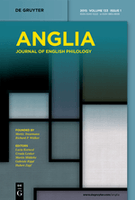
ANGLIA-ZEITSCHRIFT FUR ENGLISCHE PHILOLOGIE
Cultivating Knowledge in the Heart of English StudiesANGLIA-ZEITSCHRIFT FUR ENGLISCHE PHILOLOGIE, published by WALTER DE GRUYTER GMBH, stands as a significant periodical in the fields of Linguistics and Literary Theory. With a rich publication history dating back to 1878 and ongoing contributions until 2024, this esteemed journal serves as a vital resource for researchers, professionals, and students interested in the evolution of the English language and literature. Although it does not currently offer open access, its rigorous peer-reviewed articles have secured a respectable standing, ranking Q3 in Linguistics and Language and Q2 in Literature and Literary Theory as of 2023. The journal, located in Berlin, Germany, continues to drive academic discourse and foster scholarly engagement in the intricacies of English philology, making it an essential platform for the latest research and developments in the field.
REVISTA DE FILOLOGIA ESPANOLA
Illuminating the Landscape of Linguistics and LiteratureREVISTA DE FILOLOGIA ESPANOLA is a distinguished academic journal dedicated to the fields of linguistics and literature, published by the CONSEJO SUPERIOR INVESTIGACIONES CIENTIFICAS (CSIC) since 1954, and has been an Open Access journal since its inception. Situated in Madrid, Spain, this journal has emerged as a crucial platform for the dissemination of scholarly research, with notable rankings including Q2 in Linguistics and Language and Q1 in Literature and Literary Theory as of 2023. The journal's commitment to fostering academic dialogue is reflected in its impressive Scopus rankings, including a 79th percentile in the Arts and Humanities for Literature and Literary Theory. Covering a wide range of topics from linguistic theory to literary critique, REVISTA DE FILOLOGIA ESPANOLA is essential reading for researchers, professionals, and students alike, providing valuable insights and cutting-edge research in the ever-evolving landscape of Spanish philology.

GREEK ROMAN AND BYZANTINE STUDIES
Unlocking the Secrets of the Past for Future GenerationsGREEK ROMAN AND BYZANTINE STUDIES, published by DUKE UNIVERSITY, is a leading journal dedicated to the exploration of ancient Greek and Roman civilizations as well as Byzantine history. With its ISSN 0017-3916 and E-ISSN 2159-3159, this prestigious journal has established itself as a vital platform for interdisciplinary research, boasting an impact factor worthy of recognition in the academic community. Since its transition to Open Access in 2004, GREEK ROMAN AND BYZANTINE STUDIES has enhanced the accessibility of scholarly work, fostering a collaborative environment for researchers, students, and professionals alike. Ranked in the Q2 category in Classics and History, and Q3 in Cultural Studies, this journal continues to be an essential resource for those investigating the philosophical, historical, and cultural dimensions of ancient societies. With a focus on innovative research and critical scholarship, GREEK ROMAN AND BYZANTINE STUDIES stands as a cornerstone for advancing knowledge and understanding within these influential fields.
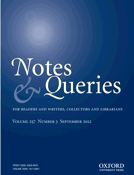
NOTES AND QUERIES
Cultivating Critical Thought in the Arts and HumanitiesNOTES AND QUERIES is a prestigious journal published by Oxford University Press, dedicated to the exploration of literary studies, linguistics, and library sciences, with a history that extends back to 1849. This journal serves as a pivotal platform for scholars and practitioners to engage in dialogues that illuminate the nuances of text interpretation and linguistic inquiry. With its emphasis on both new research and critical discussion, NOTES AND QUERIES is indexed with notable Scopus rankings, reflecting its substantial contribution to the fields of Linguistics and Literary Theory. Although it currently resides in the Q4 quartile for Library and Information Sciences and Linguistics and Language, and Q3 for Literature and Literary Theory as of 2023, it remains a vital resource for both emerging and established scholars aiming to deepen their understanding of cultural and textual contexts. While the journal is not open access, it continues to foster an environment for scholarly collaboration and knowledge dissemination, making it an essential read for anyone invested in the arts and humanities.

Italianistica-Rivista di letteratura Italiana
Illuminating the Essence of Italian LiteratureItalianistica-Rivista di letteratura Italiana is a distinguished academic journal dedicated to the exploration and analysis of Italian literature, published by FABRIZIO SERRA EDITORE. With its ISSN 0391-3368 and E-ISSN 1724-1677, the journal serves as a pivotal platform for scholars and researchers interested in literary theory and the richness of Italian literary heritage. Operating out of Pisa, Italy, it has been a significant contributor to the field since its inception in 2002, with publication converging through to 2023. Although classified in the Q4 category in Literature and Literary Theory for 2023, the journal occupies a unique position in fostering academic dialogue and advancing scholarly research amidst a competitive landscape, as evidenced by its Scopus rank of #784 out of 1106 in the same category. The journal does not currently offer open access options, making it a focused resource for those affiliated with institutions that facilitate access to subscription-based research. Researchers and students alike will find Italianistica invaluable for its rigorous scholarship and commitment to the nuanced study of Italian literature.
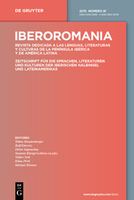
IBEROROMANIA
Unveiling Complexities in Linguistics and Literary NarrativesIBEROROMANIA, published by WALTER DE GRUYTER GMBH, stands as a pivotal journal in the fields of Linguistics and Language and Literature and Literary Theory. Since its inception in 1969, IBEROROMANIA has facilitated scholarly discourse by providing a platform for cutting-edge research that explores the complexities of Romance languages and their literatures. The journal is recognized for its valuable contributions, currently holding a Q3 quartile ranking in Linguistics and Language and a Q2 ranking in Literature and Literary Theory as of 2023. With its diverse scope spanning several years, including works from 1970 to 2024, IBEROROMANIA is pivotal for researchers, professionals, and students alike, fostering a deeper understanding of Romantic linguistic and literary frameworks. Although it does not provide open access, its impact in the Arts and Humanities is underscored by its Scopus rankings, reflecting a commitment to high-quality scholarship. For those dedicated to exploring the nuances of Romance languages and literature, IBEROROMANIA is an indispensable resource.

Skandinavskaya Filologiya
Fostering Interdisciplinary Insights in Scandinavian Studies.Skandinavskaya Filologiya is a distinguished academic journal published by St Petersburg University Press that specializes in Scandinavian philology and linguistics. With its ISSN 0202-2397 and E-ISSN 2618-9518, this journal serves as a vital platform for scholarly articles that explore the intricate languages, literature, and cultural nuances of the Scandinavian region. The journal seeks to promote interdisciplinary research and foster collaboration among linguists, literary scholars, and cultural researchers interested in the rich heritage and contemporary developments within Scandinavian studies. Although the journal operates without open access, it is committed to enhancing academic discourse and providing a valuable resource for students, professionals, and researchers. Located in the vibrant city of St Petersburg, Russia, the journal aims to bridge the gap between Eastern and Western scholarship in Scandinavian philology, making it a significant contributor to the field.

HUDSON REVIEW
Illuminating Voices in Contemporary CriticismHUDSON REVIEW is a prestigious literary journal published by HUDSON REVIEW INC, based in New York City. Established to foster an appreciation for the arts and literature, this journal provides a platform for in-depth literary analysis, critical essays, and poetry exploring the complexities of human experience. With its extensive history of publication and established reputation, HUDSON REVIEW plays a significant role in the literary field, attracting contributions from esteemed authors and scholars. While the journal operates under a traditional model without open access, it nevertheless offers valuable insights and promotes rigorous discourse among researchers, professionals, and students interested in the evolving landscape of literature and criticism. Noteworthy for its contributions from 2002 to 2011 in Scopus, the journal remains an essential resource for anyone looking to deepen their understanding of contemporary literary trends.