REVUE DES ETUDES JUIVES
metrics 2024
Advancing Scholarship in Jewish Studies Since 1967
Introduction
REVUE DES ETUDES JUIVES, published by PEETERS, stands as a vital platform for scholarly discourse in the realms of Cultural Studies, History, Literature and Literary Theory, and Religious Studies. Based in Belgium, this journal, bearing the ISSN 0484-8616 and E-ISSN 1783-175X, has been faithfully chronicling research since its inception, with comprehensive coverage spanning from 1967, 1969, and several periods thereafter until 2023. Although categorized in Q4 quartiles across its fields—showing a diverse yet niche presence—it provides an invaluable space for emerging voices and established scholars to explore Jewish studies in a multidisciplinary context. Despite its compact impact factor and Scopus rankings reflecting its emerging status in the academic community, the journal is committed to fostering dialogue on the cultural and historical aspects of Jewish identity, offering a unique opportunity for researchers, professionals, and students to engage with contemporary and historical issues of Jewish significance. As a non-open access resource, it appeals to those seeking rigorous academic inquiry supported by Peeters' esteemed publishing acumen.
Metrics 2024
 0.100.100.2010
Metrics History
Rank 2024
Scopus
JCI (Web Of Science)
Quartile History
Similar Journals
Shofar-An Interdisciplinary Journal of Jewish Studies
Bridging Disciplines to Enrich Jewish UnderstandingShofar: An Interdisciplinary Journal of Jewish Studies, published by Purdue University Press, is a prominent peer-reviewed journal that engages with the diverse and rich tapestry of Jewish studies through interdisciplinary approaches. With a focus on cultural studies, history, and religious studies, the journal has established itself within the academic community, achieving significant recognition evidenced by its Q3 ranking in these disciplines as of 2023. Researchers and scholars in the field will find valuable insights and innovative discussions that push the boundaries of traditional scholarship. Though currently not open access, Shofar offers an enriching forum for scholarly discourse that fosters a deeper understanding of Jewish identity, history, and culture, making it an essential resource for professionals and students alike. The journal's ISSN is 0882-8539, while its E-ISSN is 1534-5165. It is operational from 2014 to 2024 and is located in the United States.
Journal of Ancient Judaism
Illuminating the Cultural Contexts of Ancient JudaismThe Journal of Ancient Judaism is an esteemed academic publication focusing on the dynamic field of religious studies, particularly the historical and cultural contexts of ancient Judaism. Published by BRILL, a reputable international publisher known for its scholarly contributions, this journal is dedicated to advancing the study of ancient Jewish texts, traditions, and their socio-political environments. With an ISSN of 1869-3296 and an E-ISSN of 2196-7954, the journal has established its footprint in the scholarly community, supported by its ranking in the Q3 quartile for Religious Studies in 2023 and a Scopus rank of #371 out of 644 in its category. The content showcased in this journal is vital for researchers, professionals, and students alike, offering peer-reviewed articles that contribute to the broader understanding and appreciation of ancient Jewish heritage and its influence on contemporary religious thought. With a timeline spanning from 2015 to 2024, the journal aims to facilitate rigorous academic discourse and provide open access to vital research findings, fostering a deeper engagement with the complexities of ancient Judaism.
AJS Review-The Journal of the Association for Jewish Studies
Advancing Jewish Studies through Interdisciplinary DialogueAJS Review - The Journal of the Association for Jewish Studies is a leading academic journal published by the University of Pennsylvania Press, dedicated to advancing scholarship in Jewish studies. With its ISSN 0364-0094 and E-ISSN 1475-4541, the journal offers a rich compendium of research from various disciplines, including cultural studies, history, literature and literary theory, and religious studies. Recognized within the Q2 and Q3 quartiles across multiple categories in 2023, AJS Review provides an esteemed platform for academics to disseminate innovative ideas and engage with critical issues relevant to Jewish history and culture from 1976 to 2024. Although not an open-access journal, it ensures that high-quality, peer-reviewed articles are available to a global audience, enabling researchers, professionals, and students to foster deeper insights into Jewish narratives and heritage. By promoting interdisciplinary dialogue, AJS Review is integral to the academic community, offering valuable contributions to our understanding of Jewish studies and its broader implications.

Jewish Historical Studies-Transactions of the Jewish Historical Society of England
Fostering Interdisciplinary Insights in Jewish StudiesJewish Historical Studies - Transactions of the Jewish Historical Society of England is a premier scholarly journal dedicated to advancing the understanding of Jewish history in its diverse contexts. Published by UCL PRESS, this open access journal has been freely accessible since 2015, providing an invaluable resource for researchers, educators, and students alike. With an ISSN of 0962-9696 and E-ISSN 2397-1290, it features a wide variety of articles that delve into topics related to the historical, cultural, and societal aspects of Jewish communities. Located at University College London, the journal is committed to fostering interdisciplinary insights and encouraging critical discourse within Jewish studies. Its dedication to open access amplifies the visibility and dissemination of high-quality research, ensuring that vital scholarship reaches a global audience. As a vital platform for sharing cutting-edge research, Jewish Historical Studies plays a crucial role in the ongoing dialogue regarding Jewish history, heritage, and identity.

Arquivo Maaravi-Revista Digital de Estudos Judaicos da UFMG
Exploring Jewish Culture and HistoryArquivo Maaravi-Revista Digital de Estudos Judaicos da UFMG is a distinguished open-access journal dedicated to the field of Jewish Studies, published by the Universidade Federal de Minas Gerais (UFMG). With an ISSN of 1982-3053, the journal has been serving the academic community since 2007, facilitating the dissemination of research and scholarship in Jewish cultural, historical, and religious studies. Situated in the vibrant academic landscape of Brazil, the journal aims to foster dialogue among researchers, professionals, and students, providing a platform for innovative and critical perspectives. Although the H-Index and specific Scopus ranks are not available, the journal's commitment to academic rigor and open access ensures that its content reaches a broad audience, empowering researchers and enriching the field of Jewish studies worldwide. The journal is based at FAC Ciências Econômicas, Av. Antonio Carlos, 6627, Belo Horizonte MG 31270-901, Brazil, making it an integral part of the UFMG's academic ecosystem.

AMERICAN JEWISH HISTORY
Illuminating the Past, Enriching the PresentAMERICAN JEWISH HISTORY is a premier academic journal published by Johns Hopkins University Press, dedicated to the exploration and analysis of the Jewish experience in the American context. With ISSN 0164-0178 and E-ISSN 1086-3141, this journal serves as a vital resource for scholars and students in the fields of cultural studies, history, and religious studies, as evidenced by its placement in the Q3 quartile across these disciplines in 2023. Reaching a broad audience interested in the historical, social, and cultural dimensions of the American Jewish narrative, the journal has converged in various years, ensuring a robust collection of multidisciplinary research and discussions. Although it operates under a traditional subscription model, the journal remains an essential platform for critical analysis, fostering deeper understanding of Jewish identity and history. With Scopus rankings placing it at the 60th percentile in History and 62nd percentile in Religious Studies, AMERICAN JEWISH HISTORY stands as a respected publication that significantly contributes to the discourse surrounding Jewish history and culture in the United States.
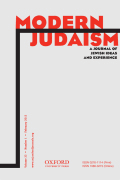
MODERN JUDAISM
Fostering Scholarly Dialogue on Contemporary JudaismMODERN JUDAISM is a premier journal dedicated to the multifaceted exploration of Jewish culture, history, and religious practice, providing a significant platform for scholarly discourse since its inception in 1981. Published by Oxford University Press Inc in the United States, this journal stands out with its diverse engagement across disciplines, reflected in its commendable 2023 category quartiles: Q2 in Cultural Studies and History, Q1 in Religious Studies, and notable rankings in Political Science and Sociology. With an impact factor that underscores its rigorous peer-review process and scholarly relevance, MODERN JUDAISM serves as an essential resource for researchers, professionals, and students alike, fostering an academic environment conducive to innovative ideas and comprehensive studies. Although not open access, the journal remains crucial for anyone looking to deepen their understanding of contemporary Jewish thought and its intersection with broader cultural and political currents. For further inquiry or submissions, please refer to the Journals Department at 2001 Evans Rd, Cary, NC 27513.
Jewish Studies Quarterly
Navigating Contemporary Issues in Jewish ScholarshipJewish Studies Quarterly, published by MOHR SIEBECK, is a leading academic journal dedicated to advancing scholarship in the field of Jewish studies. With its ISSN 0944-5706 and E-ISSN 1868-6788, this journal provides a platform for rigorous research that explores various dimensions of Jewish history, culture, religious practices, and contemporary issues. Although it does not currently offer open access options, it remains an essential resource for researchers, professionals, and students seeking insightful analysis and academic discourse. The journal is widely recognized for its commitment to excellence and contribution to understanding Jewish identities within global contexts. Located in Tübingen, Germany, Jewish Studies Quarterly is integral to the dialogue and scholarship surrounding Jewish thought and heritage, making it a vital reference point in the academic community.
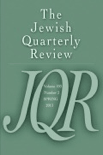
JEWISH QUARTERLY REVIEW
Unveiling the Rich Tapestry of Jewish ExperienceJewish Quarterly Review, published by University of Pennsylvania Press, is a distinguished academic journal that delves into the multifaceted realms of Jewish culture, history, and religious studies. With a rich publication history dating back to 1953 and an impressive track record of rigorous scholarship, this journal maintains a Q2 ranking in key categories such as Cultural Studies, History, and Religious Studies in 2023, placing it among the top-tier journals in its field. The ISSN number 0021-6682 and the E-ISSN 1553-0604 ensure that its scholarship is widely accessible and traceable in academic databases. While the journal is not open access, it remains an essential resource for researchers, professionals, and students seeking in-depth analysis and perspectives on Jewish thought and heritage. The JQR is known for its editorial commitment to enhancing understanding and dialogue across cultural and historical contexts, making it an invaluable asset for anyone engaged in Jewish studies and related disciplines. With its headquarters in Philadelphia, PA, the journal continues to foster scholarly engagement and critical discourse on Jewish identity and experience through its carefully curated articles and reviews.
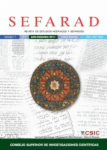
SEFARAD
Pioneering Research on Jewish Culture and HistorySEFARAD, published by the CONSEJO SUPERIOR INVESTIGACIONES CIENTIFICAS-CSIC, is a renowned open-access journal that has been a pivotal platform for scholarly communication since its inception in 1996. Based in Spain, it caters to a diverse readership across multiple disciplines, including Cultural Studies, History, Literature and Literary Theory, Religious Studies, and Linguistics and Language. The journal has successfully established itself within respected academic circles, achieving Q2 rankings in both History and Literature and Literary Theory as per the 2023 category quartiles, emphasizing its significance in these fields. With a commitment to fostering interdisciplinary dialogue and enhancing understanding of the Jewish heritage and culture in the Iberian Peninsula, SEFARAD presents original research articles, comprehensive reviews, and critical essays that inspire further scholarly inquiry. Researchers, professionals, and students alike will find this journal an invaluable resource for contemporary studies in its vibrant subject areas.