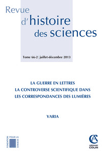
Revue d Histoire des Sciences
metrics 2024
Chronicling the Evolution of Scientific Ideas.
Introduction
Revue d'Histoire des Sciences is a distinguished academic journal published by Armand Colin, focusing on the intricate interplay of history and philosophy within the sciences. Since its inception in 1973, the journal has served as a vital platform for researchers, scholars, and students interested in exploring the historical dimensions of scientific development. With an ISSN of 0151-4105 and an E-ISSN of 1969-6582, this journal is recognized within the academic community, achieving a modest 2023 Scopus ranking of Q3 in History and Philosophy of Science, positioning it within the 41st percentile of its category. The journal offers a prestigious space for rigorous discourse, critical analysis, and innovative research aimed at advancing our understanding of the scientific enterprise's past. While it operates under a traditional access model, the ongoing commitment to rich scholarly content ensures that the contributions will resonate with those dedicated to the intersections of history, science, and philosophy, providing insights into how historical context shapes scientific inquiry and advancement.
Metrics 2024
 0.160.300.407
Metrics History
Rank 2024
Scopus
IF (Web Of Science)
JCI (Web Of Science)
Quartile History
Similar Journals
THEORIA-REVISTA DE TEORIA HISTORIA Y FUNDAMENTOS DE LA CIENCIA
Pioneering Insights in Philosophy and History of ScienceTHEORIA-REVISTA DE TEORIA HISTORIA Y FUNDAMENTOS DE LA CIENCIA, published by the Servicio Editorial Universidad del País Vasco, is a leading open access journal dedicated to advancing the fields of History, Philosophy of Science, and related disciplines since its inception in 2003. With a robust impact factor placing it in the esteemed Q1 and Q2 quartiles in its respective categories, this journal serves as a crucial platform for researchers, professionals, and students who are engaged in profound discussions and analyses of scientific foundations and historical contexts. Based in Spain, THEORIA has consistently demonstrated its commitment to scholarly excellence, achieving notable rankings in Scopus, particularly in the fields of Arts and Humanities, where it holds a rank of #169 in Philosophy and #59 in History and Philosophy of Science. The journal not only allows immediate open access to its diverse range of articles, fostering global knowledge dissemination, but also aims to bridge connections across varied philosophical inquiries and historical explorations within science. Join the dialogue today in shaping the future understanding of our scientific heritage.
Foundations of Science
Bridging Disciplines in the Pursuit of KnowledgeFoundations of Science is a renowned academic journal published by SPRINGER, dedicated to the interdisciplinary exploration of both the historical and philosophical dimensions of science. Established in 1995 and based in the Netherlands, this journal has carved out a significant niche within the History and Philosophy of Science and Multidisciplinary fields, holding an impressive Q2 ranking in both categories as of 2023. The journal's rigorous peer-review process ensures the dissemination of high-quality research, supported by its Scopus rankings, which place it in the top 15% of its peer group in History and Philosophy of Science and the top 28% in Multidisciplinary studies. Although not an open-access journal, Foundations of Science remains accessible through various academic channels, making its vital contributions to the discourse surrounding scientific foundations available to a broad audience. By fostering dialogue across disciplines, it plays a crucial role in advancing the understanding of science's philosophical underpinnings and its historical development, making it an essential resource for researchers, professionals, and students alike.
JOURNAL OF THE HISTORY OF BIOLOGY
Charting the Historical Landscape of BiologyJOURNAL OF THE HISTORY OF BIOLOGY, published by Springer, stands as a vital academic resource devoted to examining the historical development of biological science and its philosophical dimensions. This esteemed journal, which has been in continuous publication since 1968 and encompasses research through 2024, is recognized for its significant contributions to the fields of Agricultural and Biological Sciences, and the History and Philosophy of Science, proudly holding a Q2 ranking in both categories as of 2023. With an ISSN of 0022-5010 and an E-ISSN of 1573-0387, it serves a diverse audience of researchers, professionals, and students interested in the interplay between biological advancements and historical context. The journal’s particular emphasis on interdisciplinary investigation provides a platform for innovative scholarship that enriches our understanding of not only the science itself but also its societal implications. While it does not currently offer open access, the rigor and reputation of the journal underscore its importance as a leading publication in the academic landscape of biological history.

HISTORY OF SCIENCE
Documenting the Evolution of Ideas that Changed the WorldHISTORY OF SCIENCE, published by SAGE PUBLICATIONS LTD, stands as a pivotal journal in the domain of historical studies, with a focus on the development and evolution of scientific thought and practice throughout history. With an ISSN of 0073-2753 and an E-ISSN of 1753-8564, this journal is recognized for its commitment to high-quality research, as evidenced by its categorization in the Q2 quartile for History and Q3 for History and Philosophy of Science in 2023. Spanning a converged history from 1962 to 2024, the journal serves as an essential platform for scholars, providing in-depth analyses and discussions that foster a deeper understanding of the interplay between science and its historical context. As a well-regarded source in the field, it ranks #140 out of 1760 in Arts and Humanities History and maintains a commendable 92nd percentile ranking, highlighting its influence and reach among researchers and professionals alike. Although not an Open Access journal, it remains accessible to students, scholars, and practitioners in the field, bridging the past and present of scientific inquiry.

Spontaneous Generations-Journal for the History and Philosophy of Science
Unraveling the Threads of Scientific Thought Through TimeSpontaneous Generations: Journal for the History and Philosophy of Science is a dedicated publication focusing on the rich fields of history and philosophy within the scientific domain. Published by the Institute for the History and Philosophy of Science and Technology, this journal provides a vital platform for scholars, researchers, and students to explore and disseminate ideas that bridge the historical context and philosophical inquiries of scientific practices. With its commitment to open access, Spontaneous Generations ensures that groundbreaking research is widely available, fostering an environment of collaboration and knowledge sharing. Aiming to engage a diverse audience, this journal is pivotal for those looking to understand the evolution of scientific thought and its implications on contemporary issues, making it an essential resource in the academic community.
History of Geo- and Space Sciences
Exploring the rich tapestry of geo-science history.History of Geo- and Space Sciences is a distinguished open-access journal published by COPERNICUS GESELLSCHAFT MBH since 2010, committed to advancing knowledge in the interdisciplinary fields of Earth and planetary sciences as well as the history and philosophy of science. Based in Germany, this journal operates under ISSN 2190-5010 and E-ISSN 2190-5029, providing a platform for researchers, professionals, and students to disseminate and access high-quality scholarly articles. With a remarkable impact reflected in its 2023 Scopus rankings, placing it in Q3 for Earth and Planetary Sciences (miscellaneous) and Q2 for History and Philosophy of Science, the journal plays a crucial role in fostering dialogue and collaboration among the scientific community. It not only covers significant advancements in geo-sciences but also addresses historical perspectives and philosophical inquiries that shape our understanding of the discipline. Engage with groundbreaking research and broaden your insights by contributing to or reading articles from this pivotal journal.
Rhizomata-A Journal for Ancient Philosophy and Science
Bridging Ancient Wisdom and Modern ScienceRhizomata - A Journal for Ancient Philosophy and Science is a key academic publication dedicated to exploring the intricate intersections of ancient philosophical thought and scientific inquiry. Published by WALTER DE GRUYTER GMBH, this journal has established a significant presence in the field since its inception in 2013, with its convergence years extending to 2024. With a strong Q2 ranking in both the History and Philosophy of Science and Philosophy categories, it offers rigorous peer-reviewed articles that engage with the historical context and evolution of scientific ideas. The journal enjoys a commendable standing in Scopus rankings, positioned at 310 out of 806 in Philosophy, and 126 out of 223 in History and Philosophy of Science, showcasing its relevance and impact within these disciplines. While currently not an Open Access publication, the journal is instrumental for researchers, professionals, and students eager to delve into the foundational theories that have shaped modern scientific discourse. Join the dialogue and contribute to the vibrant academic community by engaging with Rhizomata, where ancient wisdom meets contemporary thought.
European Journal for Philosophy of Science
Advancing the Dialogue Between Science and PhilosophyThe European Journal for Philosophy of Science, published by SPRINGER, stands as a prestigious platform for scholars in the realms of philosophy and history of science. With an impressive impact factor and categorized in the Q1 Quartile for both History and Philosophy of Science and Philosophy, this journal ranks among the top 10% of its peers, reinforcing its critical role in advancing academic discussions and insights within these fields. With its composition of rigorous peer-reviewed articles and a commitment to fostering interdisciplinary dialogue, the journal navigates foundational and contemporary issues that shape scientific inquiry. Although currently not Open Access, it provides invaluable access to researchers, professionals, and students who seek to deepen their understanding of the philosophical underpinnings of scientific practice. Housed in the Netherlands, the journal continuously engages with the evolving landscape of philosophy in the scientific domain, making it a key resource for anyone invested in the intersection of science and philosophy.

Bollettino di Storia delle Scienze Matematiche
Bridging Disciplines: History, Philosophy, and MathematicsBollettino di Storia delle Scienze Matematiche, published by FABRIZIO SERRA EDITORE, stands as a vital platform for the exploration of the rich history and philosophical underpinnings of mathematical sciences. With its origins tracing back to 2003, this journal primarily serves as an interdisciplinary forum where historians, philosophers, and mathematicians converge, reflecting the complex interplay between mathematics and its historical context. Although classified within the Q4 quartile for both the History and Philosophy of Science and Mathematics categories in 2023, the journal continues to stimulate critical discourse and encourage new avenues of research that challenge traditional narratives. While it is not an open-access publication, it is recognized for its scholarly rigor and contributes essential insights to the academic community, particularly those engaged in the nuanced study of mathematical practices through time. Researchers, professionals, and students alike will find valuable resources within its pages to inform their inquiries and broaden their understanding of the historical trajectory of mathematical thought.
PHYSICS IN PERSPECTIVE
Revealing the Legacy of Physics in Contemporary ThoughtPHYSICS IN PERSPECTIVE, published by SPRINGER BASEL AG, is an esteemed journal dedicated to the intricate interplay between the history of physics and its contemporary implications. With an ISSN of 1422-6944 and an E-ISSN of 1422-6960, this journal has established itself as a pivotal resource for researchers, scholars, and students who seek a deeper understanding of physics through a historical lens. The journal enjoys a Q1 ranking in History and a Q3 ranking in Physics and Astronomy (miscellaneous), illustrating its significance in the arts and humanities as well as its notable contributions to physics scholarship. Published in Switzerland, it provides a unique platform for interdisciplinary dialogue, combining historical analysis with modern physics discussions. As it continues to grow through its converged years from 1999 to 2024, PHYSICS IN PERSPECTIVE remains committed to enriching the academic community and fostering innovative research that bridges the past and present of the physical sciences.