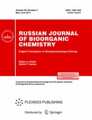
RUSSIAN JOURNAL OF BIOORGANIC CHEMISTRY
metrics 2024
Cultivating Insights for a Sustainable Future in Chemistry
Introduction
Russian Journal of Bioorganic Chemistry (ISSN: 1068-1620, E-ISSN: 1608-330X), published by MAIK Nauka/Interperiodica/Springer, serves as a vital resource for researchers and professionals in the fields of bioorganic chemistry, biochemistry, and organic chemistry. With a focus on the integration of organic chemistry principles with biological processes, this journal aims to disseminate significant findings and advancements from both theoretical and practical perspectives. Although currently not open access, the journal retains a dedication to high-quality, peer-reviewed content, contributing to its reputation within the academic community. The 2023 Scopus rankings position it within the Q4 category for both biochemistry and organic chemistry, indicating its critical niche within these disciplines amid a competitive landscape. Since its inception in 1996, the journal has continued to evolve, providing enriching insights and fostering collaborations among scholars and practitioners alike, with publication converging up to the year 2024. By exploring complex biomolecular interactions and the synthesis of biologically relevant compounds, the Russian Journal of Bioorganic Chemistry remains a significant platform for advancing knowledge and innovation in the life sciences.
Metrics 2024
 0.221.101.0031
Metrics History
Rank 2024
Scopus
IF (Web Of Science)
JCI (Web Of Science)
Quartile History
Similar Journals
BIOORGANIC CHEMISTRY
Fostering collaboration for groundbreaking chemical insights.BIOORGANIC CHEMISTRY, published by Academic Press Inc., a prestigious imprint of Elsevier Science, represents a cornerstone in the fields of biochemistry, organic chemistry, and drug discovery. With an impressive Scopus rank placing it in the top quartiles across critical categories—including Q2 for Biochemistry and Drug Discovery, and Q1 for Organic Chemistry—this journal has established itself as a vital resource for researchers, professionals, and students alike. Featuring a diverse array of articles that explore innovative methodologies and emerging trends from 1971 to the present, BIOORGANIC CHEMISTRY effectively bridges the gap between laboratory research and practical applications. Although not an Open Access journal, its rigorous peer-review process ensures the delivery of high-quality, impactful research that drives advances in the understanding and application of biochemistry. With an aim to facilitate scientific discourse and collaboration, it invites contributions that further the exploration of chemical processes within biological systems.

BIOORGANIC & MEDICINAL CHEMISTRY LETTERS
Unraveling the complexities of medicinal chemistry.BIOORGANIC & MEDICINAL CHEMISTRY LETTERS, published by PERGAMON-ELSEVIER SCIENCE LTD, is a leading journal in the fields of biochemistry, drug discovery, and medicinal chemistry, designed to disseminate significant advances in these disciplines. Established in 1991, the journal spans various important categories, including Organic Chemistry and Pharmaceutical Science, with its 2023 Scimago Journal Rank placing it at Q2 in Organic Chemistry and Q3 in several other relevant fields. Though not an open-access publication, it provides invaluable insights into contemporary research and innovative methodologies, appealing to researchers, professionals, and students alike. The journal's commitment to quality and relevance makes it a vital resource for those aiming to stay at the forefront of bioorganic and medicinal chemistry developments. For more information, please visit the journal's website as it remains a critical platform for scholarly exchange, particularly for those engaged in interdisciplinary research.

INDIAN JOURNAL OF HETEROCYCLIC CHEMISTRY
Pioneering Research in Biochemistry and BeyondINDIAN JOURNAL OF HETEROCYCLIC CHEMISTRY, published by CONNECT JOURNALS, is a vital resource in the fields of organic chemistry and biochemistry, aiming to advance research and promote innovation within the realm of heterocyclic compounds. Established in 1996, this journal has successfully converged into an influential publication with a commitment to disseminating high-quality, peer-reviewed research articles that enhance the understanding of heterocyclic chemistry applications. Although it currently holds a Q4 quartile ranking in both biochemistry and organic chemistry according to the 2023 categorizations, its broader contributions to the scientific community should not be underestimated, as it seeks to support the ongoing dialogue among researchers, professionals, and students. The journal operates from Ghaziabad, India, providing open access to its publications, thereby fostering a collaborative and informative environment for its international readership. With an ISSN of 0971-1627 and a special focus on contemporary challenges and developments in the field, the INDIAN JOURNAL OF HETEROCYCLIC CHEMISTRY is poised to make a significant impact as it continues to evolve through 2024 and beyond.

Organic Communications
Elevating the discourse in Organic Chemistry since 2008.Organic Communications is an esteemed journal published by ACG PUBLICATIONS, dedicated to advancing the field of Organic Chemistry. Established in 2008 and continuing its journey into 2024, this scholarly journal provides a platform for the dissemination of high-impact research findings, reviews, and methodological advances that shape the landscape of organic chemistry. Located in Turkey, it has made notable strides with a current Scopus rank of #148 out of 211 within its category, placing it in the 30th percentile. As a Q3 journal in organic chemistry, it caters to a diverse readership of researchers, professionals, and students, offering insights that bridge theoretical research and practical applications. Although it does not operate under an open access model, Organic Communications is poised to contribute significantly to the academic community by enabling access to crucial research developments and fostering collaboration within the discipline.

Chemical Methodologies
Bridging Theory and Practice in ChemistryWelcome to Chemical Methodologies, a premier journal published by SAMI PUBLISHING CO-SPC, dedicated to advancing the field of chemistry through innovative research and methodologies. With an ISSN of 2645-7776 and an E-ISSN of 2588-4344, this journal provides a vital platform for researchers and scholars to share their findings in areas encompassing physical, theoretical, and organic chemistry. Despite its initial HIndex and quartile rankings still being established, the journal's evolving impact within the academic landscape is underscored by its Scopus Ranks, which place it in the 35th percentile for physical and theoretical chemistry and the 33rd percentile for organic chemistry. Since its inception in 2022, and continuing through 2024, Chemical Methodologies aims to foster collaboration and knowledge dissemination among academics and practitioners alike, bridging theoretical concepts and practical applications. This open-access platform enhances accessibility for researchers and students worldwide, ensuring that groundbreaking contributions to chemical science reach a broad audience.
TETRAHEDRON LETTERS
Advancing the Frontiers of Chemical KnowledgeTETRAHEDRON LETTERS, published by Pergamon-Elsevier Science Ltd, is a leading journal in the fields of Biochemistry, Drug Discovery, and Organic Chemistry, with a rich legacy since its inception in 1959. This prestigious journal serves as a vital resource for researchers and professionals dedicated to advancing the understanding of chemical sciences, featuring high-impact research that influences both academic and practical applications. Although it is currently classified in the third quartile across its categories for 2023, its rigorous peer-review process ensures the publication of quality research that contributes to the scientific community. With an ISSN of 0040-4039 and an E-ISSN of 1873-3581, TETRAHEDRON LETTERS is easily accessible for those in the academic landscape seeking to stay abreast of innovative developments. Researchers, professionals, and students alike will find invaluable insights and collaborative opportunities within the pages of TETRAHEDRON LETTERS, making it an essential read for anyone involved in the chemical sciences.
Open Chemistry
Unlocking Innovative Discoveries in ChemistryOpen Chemistry, published by DE GRUYTER POLAND SP Z O O, is a distinguished peer-reviewed journal that has been serving the global chemistry community since its inception. With an ISSN of 2391-5420 and an E-ISSN also of 2391-5420, this open-access journal has been accessible to researchers and practitioners alike since 2015, ensuring a wide dissemination of high-quality research findings. Located in Germany, specifically at BOGUMILA ZUGA 32A STR, 01-811 WARSAW, MAZOVIA, POLAND, Open Chemistry aims to publish innovative research across various chemical disciplines, with special attention to miscellaneous chemistry and materials chemistry. It is currently ranked in the Q3 category for both fields as of 2023, reflecting its solid standing within the academic community, with specific ranks of 187/408 in General Chemistry and 153/317 in Materials Chemistry, corresponding to respective percentiles of 54 and 51. Open Chemistry not only enhances the accessibility of cutting-edge research but also serves as a vital resource for students, professionals, and scholars seeking to advance their knowledge in the rapidly evolving landscape of chemical sciences.
PHOSPHORUS SULFUR AND SILICON AND THE RELATED ELEMENTS
Pioneering Research in Inorganic and Organic ChemistryPHOSPHORUS SULFUR AND SILICON AND THE RELATED ELEMENTS, published by Taylor & Francis Ltd, is a distinguished journal dedicated to advancing knowledge in the fields of Biochemistry, Inorganic Chemistry, and Organic Chemistry. Established in 1989, the journal has carved a niche in the scientific community by offering a platform for the publication of innovative research that explores the chemistry and applications of phosphorus, sulfur, silicon, and related elements. With an ISSN of 1042-6507 and an E-ISSN of 1563-5325, this journal provides access to valuable insights, albeit without open access options. Despite being positioned in the fourth quartile of its categories (Q4), it remains an essential resource for researchers, professionals, and students seeking to expand their understanding of these pivotal elements and their interactions. With a publishing horizon extending to 2024, the journal invites contributions aimed at pushing the boundaries of chemistry and fostering interdisciplinary dialogue.

ORGANIC SYNTHESES
Advancing the Frontiers of Organic ChemistryORGANIC SYNTHESES is a prestigious journal dedicated to the field of organic chemistry, published by ORGANIC SYNTHESES INC. Since its inception in 1946, the journal has served as a vital platform for researchers, educators, and practitioners in chemistry, showcasing significant findings and methodologies that advance the discipline. Although it currently does not offer open access, it is recognized for its rigorous peer-review process and its contribution to standardizing organic synthesis methods. With an ISSN of 0078-6209 and an E-ISSN of 2333-3553, the journal's impact reflects its quality, with a current Scopus ranking placing it in the fourth quartile in both Organic Chemistry and Physical and Theoretical Chemistry. This positioning underscores its critical role in fostering knowledge and innovation within these fields. Researchers and students alike will find ORGANIC SYNTHESES an essential resource for staying informed on contemporary practices and discoveries in organic synthesis.

JOURNAL OF HETEROCYCLIC CHEMISTRY
Advancing Knowledge in Organic ChemistryJournal of Heterocyclic Chemistry, published by Wiley, stands as a key resource in the field of organic chemistry, offering in-depth research articles and insights spanning from 1966 to 2024. With its strong Scopus ranking of #83 out of 211 in the Organic Chemistry category, placing it in the 60th percentile, the journal maintains its significance and relevance within the academic community. Although it does not currently offer open access options, it provides extensive coverage of heterocyclic compounds, which are vital to various applications in pharmaceuticals and material sciences. The journal's commitment to high-quality research is further reflected in its classification as Q3 in the 2023 quartiles for Organic Chemistry. Researchers, professionals, and students alike will find valuable contributions to the intricate studies of heterocycles, enhancing their understanding and exploration of this fascinating area of chemistry.