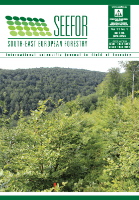
SEEFOR-South-East European Forestry
Scope & Guideline
Advancing sustainable forestry practices in South-East Europe.
Introduction
Aims and Scopes
- Sustainable Forest Management:
Research on practices and methodologies that promote the sustainable use of forest resources, ensuring ecological balance while meeting economic and social needs. - Forest Ecology and Biodiversity:
Studies investigating the ecological characteristics of forest ecosystems, including species diversity, forest dynamics, and the impacts of environmental changes on forest health. - Forest Genetics and Tree Improvement:
Exploration of genetic diversity, conservation of forest genetic resources, and the development of improved tree varieties for better adaptation to changing environmental conditions. - Impact of Climate Change:
Research focusing on how climate change affects forest ecosystems, including studies on resilience, adaptation strategies, and the role of forests in carbon sequestration. - Forest Economics and Policy:
Analysis of economic factors impacting forestry, including market dynamics, forest ownership, and the socio-economic implications of forestry policies in Southeast Europe. - Forest Protection and Management of Invasive Species:
Studies on the threats posed by invasive species, pests, and diseases to forest health, and strategies for their management and control. - Innovative Forestry Practices:
Research on new technologies and practices in forestry, including mechanization, forest monitoring, and the use of alternative materials and energy sources.
Trending and Emerging
- Climate Resilience and Adaptation Strategies:
An increasing number of studies focus on developing climate-resilient forestry practices, assessing the impacts of climate change on forest ecosystems, and exploring adaptive management techniques. - Integrated Watershed Management:
Research is increasingly addressing the holistic management of watersheds, recognizing the interconnectedness of forest ecosystems and water resources, and promoting sustainable land-use practices. - Forest Health and Invasive Species Management:
There is a growing emphasis on understanding the dynamics of forest health, including the effects of invasive species and pathogens, and developing effective management strategies. - Socio-Economic Aspects of Forestry:
Emerging studies are focused on the socio-economic impacts of forestry, including community involvement, economic valuation of forest resources, and the role of forests in rural development. - Technological Innovations in Forestry:
The incorporation of new technologies, such as remote sensing and big data analytics, in forestry research is gaining traction, reflecting a trend towards more data-driven and precise forest management practices.
Declining or Waning
- Traditional Silviculture Practices:
There has been a noticeable decrease in research focused solely on traditional silvicultural methods, as the field moves towards more integrated and sustainable approaches that consider ecological impacts. - Non-Timber Forest Products:
Research on non-timber forest products, such as medicinal plants and edible fungi, has seen a decline as the journal's focus shifts towards broader ecological and management issues. - Forest Fire Management Techniques:
While still relevant, the frequency of studies specifically addressing traditional forest fire management methods has waned, possibly due to a greater emphasis on climate change impacts and innovative fire management strategies. - Historical Forest Management Practices:
Less emphasis is being placed on historical analyses of forest management, as contemporary studies prioritize current challenges and future strategies in forestry.
Similar Journals

Forest Ecosystems
Illuminating the vital role of forests in our ecosystem.Forest Ecosystems is a prestigious open access journal published by KEAI PUBLISHING LTD, dedicated to advancing knowledge in the fields of forestry, ecology, and conservation. Established in 2014 and located in Beijing, China, this journal has rapidly gained prominence, achieving Q1 status in multiple categories, including Ecology, Evolution, Behavior and Systematics, and Forestry in 2023. With an impressive rank of 19 out of 174 in the Scopus category of Agricultural and Biological Sciences - Forestry, it stands in the 89th percentile, reflecting its influential contributions to the field. The journal fosters scholarly discourse and disseminates innovative research aimed at understanding forest ecosystems and their vital role in our environment. Offering a robust platform for researchers, professionals, and students, Forest Ecosystems ensures accessibility through its open access format, enabling a wider audience to engage with and benefit from cutting-edge research dedicated to the stewardship of forest resources.

BOSQUE
Bridging Theory and Practice in Forestry ScienceBOSQUE, published by Universidad Austral de Chile, Facultad de Ciencias Forestales, stands as a pivotal platform for advancing the field of forestry and related environmental sciences. With an ISSN of 0717-9200, this journal has been committed to disseminating original research, reviews, and case studies essential for understanding forest ecosystems and management practices since its inception in 2006. As of 2023, it holds a Q3 ranking in the forestry category, showcasing a significant yet developing influence in the broader academic landscape, evidenced by its Scopus ranking placing it at the 12th percentile in Agricultural and Biological Sciences - Forestry. While boasting a diverse range of articles, BOSQUE promotes open access to a growing community of researchers, professionals, and students eager to contribute to sustainable forest management and conservation efforts. The journal continues to foster critical dialogue and innovation, making it an invaluable resource for those dedicated to enhancing forest sciences.

Revista Cubana de Ciencias Forestales
Advancing forestry knowledge for a sustainable future.Revista Cubana de Ciencias Forestales, published by UNIV PINAR RIO HERMANOS SAIZ MONTES OCA, is a vital resource in the field of forestry and environmental sciences. Since its inception in 2013, this Open Access journal has dedicated itself to disseminating high-quality research and innovations pertinent to forest ecology, sustainable management, and conservation strategies within the Cuban context and beyond. The journal aims to foster academic dialogue among researchers, professionals, and students by providing a platform for the sharing of interdisciplinary studies that address contemporary challenges in forestry. With its commitment to accessibility, Revista Cubana de Ciencias Forestales ensures that knowledge is available to a global audience, thereby contributing to the advancement of forest sciences and ecological awareness.

Forestist
Connecting scholars to cultivate forestry knowledge.Forestist, published by AVES, is a pivotal open-access journal dedicated to the field of Forestry, providing a platform for researchers, professionals, and students to explore cutting-edge developments and research within the discipline since 1980. Operating from Turkey, this journal offers a unique opportunity for scholars to share their findings with a broad audience, contributing to the global discourse on sustainable forest management, conservation practices, and ecological research. With an impressive impact factor and a current categorization in the Q3 quartile for 2023, Forestist ranks among the essential resources in Agricultural and Biological Sciences, particularly within the realm of Forestry, as indicated by its Scopus ranking of #119 out of 174 journals. This publication is committed to fostering open access to knowledge, making research freely available while encouraging innovative studies that address the pressing challenges in forestry and environmental science.

Lesnoy Zhurnal-Forestry Journal
Connecting Global Scholars for Sustainable Forestry SolutionsLesnoy Zhurnal-Forestry Journal is a prominent academic publication dedicated to advancing the field of forestry and environmental sciences. Published by the Northern Arctic Federal University M. V. Lomonosov, this journal focuses on innovative research, practices, and policies related to forestry management and conservation. With an Open Access model established since 2015, the journal ensures widespread dissemination of knowledge and foster collaborative research across global scholarly communities. Located in Arkhangelsk, Russia, the Lesnoy Zhurnal appeals to researchers, professionals, and students alike, providing a platform for sharing valuable insights and addressing emerging challenges in forestry. Though specific metrics like HIndex and Scopus rankings are presently unlisted, the journal is committed to excellence and aims to enhance its visibility and impact within the scientific community. This publication is not only a critical resource for ongoing research but a key player in shaping sustainable forestry practices in a rapidly changing environment, making it indispensable for anyone involved in forestry and environmental studies.
AUSTRALIAN FORESTRY
Advancing Sustainable Solutions in ForestryAustralian Forestry is an esteemed journal dedicated to advancing knowledge in the field of forestry and related environmental science. Published by Taylor & Francis Australia, this journal plays a pivotal role in disseminating high-quality research that spans various aspects of forestry, including sustainable management, conservation practices, and policy analysis. With an impact factor reflecting its significance in the academic community and a Scopus rank of #44 out of 174 in the category of Agricultural and Biological Sciences, Australian Forestry proudly holds a Q2 ranking in its field as of 2023. The journal has maintained a continuous publication record since its inception in 1936, with a commitment to addressing contemporary challenges within forestry. Researchers, professionals, and students alike are invited to engage with this vital resource that fosters insightful dialogue, innovative solutions, and a deeper understanding of forestry science.

Austrian Journal of Forest Science
Exploring the intersection of ecology and forest management.Austrian Journal of Forest Science, published by OSTERREICHISCHER AGRARVERLAG, is a distinguished peer-reviewed journal dedicated to advancing knowledge in the fields of forestry and ecological science. With an ISSN of 0379-5292 and an E-ISSN of 0375-524X, this journal serves as a vital platform for researchers, professionals, and students alike, aiming to disseminate innovative research findings, methodologies, and case studies pertinent to forest conservation, management, and policy. Situated in Austria, its diverse scope encompasses critical topics within ecology, evolution, and biodiversity, evidenced by its competitive quartile rankings in 2023, placing it in Q2 for Forestry and Q3 in other related fields. The journal is committed to fostering a deeper understanding of forest ecosystems, making it an essential resource for anyone invested in sustainable forestry practices and environmental policy.

JOURNAL OF TROPICAL FOREST SCIENCE
Cultivating Insights for Tropical Forest SustainabilityThe JOURNAL OF TROPICAL FOREST SCIENCE, published by the FOREST RESEARCH INST MALAYSIA, serves as a vital platform for disseminating research focused on tropical forestry. Since its inception in 1988 and transitioning to its current form in 1993, this journal has established itself within the academic community, currently holding a commendable Q3 ranking in the Forestry category, as per the 2023 metrics. With an ISSN of 0128-1283 and E-ISSN 2521-9847, it provides crucial insights into the ecological, economic, and social aspects of tropical forest management and conservation, making it an indispensable resource for researchers, practitioners, and students alike. Although it does not operate under an open-access model, the journal emphasizes quality and relevance in its publications, contributing significantly to the ongoing discourse in agricultural and biological sciences with a Scopus rank of #89 out of 174 and a 49th percentile position.
CANADIAN JOURNAL OF FOREST RESEARCH
Advancing knowledge in forestry and ecological sciences.Canadian Journal of Forest Research (ISSN: 0045-5067, E-ISSN: 1208-6037), published by Canadian Science Publishing, stands as a leading platform for disseminating cutting-edge research in the field of forestry and ecological sciences. With an impressive impact factor and a steady reputation for high-quality publications, this journal occupies a prestigious position indicated by its Q1 ranking in Forestry and Q2 in Ecology as of 2023, alongside commendable placements in global and planetary change studies. Covering a broad scope from sustainable forest management to the impacts of climate change on forest ecosystems, the journal encourages submissions that address contemporary challenges and innovations in forest research. Operating from its base in Ottawa, Canada, the Canadian Journal of Forest Research has been a cornerstone of academic discourse since 1974, offering researchers and professionals vital access to pioneering studies that inform policy and practice in forestry. Researchers, educators, and students alike will find this journal an indispensable resource for advancing knowledge and fostering collaboration in the vital realm of forest research.
ANNALS OF FOREST SCIENCE
Bridging Research and Practice in Forest ConservationANNALS OF FOREST SCIENCE, published by Springer France, stands at the forefront of ecological research, contributing significantly to both the fields of Ecology and Forestry, as evidenced by its prestigious Q1 ranking in both categories for 2023. Since its inception in 1999, this journal has become an essential resource for academics, practitioners, and students who are eager to explore the complexities of forest ecosystems and their interactions with global environmental changes. With an ISSN of 1286-4560 and E-ISSN 1297-966X, it disseminates cutting-edge research and critical reviews that enhance our understanding of forest science. Although it does not offer open access, the journal continues to be a pivotal platform for presenting innovative scientific findings that address the pressing challenges of forest management and conservation. Its significant impact factor reflects the high-quality contributions that have made a lasting mark on the discipline.