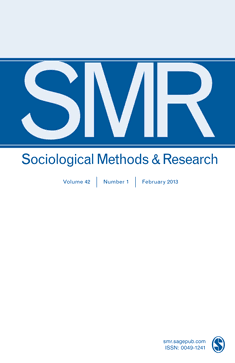
SOCIOLOGICAL METHODS & RESEARCH
Scope & Guideline
Empowering researchers with cutting-edge methodological insights.
Introduction
Aims and Scopes
- Quantitative Methodologies:
The journal consistently publishes articles that focus on quantitative research methods, including advanced statistical techniques, causal inference, regression models, and machine learning applications in social science research. - Qualitative Research Methods:
There is a strong emphasis on qualitative methodologies, with papers exploring ethnographic methods, interview techniques, and mixed-methods approaches to enhance understanding of complex social phenomena. - Data Analysis and Interpretation:
A core area of focus is on innovative data analysis techniques, including the use of software tools for big data analysis, network analysis, and causal modeling, which aim to improve the interpretation of sociological data. - Survey Methodology:
The journal places significant importance on survey design and methodology, discussing issues such as sampling strategies, data collection techniques, and the impact of survey design on data quality. - Social Inequality and Disparities:
Research addressing social inequalities, including class, race, and gender disparities, is a recurring theme, with methodologies developed to analyze and understand these issues more effectively. - Emerging Technologies in Research:
The journal explores the integration of new technologies in sociological research, such as digital trace data, machine learning, and computational methods, reflecting the evolving landscape of data in social science.
Trending and Emerging
- Causal Inference Techniques:
Recent publications emphasize advanced causal inference techniques, including the use of instrumental variables and structural equation modeling, reflecting a growing interest in understanding causal relationships in social contexts. - Digital and Computational Methods:
There is a marked increase in studies utilizing digital data and computational methods, such as machine learning and natural language processing, which are becoming integral to sociological research, enabling new insights from large datasets. - Data Quality and Measurement Issues:
Emerging themes focus on data quality, measurement invariance, and addressing biases in survey research, indicating a heightened awareness of the challenges in ensuring the reliability and validity of sociological data. - Interdisciplinary Approaches:
The journal is increasingly showcasing interdisciplinary methodologies that draw from fields such as computer science, psychology, and economics, promoting a more holistic understanding of social phenomena. - Innovations in Survey Design:
Innovative survey designs, including adaptive and responsive survey techniques, are gaining prominence, reflecting the need for more flexible and effective data collection methods in diverse populations.
Declining or Waning
- Traditional Regression Techniques:
There appears to be a waning focus on classical regression techniques, as researchers increasingly seek more robust and nuanced approaches to causal inference and data analysis, favoring methods that account for complexity and heterogeneity. - Descriptive Statistics:
The use of basic descriptive statistics has diminished, as the field moves towards more sophisticated analytical frameworks that offer deeper insights into social phenomena, highlighting the need for more rigorous methodologies. - Single-Method Studies:
There is a noticeable decline in papers focusing on single-method studies, as the trend shifts towards mixed-methods approaches that combine qualitative and quantitative techniques for a more comprehensive understanding of research questions. - Theoretical Methodologies:
Research that primarily focuses on theoretical discussions without empirical applications seems to be less frequent, as the journal prioritizes methodological advancements that demonstrate practical relevance and application in sociological research.
Similar Journals
STATISTICS IN MEDICINE
Pioneering statistical methods for impactful medical insights.Statistics in Medicine, published by Wiley, is a prestigious journal dedicated to the advancement of statistical methods and their application in biomedical research. Established in 1982, this journal has become a cornerstone in the fields of Epidemiology and Statistics and Probability, demonstrating its importance by consistently achieving a Q1 ranking in the 2023 category quartiles. With an impressive ISSN of 0277-6715 and an E-ISSN of 1097-0258, it serves as a vital platform for disseminating high-quality research that enhances evidence-based medicine. Although the journal does not currently offer open access, it remains highly regarded, holding a Scopus rank of #66 in Mathematics and #80 in Medicine, indicating its significant impact on the academic community. By publishing cutting-edge research, Statistics in Medicine aims to bridge the gap between statistical theory and practical application in health domains, fostering a rigorous dialogue among researchers, clinicians, and statisticians alike.

Journal of Official Statistics
Informing the Global Community with Open Access StatisticsThe Journal of Official Statistics, published by SAGE Publications Inc, is a premier open-access journal that has been fostering advancements in the field of statistics since its inception. With its focus on disseminating high-quality research from 1986 to present, this journal provides a vital platform for statistical practices, innovations, and methodologies applicable to various domains, including governmental and organizational data analysis. Recognized as a Q2 journal in the Statistics and Probability category with a Scopus ranking of #143 out of 278, the Journal of Official Statistics boasts a significant impact in informing statisticians and practitioners alike. Located in Sweden, this journal has embraced open access since 2013, ensuring that its comprehensive and research-driven content is accessible to a global audience. Whether you are a researcher, professional, or student, this journal serves as an essential resource for staying informed about the latest trends and discussions in the official statistical community.
COMPUTATIONAL STATISTICS
Unveiling the synergy between computational mathematics and statistical inference.COMPUTATIONAL STATISTICS, published by Springer Heidelberg, is a prominent international journal that bridges the fields of computational mathematics and statistical analysis. Since its inception in 1996, this journal has served as a critical platform for disseminating high-quality research and advancements in statistical methodologies and computational techniques. Operating under Germany's esteemed scholarly tradition, it holds a commendable Q2 ranking in key categories such as Computational Mathematics and Statistics and Probability, reflecting its significant impact and relevance in the academic community. Although it does not offer Open Access, the journal remains a vital resource for researchers, professionals, and students seeking to enhance their understanding of the intricate interplay between computation and statistical inference. Each issue features rigorously peer-reviewed articles that contribute to the development of innovative methodologies and applications, thereby solidifying its role in shaping the future of computational statistics.
ANNALS OF STATISTICS
Your Premier Source for High-Impact Statistical DiscoveriesANNALS OF STATISTICS, published by the Institute of Mathematical Statistics (IMS), stands as a premier journal in the field of statistical science, particularly recognized for its rigorous peer-reviewed articles and innovative contributions. With an impressive impact factor and categorized in the Q1 quartile for both Statistics and Probability, as well as Statistics, Probability, and Uncertainty, this journal is a vital resource for researchers, professionals, and students alike. Covering a comprehensive array of statistical theories and methodologies from 1996 to 2024, it aims to foster the advancement of mathematical statistics while addressing contemporary challenges in data analysis and interpretation. The journal, operating without an Open Access model, remains a key platform for disseminating high-quality research, evident from its commendable Scopus rankings of Rank #9 out of 278 in Statistics and Probability and Rank #9 out of 168 in Decision Sciences. Located in Cleveland, Ohio, the ANNALS OF STATISTICS is not just a journal but a beacon of knowledge that continues to influence statistical practices globally.
Journal of Econometrics
Advancing the Frontiers of Econometric Research.Journal of Econometrics, published by ELSEVIER SCIENCE SA, is a leading journal in the fields of applied mathematics and econometrics, with a commendable reputation established since its inception in 1973. The journal's ISSN 0304-4076 and E-ISSN 1872-6895, reflect its commitment to quality research output, and it enjoys a high impact factor, ranking in the Q1 category for economics and applied mathematics as per the latest 2023 assessments. The journal aims to provide rigorous theoretical developments, empirical analyses, and methodologies in the rapidly evolving discipline of econometrics, thus catering to a diverse audience of researchers, professionals, and students alike. While currently not offered in an open access format, the quality and depth of research articles published within its pages make it a vital resource for anyone interested in the quantitative analysis of economic data. With a strong ranking in Scopus, particularly in the 96th percentile for applied mathematics, Journal of Econometrics continues to be at the forefront of academic inquiry, fostering advancements in both theory and practice within the global economy.
STATISTICAL METHODS IN MEDICAL RESEARCH
Pioneering statistical methodologies for evidence-based medicine.STATISTICAL METHODS IN MEDICAL RESEARCH is a leading academic journal dedicated to advancing the field of statistical methodologies as they apply to medical research. Published by SAGE Publications Ltd, this prestigious journal focuses on innovative statistical techniques that are pivotal for health-related data analysis and interpretation. With its Q1 ranking in Epidemiology, Health Information Management, and Statistics and Probability as of 2023, it stands out as a vital resource for researchers and practitioners alike. The journal, which has been in circulation since 1992, is widely recognized for its robust contributions to evidence-based medicine and public health, ensuring that practitioners have access to cutting-edge research. Although it currently does not offer Open Access options, the high-impact nature indicated by its rankings and percentile positions solidifies its importance as a go-to source for statistical theories and applications in health research. Researchers, healthcare professionals, and students are encouraged to explore the rich content of this journal to stay abreast of the latest advancements and methodologies.
Sociological Methodology
Advancing sociological inquiry through innovative methodologies.Sociological Methodology is a premier journal published by SAGE Publications Inc that serves as a vital platform for advancing the field of sociology through innovative methodological approaches. Since its inception, this esteemed journal has provided a rigorous forum for empirical and theoretical contributions in sociological research, making it an essential resource for both established scholars and emerging researchers. With an impressive Q1 ranking in both Social Sciences and Sociology and Political Science, as well as a notable position in the Scopus rankings, the journal ensures that published works meet the highest academic standards. Although it does not offer open access, its contributions have a significant impact on the field, and it enriches interdisciplinary dialogues through its diverse scope. The journal emphasizes the importance of methodological rigor and the application of cutting-edge techniques to address complex social issues, thereby shaping contemporary sociological discourse. Located in the United Kingdom, Sociological Methodology is dedicated to fostering scholarly communication and driving forward innovative research that challenges conventional paradigms.
METRIKA
Navigating Complexity with Statistical Precision.METRIKA is a distinguished journal published by Springer Heidelberg, specializing in the field of Statistics and Probability. Since its inception in 1958, this journal has been pivotal in advancing the study and application of statistical methods, theory, and research. With an impressive academic legacy extending to 2024, METRIKA holds a Q2 category ranking in both Statistics and Probability and Statistics, Probability and Uncertainty, as of 2023, which underscores its significance within the scholarly community. Researchers and professionals will find that METRIKA not only emphasizes the recent developments and applications in the field but also aims to foster an interdisciplinary dialogue among statisticians and data scientists. Its contributions are invaluable for those seeking to navigate the complexities of statistical methodologies. Although the journal primarily operates under a traditional access model, its commitment to excellence and relevance in statistical discourse ensures that it remains an essential resource for academics, practitioners, and students alike.
STATISTICS
Advancing statistical science for a brighter future.STATISTICS is a distinguished journal published by Taylor & Francis Ltd, dedicated to advancing the field of statistical science since its inception in 1985. With a strong focus on both the theoretical and practical aspects of Statistics and Probability, this journal serves as a vital platform for researchers, professionals, and students seeking to disseminate their findings and contribute to critical discussions in the discipline. Although categorized in the Q3 quartile for both Statistics and Probability and Statistics, Probability and Uncertainty, the journal's commitment to quality research is evidenced by its inclusion in relevant Scopus rankings. It holds respectable positions, ranked #132/168 in Decision Sciences and #219/278 in Mathematics. By providing a venue for high-quality research articles and reviews, STATISTICS aims to foster innovation, reinforce methodological advancements, and address contemporary challenges in statistical applications. The journal does not currently offer open access, but it is widely distributed, ensuring that significant research reaches the communities that need it most. Researchers are encouraged to submit their work to this essential resource that continues to shape the landscape of statistical inquiry.
CANADIAN JOURNAL OF STATISTICS-REVUE CANADIENNE DE STATISTIQUE
Your Gateway to Cutting-Edge Statistical ResearchCanadian Journal of Statistics - Revue Canadienne de Statistique is a prestigious publication in the field of statistics, managed by Wiley. Since its inception in 1973, this journal has served as an essential resource for researchers, practitioners, and students, offering insights into a diverse range of statistical methodologies and applications. With its impact reflected in its 2023 categorization as Q2 in Statistics and Probability and Q3 in Statistics, Probability and Uncertainty, the journal stands out among its peers, exemplifying rigorous standards in empirical research. The journal's ISSN is 0319-5724 and its E-ISSN is 1708-945X, providing a robust platform for the dissemination of knowledge in the field. While it does not offer open access, the journal remains highly regarded and well-cited, contributing significantly to the advancement of statistical theory and practice. As it continues to publish cutting-edge research through to 2024, the Canadian Journal of Statistics is a must-read for anyone seeking to stay informed on the latest trends and developments in statistics.