
STATISTICA SINICA
Scope & Guideline
Connecting Researchers to the Heart of Statistical Discovery
Introduction
Aims and Scopes
- High-Dimensional Data Analysis:
The journal frequently publishes research that addresses challenges and methodologies associated with high-dimensional datasets, focusing on inference, estimation, and model selection in complex data settings. - Robust Statistical Methods:
A significant portion of the research is dedicated to developing robust statistical methods that are resilient to outliers and model misspecifications, ensuring reliable inference in practical applications. - Functional Data Analysis:
There is a consistent focus on functional data analysis, where techniques are developed to handle data that are functions or curves, emphasizing applications in areas like health and environmental statistics. - Bayesian Inference and Model Selection:
The journal features a range of contributions on Bayesian methods, including model averaging and selection, which are increasingly relevant for modern statistical analysis. - Statistical Learning and Machine Learning Techniques:
Research articles often explore intersections between statistical theory and machine learning, contributing to the development of new algorithms and learning frameworks. - Statistical Inference for Complex Models:
The journal publishes studies on statistical inference methods for complex models, including those with latent variables, hierarchical structures, and spatial dependencies.
Trending and Emerging
- Machine Learning Integration:
There is an increasing trend towards integrating machine learning techniques with traditional statistical methods, highlighting the importance of predictive analytics and data-driven modeling. - Causal Inference Techniques:
Research focusing on causal inference, particularly in high-dimensional settings, is gaining traction, suggesting a growing interest in understanding causal relationships in complex data. - Dynamic and Adaptive Models:
There is a notable increase in studies exploring dynamic models and adaptive methodologies that can adjust to changing data patterns over time, particularly in time series and longitudinal data. - Network and Graph-Based Statistics:
Emerging themes in network analysis and graph-based statistics are becoming more prominent, addressing complex relationships and dependencies in data that are structured as networks. - Statistical Methods for Big Data:
The journal is increasingly publishing work that specifically addresses the challenges posed by big data, including scalable algorithms and efficient computational techniques. - Functional and Spatial Data Analysis:
Research on functional data and spatial statistics is on the rise, indicating a growing interest in methodologies that can handle data with inherent temporal or spatial structures.
Declining or Waning
- Traditional Parametric Methods:
There seems to be a declining interest in classical parametric models, as researchers increasingly favor flexible, nonparametric, and Bayesian approaches that can better handle complex data structures. - Simple Linear Regression Models:
The focus on basic linear regression models has decreased, with more emphasis placed on advanced modeling techniques that accommodate high-dimensionality and non-linear relationships. - Basic Descriptive Statistics:
There is a noticeable reduction in papers that solely utilize descriptive statistical methods, as the journal shifts towards more sophisticated analytical techniques that offer deeper insights. - Basic Hypothesis Testing:
The prevalence of straightforward hypothesis testing methodologies appears to be waning, giving way to more nuanced approaches that consider model complexity and data structure.
Similar Journals
STATISTICS
Exploring the depths of statistical inquiry since 1985.STATISTICS is a distinguished journal published by Taylor & Francis Ltd, dedicated to advancing the field of statistical science since its inception in 1985. With a strong focus on both the theoretical and practical aspects of Statistics and Probability, this journal serves as a vital platform for researchers, professionals, and students seeking to disseminate their findings and contribute to critical discussions in the discipline. Although categorized in the Q3 quartile for both Statistics and Probability and Statistics, Probability and Uncertainty, the journal's commitment to quality research is evidenced by its inclusion in relevant Scopus rankings. It holds respectable positions, ranked #132/168 in Decision Sciences and #219/278 in Mathematics. By providing a venue for high-quality research articles and reviews, STATISTICS aims to foster innovation, reinforce methodological advancements, and address contemporary challenges in statistical applications. The journal does not currently offer open access, but it is widely distributed, ensuring that significant research reaches the communities that need it most. Researchers are encouraged to submit their work to this essential resource that continues to shape the landscape of statistical inquiry.

Statistical Theory and Related Fields
Pioneering research in statistics and its diverse applications.Statistical Theory and Related Fields is a cutting-edge journal published by Taylor & Francis Ltd, dedicated to advancing the field of statistical theory and its applications across diverse disciplines. With an open access policy introduced in 2022, this journal strives to make high-quality research accessible to a global audience. Its ISSN 2475-4269 and E-ISSN 2475-4277 ensure that it is widely recognized in the academic community. The journal covers crucial topics ranked across various categories, including Q3 in Analysis and Applied Mathematics, and has a growing presence in important subfields of mathematics, as evidenced by its Scopus rankings. This positions it prominently as a valuable resource for researchers, professionals, and students seeking to explore and contribute to statistical theory and its related fields. With a commitment to fostering rigorous theoretical research, as well as practical applications, the journal plays a significant role in shaping the dialogue and advancements in statistics, probability, and computational theories.
COMPUTATIONAL STATISTICS
Unveiling the synergy between computational mathematics and statistical inference.COMPUTATIONAL STATISTICS, published by Springer Heidelberg, is a prominent international journal that bridges the fields of computational mathematics and statistical analysis. Since its inception in 1996, this journal has served as a critical platform for disseminating high-quality research and advancements in statistical methodologies and computational techniques. Operating under Germany's esteemed scholarly tradition, it holds a commendable Q2 ranking in key categories such as Computational Mathematics and Statistics and Probability, reflecting its significant impact and relevance in the academic community. Although it does not offer Open Access, the journal remains a vital resource for researchers, professionals, and students seeking to enhance their understanding of the intricate interplay between computation and statistical inference. Each issue features rigorously peer-reviewed articles that contribute to the development of innovative methodologies and applications, thereby solidifying its role in shaping the future of computational statistics.
STATISTICAL PAPERS
Unveiling Insights in Statistics and ProbabilitySTATISTICAL PAPERS, published by Springer, is a leading journal in the field of Statistics and Probability that has been contributing to the academic community since 1988. With an impressive track record spanning over three decades, this journal falls within the prestigious Q2 quartile in both the Statistics and Probability and Statistics, Probability and Uncertainty categories, signifying its high-quality research output. It currently ranks #92 out of 278 in the Mathematics - Statistics and Probability category and #61 out of 168 in Decision Sciences - Statistics, Probability and Uncertainty, placing it in the 67th and 63rd percentiles respectively. Although the journal is not open access, it offers a vital platform for researchers, professionals, and students seeking to disseminate their findings and stay abreast of the latest advancements in statistical methods and applications. With its commitment to the highest standards of scholarship, STATISTICAL PAPERS plays a crucial role in shaping contemporary statistical discourse and fostering innovation within the field.
STATISTICS AND COMPUTING
Exploring the intersection of data and computation.Statistics and Computing is a premier journal published by Springer, dedicated to advancing the fields of statistics and computational theory. With a strong focus on interdisciplinary research, this journal covers a broad spectrum of topics including, but not limited to, statistical methodologies, computational algorithms, and the latest advancements in data analysis. As of 2023, it proudly holds a Q1 ranking in multiple categories including Computational Theory and Mathematics and Statistics and Probability, underscoring its significant influence and recognition within the academic community. The journal's impact is further demonstrated by its commendable positions in Scopus ranks, making it a valuable resource for researchers, professionals, and students alike. Published in the Netherlands, Statistics and Computing is known for its rigorous peer-review process and commitment to quality, ensuring that only the most impactful research is disseminated to the global audience. Submissions from a diverse range of backgrounds are encouraged, fostering an inclusive environment for innovation and collaboration in the statistics and computing realm.
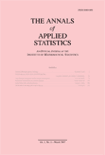
Annals of Applied Statistics
Advancing the Frontiers of Applied StatisticsThe Annals of Applied Statistics, published by the Institute of Mathematical Statistics (IMS), is a leading academic journal that serves as a crucial repository for groundbreaking research in the fields of statistics and probability applications. Since its inception in 2008 and continuing through 2024, this journal has established itself as an influential platform with a notable reputation, boasting a prestigious Q1 classification in 2023 across critical categories such as Modeling and Simulation and Statistics, Probability, and Uncertainty. With its rigorous peer-review process and significant Scopus rankings—including a position of #78 in Statistics and Probability—Annals of Applied Statistics aims to foster innovative statistical methods and their applications in a variety of disciplines. Researchers, professionals, and students interested in the latest advancements in analytical methods will find this journal essential for navigating the evolving landscape of applied statistics. The journal does not offer open access options, ensuring that published content reflects the highest academic standards.

Journal of the Indian Society for Probability and Statistics
Empowering Research Through Rigorous Statistical InsightsJournal of the Indian Society for Probability and Statistics, published by SpringerNature in Germany, is a prominent platform dedicated to advancing the field of statistics and probability. With its E-ISSN of 2364-9569, the journal features rigorous research articles, reviews, and theoretical advancements aimed at promoting the application of statistical methodologies in diverse areas. As part of the academic community since 2016, it has maintained a commendable Q3 ranking in the Statistics and Probability category for 2023, indicating its growing influence and relevance. As the journal aims to foster collaborations among statisticians and probabilists, it serves as an invaluable resource for researchers, professionals, and students looking to deepen their understanding and share innovative ideas. While the journal operates under a subscription model, its commitment to open access publication contributes to the broader dissemination of knowledge in this vital field, further enhancing its importance and utility within the scientific landscape.
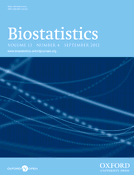
BIOSTATISTICS
Elevating biostatistics to enhance medical research.BIOSTATISTICS is a premier academic journal dedicated to the intersection of statistical methodologies and their applications in the field of biomedicine, published by Oxford University Press. With its ISSN 1465-4644 and E-ISSN 1468-4357, the journal has established itself as a crucial resource for researchers and professionals in the broad disciplines of statistics and probability, particularly within medical contexts. The journal proudly holds a Q1 ranking in multiple categories as of 2023, including Medicine (miscellaneous), Statistics and Probability, as well as Statistics, Probability, and Uncertainty, placing it at the forefront of statistical research. It has also achieved notable Scopus rankings, underscoring its influence and reach—ranking 27th in Mathematics (Statistics and Probability) and 94th in Medicine (General Medicine). Although it does not currently offer open access options, BIOSTATISTICS remains committed to advancing scholarly conversation and innovation in statistical science, making it an essential outlet for both established and emerging researchers. With contributions spanning from 2003 to 2024, this journal is actively seeking to foster an understanding of complex statistical approaches in biomedicine, enabling professionals in the field to apply robust statistical techniques to real-world problems.
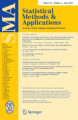
Statistical Methods and Applications
Exploring the intersection of theory and application in statistics.Statistical Methods and Applications is a leading journal published by SPRINGER HEIDELBERG, dedicated to advancing the field of statistics and its applications in various domains. With an ISSN of 1618-2510 and an E-ISSN of 1613-981X, this journal serves as a vital resource for researchers and professionals looking to explore innovative statistical methodologies and their practical implications. The journal has demonstrated a notable influence within the scholarly community, ranked Q3 in both Statistics and Probability and Statistics, Probability and Uncertainty categories as of 2023. Covering a scope that spans from its inception in 1996 to the present, Statistical Methods and Applications provides robust platforms for empirical studies, theoretical advancements, and applied statistics. Although currently not open access, the journal is well-regarded for its rigorous peer-review process and commitment to high-quality research, making it an essential read for anyone dedicated to enhancing their statistical knowledge and expertise.
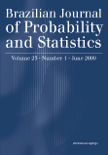
Brazilian Journal of Probability and Statistics
Fostering Dialogue Between Academics and PractitionersThe Brazilian Journal of Probability and Statistics, published by the Brazilian Statistical Association, stands as a pivotal platform for researchers and practitioners in the realms of probability and statistics. With an ISSN of 0103-0752, this esteemed journal has contributed significantly to the advancement of statistical theory and its applications since its inception. The journal is currently indexed in Scopus, holding a rank of #175 in the Statistics and Probability category and a third quartile (Q3) designation as of 2023, indicating its steady impact within the field. Covering a broad scope of topics, from theoretical advancements to practical applications, it invites submissions that enhance understanding and fosters discussion among academics and professionals alike. The journal is based in São Paulo, Brazil, and operates without open access, ensuring a quality review process that adheres to the highest scholarly standards. Researchers, professionals, and students interested in the latest findings and innovative methodologies in statistics are encouraged to engage with the Brazilian Journal of Probability and Statistics, a vital resource at the intersection of theory and practice.