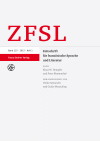
ZEITSCHRIFT FUR FRANZOSISCHE SPRACHE UND LITERATUR
Scope & Guideline
Navigating the Complexities of French Linguistics and Literature
Introduction
Aims and Scopes
- Linguistic Studies:
The journal covers a wide range of linguistic topics, including syntax, semantics, morphology, and historical linguistics, offering insights into the evolution and structure of the French language. - Literary Analysis:
Critical examinations of French literature across various periods, genres, and authors are a core focus, including in-depth studies of poetic forms, narrative techniques, and thematic explorations. - Interdisciplinary Approaches:
The journal promotes interdisciplinary research, integrating perspectives from history, philosophy, and cultural studies to enrich the understanding of French literature and language. - Cultural Contextualization:
Research that contextualizes literary works within their socio-political and historical frameworks is emphasized, highlighting how these factors influence language and literature. - Gender Studies and Identity:
There is a significant focus on gender dynamics and identity within French literature, investigating themes of femininity, sexuality, and the representation of marginalized voices.
Trending and Emerging
- Intertextuality and Literary Influence:
There is a notable increase in studies examining intertextuality and the influence of various literary traditions on contemporary French literature, reflecting a broader interest in how texts interact across time. - Gender and Sexuality Studies:
Recent issues reveal an emerging focus on gender and sexuality, particularly in the context of French poetry and prose, addressing topics such as female homoeroticism and gender-specific literary strategies. - Cultural and Linguistic Diversity:
Research exploring multilingualism and the impact of cultural diversity on the French language is gaining traction, highlighting the complexity of identity in Francophone contexts. - Digital Humanities:
There is a growing interest in applying digital humanities methodologies to the study of French literature and linguistics, facilitating new forms of analysis and engagement with texts. - Environmental and Ecocritical Perspectives:
Emerging themes related to ecocriticism and environmental literature within the French canon indicate a rising awareness of ecological issues and their representation in literary discourse.
Declining or Waning
- Traditional Historical Studies:
There has been a decrease in papers focusing solely on traditional historical studies of the French language and literature, indicating a move towards more contemporary and applied linguistic studies. - Classical Literary Forms:
Research centered on classical poetic forms and their conventions appears to be declining, possibly due to a growing interest in modern and experimental literary styles. - Strictly Theoretical Linguistics:
Papers that engage with purely theoretical linguistics without application to literary texts or cultural contexts are less frequent, suggesting a preference for more applied linguistic research.
Similar Journals
INTERNATIONAL JOURNAL OF FRANCOPHONE STUDIES
Advancing Scholarly Discourse in Francophone StudiesThe INTERNATIONAL JOURNAL OF FRANCOPHONE STUDIES, published by INTELLECT LTD, serves as a significant platform for exploring the multifaceted dimensions of Francophone culture and its impact across various disciplines. With an ISSN of 1368-2679 and E-ISSN 1758-9142, this journal supports a diverse scholarly discourse in areas such as Cultural Studies, Gender Studies, History, Linguistics, Literature, and Sociology, among others. As of 2023, it is categorized in Q4 for multiple fields and Q3 for Literature and Literary Theory, underscoring its evolving academic presence. Researchers, professionals, and students can benefit from its rich repository of critical analyses and innovative perspectives that foster an understanding of the Francophone world from a global viewpoint. Although it does not offer open access options, its rigorous peer-review process ensures high-quality contributions that are essential for anyone engaged in Francophone studies. Situated in the United Kingdom, the journal has forged an academic legacy since its inception and continues to be a vital resource for those studying the intersections of language, culture, and identity.

Zeitschrift fur Katalanistik
Bridging Cultures through Catalan ScholarshipZeitschrift für Katalanistik is a distinguished academic journal published by Albert Ludwig University in Germany, catering to the fields of Linguistics and Literature. With an impressive converged history from 2010 to 2023, this journal operates under rigorous academic scrutiny, as evidenced by its classification in the Q3 quartile for Linguistics and Q2 for Literature and Literary Theory. It holds a respectable ranking in the Scopus database, indicating its solid contribution to ongoing scholarly dialogue, particularly in the realms of both language and literary studies. Despite not currently offering Open Access options, the journal provides a vital platform for researchers, professionals, and students seeking to publish and explore contemporary issues in Katalan studies. With its comprehensive scope and academic rigor, Zeitschrift für Katalanistik remains an essential resource for anyone passionate about the intersection of Catalan language and literature.
Cedille-Revista de Estudios Franceses
Empowering Scholars to Explore French Cultural NarrativesCedille-Revista de Estudios Franceses is a prominent academic journal published by the ASOC PROFESORES FRANCES UNIV ESPANOLA-APFUE and has established itself as a vital resource in the fields of Linguistics and Language and Literature and Literary Theory. Since its inception in 2005, this Open Access journal has provided a platform for rigorous scholarly articles and critical studies focused on French studies, fostering both research and discussion among academics from around the globe. Originating from Santa Cruz de Tenerife, Spain, Cedille has garnered a respectable impact factor and ranks in the second quartile for Linguistics and Language and the first quartile for Literature and Literary Theory in 2023. With converged years from 2009 to 2024, the journal aims to advance understanding and appreciation of French literature and its linguistic intricacies, serving as a vital forum for researchers, professionals, and students committed to the exploration of French culture and language studies.
NINETEENTH-CENTURY FRENCH STUDIES
Cultivating Insights into France's Literary HeritageNINETEENTH-CENTURY FRENCH STUDIES, published by University of Nebraska Press, is a premier academic journal dedicated to the exploration and analysis of French literature and culture from the 19th century. Established as a vital resource for scholars in the field, this journal is recognized for its contribution to literary studies, holding a commendable Q2 rating in the 2023 category of Literature and Literary Theory, reflecting its academic rigor and relevance. With an ISSN of 0146-7891, it offers a platform for innovative research and scholarly discourse, delving into critical topics that shape our understanding of the era. Although it does not currently operate as an open-access journal, its impactful research is instrumental in guiding literary analysis within the arts and humanities. As it continues its publication journey, converging from 2001 to 2024, NINETEENTH-CENTURY FRENCH STUDIES remains essential for researchers, professionals, and students aiming to gain deeper insights into the complexities of 19th-century French literature.

Romanic Review
Advancing Knowledge in Romance StudiesThe Romanic Review, published by Duke University Press, stands as a significant scholarly platform in the field of Romance languages and literature. With its ISSN 0035-8118 and E-ISSN 2688-5220, this journal has been serving the academic community since its inception and will continue its contribution until 2024. Situated in the United States, it has carved out a vital niche in the Arts and Humanities, currently falling within the Q3 quartile as per the 2023 rankings. Although it operates under a traditional subscription model, its focus on disseminating critical and innovative research makes it an indispensable resource for scholars and students alike. The Romanic Review is dedicated to fostering academic discussions that bridge interdisciplinary gaps, making it a cornerstone reference for anyone engaged in the study of Romance cultures, linguistics, and literary studies.

Francofonia-Studi e Ricerche sulle Letterature di Lingua Francese
Cultivating Knowledge in French Literary HeritageFrancofonia-Studi e Ricerche sulle Letterature di Lingua Francese is a distinguished academic journal dedicated to the exploration of French language literature, published by CASA EDITRICE LEO S OLSCHKI. Located in Florence, Italy, this journal provides a scholarly platform for addressing contemporary issues, critical theories, and advancements in the fields of linguistics and literary studies. With an ISSN of 1121-953X and an E-ISSN of 2036-5659, it operates within the competitive framework of academia, currently positioned in the Q4 quartile for both Linguistics and Language, as well as Literature and Literary Theory, according to 2023 rankings. Although the journal does not offer open access, it is vital for researchers and students seeking to deepen their understanding of francophone literary traditions. Additionally, the journal's engagement in relevant discourses positions it uniquely, making it an essential resource for scholars interested in the nuances of linguistic and literary developments affecting French-language literature over converged years of publication (2020 to 2022). Explore this journal to connect with the vibrant community dedicated to francophone studies and contribute to the discourse in these intertwined fields.
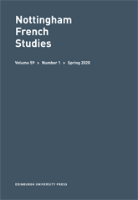
NOTTINGHAM FRENCH STUDIES
Illuminating the Intersections of Language and CultureNOTTINGHAM FRENCH STUDIES is a distinguished academic journal published by Edinburgh University Press, focusing on the diverse realms of French language, literature, culture, and history. With its ISSN 0029-4586 and E-ISSN 2047-7236, the journal serves as a vital platform for scholarly discourse, featuring interdisciplinary research that bridges gaps between Cultural Studies, Linguistics, and Literary Theory. Notable for its robust performance, it holds a Q3 ranking in Cultural Studies and Linguistics and a Q2 ranking in Literature and Literary Theory as of 2023, placing it among the key publications within its field. Throughout its publication span from 1996 to 2024, NOTTINGHAM FRENCH STUDIES has consistently catered to the academic community with insightful articles, enriching the understanding of French cultural contexts. While it is not an Open Access journal, its contributions are pivotal in advancing scholarly dialogue and fostering critical perspectives, making it an essential resource for researchers, professionals, and students engaged in French studies and its interdisciplinary connections.

Anales de Filologia Francesa
Connecting Researchers Through Open Access KnowledgeAnales de Filologia Francesa is a prominent academic journal dedicated to the fields of French philology, linguistics, and literature, published by UNIV MURCIA. Since its transition to open access in 1985, this journal has enabled a wider dissemination of knowledge, fostering scholarly communication among researchers, professionals, and students alike. Based in Spain, Anales de Filologia Francesa plays a pivotal role in addressing current issues and advancements within its scope, underscored by its notable rankings within the Scopus database, where it places in the second and third quartiles across various disciplines related to literature and linguistics. With a commitment to publishing high-quality research, this journal is essential for those looking to engage with cutting-edge studies in French literary theory, language use, and educational practice.
REVUE D HISTOIRE LITTERAIRE DE LA FRANCE
Decoding the Cultural Contexts of French LiteratureREVUE D'HISTOIRE LITTERAIRE DE LA FRANCE, published by Classiques Garnier, is a distinguished academic journal dedicated to the exploration and analysis of French literary history and theory. With an ISSN of 0035-2411 and an E-ISSN of 2105-2689, this journal serves as an essential resource for researchers, professionals, and students in the fields of literature and the humanities. Though it does not currently offer open access, its rigorous scholarship contributes significantly to the understanding of historical literary movements and their cultural contexts. Despite its discontinuation in Scopus after 2016, the journal has a notable academic pedigree, providing critical perspectives on literature from the past to the contemporary era. Situated at 6 Rue de la Sorbonne, Paris 75005, France, the journal aims to enrich the discourse surrounding literary theory and history, highlighting its enduring relevance in today's scholarly landscape.

Belphegor
Exploring the Depths of Francophone ScholarshipBelphegor is a distinguished open-access academic journal published by the Department of French at Dalhousie University, specializing in the fields of French literature, cultural studies, and linguistics. With its ISSN 1499-7185, the journal has been an essential resource for researchers and academics since its inception in 2011, providing a platform for innovative scholarship and critical discourse. Located in Halifax, Canada, the journal encourages the exploration of contemporary and historical issues within the Francophone world, aiming to foster intercultural dialogue and understanding. Through its commitment to accessible research, Belphegor significantly contributes to the academic landscape, making valuable contributions to both local and international scholarly communities.