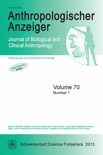
ANTHROPOLOGISCHER ANZEIGER
metrics 2024
Innovating Research at the Confluence of Species
Introduction
ANTHROPOLOGISCHER ANZEIGER, published by E Schweizerbart'sche Verlagsbuchhandlung, is a distinguished journal dedicated to the interdisciplinary fields of anthropology, animal science, and ecology, with a notable impact on advancing research in these areas. Since its inception in 1971, the journal has played a critical role in providing a platform for innovative research, fostering scholarly exchange, and enhancing the understanding of human and animal interactions and ecosystems. With its current quartile rankings—Q2 in Anthropology and Q3 in Animal Science and Zoology—it is well-positioned to serve as a vital resource for researchers, professionals, and students alike. Although it does not currently offer open access, the journal remains an essential asset for those looking to deepen their knowledge and contribute to ongoing discussions within these intersecting disciplines. For additional information, visit the publisher's office located at NAEGELE U OBERMILLER, SCIENCE PUBLISHERS, JOHANNESSTRASSE 3A, D 70176 STUTTGART, GERMANY.
Metrics 2024
 0.230.400.5027
Metrics History
Rank 2024
Scopus
IF (Web Of Science)
JCI (Web Of Science)
Quartile History
Similar Journals
Biology Letters
Bridging disciplines to elevate the field of biological sciences.Biology Letters, published by the esteemed Royal Society, stands at the forefront of research in the field of biological sciences, with a strong emphasis on innovative studies that bridge gaps across disciplines. Since its inception in 2005, the journal has garnered significant recognition, achieving a remarkable Q1 ranking in Agricultural and Biological Sciences (miscellaneous) and a percentile of 88th in the same category, according to Scopus rankings. Released in the United Kingdom, the journal offers a platform for authors to share concise research findings and theoretical perspectives that contribute meaningfully to the advancement of biological inquiry. Although not open access, the journal remains highly regarded in the academic community for its rigorous peer-review process and impactful content, making it an invaluable resource for researchers, professionals, and students dedicated to exploring the complexities of biology. With an ongoing commitment to excellence, Biology Letters continues to shape the future of biological sciences.
ANTHROPOZOOLOGICA
Fostering Interdisciplinary Insights into Anthropozoological StudiesANTHROPOZOOLOGICA, published by Publications Scientifiques du Museum, Paris, is a leading journal at the intersection of anthropology and animal science. With its ISSN 0761-3032 and E-ISSN 2107-0881, this esteemed publication has established its relevance in both fields, holding a Q3 ranking in Animal Science and Zoology and a Q2 ranking in Anthropology as of 2023. The journal aims to foster interdisciplinary research by providing a platform for scholars to explore the complex relationships between humans and animals, considering ecological, cultural, and evolutionary perspectives. Over its converged years from 2011 to 2024, ANTHROPOZOOLOGICA has gained significant recognition, reflected in its Scopus rankings where it stands at #197/502 in Anthropology and #345/490 in Animal Science. While not currently open access, the journal’s rigorous editorial standards and commitment to advancing knowledge make it an invaluable resource for researchers, professionals, and students aiming to deepen their understanding of anthropozoological phenomena.

Relaciones
Exploring Humanity, One Relationship at a Time.Relaciones is a prestigious open-access journal published by the SOC ARGENTINA ANTROPOLOGIA, dedicated to the field of anthropology. Since its inception in 1937, this journal has served as a vital platform for disseminating innovative research and insights within the social sciences community. With both its print (ISSN: 0325-2221) and online (E-ISSN: 1852-1479) formats, Relaciones ensures widespread accessibility, empowering researchers, professionals, and students to engage with contemporary anthropological discourse. The journal aims to foster critical discussions that not only reflect on cultural and societal issues but also contribute to theoretical advancements in anthropological methodologies. By maintaining a commitment to quality and open access, Relaciones plays a crucial role in shaping the future of anthropology in Argentina and beyond, encouraging scholarly collaboration and enriching the academic landscape.
Kiva-Journal of Southwestern Anthropology and History
Charting New Territories in Archaeological ResearchKiva - Journal of Southwestern Anthropology and History is a distinguished academic journal published by Routledge Journals, Taylor & Francis Ltd, that serves as a vital resource for scholars in the fields of anthropology, archaeology, and history. With an ISSN of 0023-1940 and an E-ISSN of 2051-6177, this journal has established itself as a significant avenue for scholarly communication since its inception in 1964. It consistently ranks in the top quartiles, including Q1 in Archaeology and Q2 in Anthropology, reflecting its high impact and rigorous peer-review process. Covering a wide array of topics pertinent to the Southwestern United States, Kiva invites original research articles, reviews, and methodological papers that advance understanding of the region's rich cultural heritage and historical narratives. While currently not open access, its commitment to disseminating quality research makes it an essential reading for researchers, professionals, and students aiming to explore the multifaceted dimensions of southwestern studies.

American Journal of Biological Anthropology
Elevating Knowledge in Anatomy and BeyondThe American Journal of Biological Anthropology, published by WILEY, is a premier journal in the field of biological anthropology, boasting critical insights into human biological diversity, evolution, and adaptation. With its ISSN 2692-7691, this journal has established itself firmly within the research community, achieving a Q1 ranking in key disciplines such as Anatomy, Anthropology, Archeology, and Paleontology as of 2023. This indicates its significant impact, with Scopus rankings placing it in the top tiers across diverse fields, including a stellar rank of 13th out of 113 in Paleontology. Offering open access possibilities, the journal facilitates wider dissemination of groundbreaking research and is committed to advancing knowledge that intersects genetics, epidemiology, and anthropology. Based in the United States, the journal continually fosters an international dialogue among researchers, professionals, and students eager to explore the complexities of human biology through a robust and interdisciplinary lens.
EVOLUTIONARY ANTHROPOLOGY
Elevating the Discourse on Evolutionary AnthropologyEVOLUTIONARY ANTHROPOLOGY is a premier journal published by WILEY, dedicated to advancing the field of anthropology through innovative and rigorous research. With an ISSN of 1060-1538 and an E-ISSN of 1520-6505, this journal boasts a remarkable Q1 ranking in both the Anthropology and Medicine (miscellaneous) categories, reflecting its significant impact within the academic community. Since its inception in 1992, it has continuously evolved, now encompassing a wide array of subjects pertinent to evolutionary studies and human health. Residing in the highly competitive Scopus rankings, it stands at an impressive rank of 10 out of 502 in the field, placing it within the top 2% of journals in Social Sciences - Anthropology. Researchers, professionals, and students alike will find this journal an invaluable resource for the latest findings, theoretical advancements, and discussions that shape our understanding of human evolution and its biological implications. While not categorized as an Open Access journal, EVOLUTIONARY ANTHROPOLOGY remains a vital outlet for high-quality scholarship, fostering dialogue and enriching knowledge across diverse audiences.
ANNALS OF HUMAN BIOLOGY
Illuminating the Pathways of Human Health and DiseaseANNALS OF HUMAN BIOLOGY is a distinguished academic journal published by Taylor & Francis Ltd that focuses on the intersection of human biology and health sciences. With an ISSN of 0301-4460 and an E-ISSN of 1464-5033, this journal has been a pivotal resource for researchers and practitioners since its inception in 1974. Covering critical domains such as Aging, Epidemiology, Genetics, Physiology, and Public Health, it exemplifies an interdisciplinary approach that enhances our understanding of human biological variation and its implications for health and disease. While it currently does not offer Open Access, the journal maintains a respectable standing in its field with notable rankings in Scopus, reflecting its contributions to scientific knowledge. Its commitment to high-quality research and comprehensive review makes it an essential platform for scholars, healthcare professionals, and students seeking to explore the biological underpinnings of human health.

INTERNATIONAL JOURNAL OF OSTEOARCHAEOLOGY
Unraveling the Secrets of the PastWelcome to the INTERNATIONAL JOURNAL OF OSTEOARCHAEOLOGY, an esteemed publication in the fields of anthropology and archaeological science, published by Wiley. Established in 1991, this journal has consistently provided a platform for groundbreaking research, with its scope encompassing the study of human remains in archaeological contexts. Boasting an impressive impact factor and ranking in the top quartile (Q1) for Anthropology and Archaeology, the journal stands at the forefront of academic discourse, particularly in the arts and humanities. With Scopus rankings placing it within the 88th percentile in Archeology and the 81st percentile in Anthropology, it serves as a vital resource for researchers, professionals, and students alike. Though currently not offering Open Access, the journal remains committed to disseminating high-quality research that contributes significantly to our understanding of past societies through the careful study of osteological remains. Explore our extensive archives and join a community of scholars dedicated to advancing knowledge in osteoarchaeology.

Chungara-Revista de Antropologia Chilena
Advancing Knowledge in Chilean EthnographyChungara-Revista de Antropologia Chilena is a premier academic journal dedicated to the field of anthropology, showcasing research and discourse that emphasize the rich cultural heritage of Chile and its surrounding regions. Published by UNIV TARAPACA, this journal serves as a vital platform for scholars, researchers, and students keen on exploring anthropological studies, ethnographic fieldwork, and cultural analysis. With an ISSN of 0717-7356, it adheres to rigorous academic standards and strives to promote open dialogue on contemporary and historical issues across various communities. Although currently not indexed in prominent metrics, its commitment to scholarly excellence contributes significantly to the academic landscape, fostering a deeper understanding of anthropological practices in Chile and beyond. Authors are encouraged to engage with the journal's rich repository of knowledge while readers gain access to pivotal insights that drive forward the discourse within anthropology.

Intersecciones en Antropologia
Bridging gaps in anthropological scholarship.Intersecciones en Antropologia, published by the Universidad Nacional del Centro de la Provincia de Buenos Aires (UNICEN), Facultad de Ciencias Sociales, is a premier open-access journal in the field of anthropology, having established its presence since 2010. With an impressive impact factor and currently holding the distinguished Q1 quartile ranking in anthropology for 2023, this journal has quickly become a vital resource for scholars and practitioners alike, offering a platform for innovative research and critical discussion. The journal aims to advance anthropological scholarship by encouraging the dissemination of diverse perspectives and stimulating dialogue across geographical and cultural boundaries. Its open-access model, adopted in 2017, ensures that valuable research findings are accessible to a global audience, fostering collaboration and engagement within the academic community and beyond. Located in the vibrant cultural context of Argentina, Intersecciones en Antropologia serves as a conduit for significant anthropological dialogues, making it an essential read for those dedicated to understanding and contributing to the evolving landscape of social sciences.