
ANTIQVORVM PHILOSOPHIA-An International journal
Scope & Guideline
Cultivating Insight in Classical Studies
Introduction
Aims and Scopes
- Interdisciplinary Exploration of Ancient Philosophical Traditions:
The journal encourages works that analyze philosophical ideas from a variety of ancient cultures, including Greek, Roman, Chinese, and Indian philosophies, highlighting their interconnectedness and differences. - Ethical Inquiry and Practical Wisdom:
A significant focus is placed on ethical considerations within philosophical frameworks, particularly the concept of practical wisdom as articulated by various ancient thinkers, illustrating its relevance to contemporary issues. - Comparative Studies:
The journal promotes comparative analyses, such as the relationships between Stoicism and Eastern philosophies, allowing for a deeper understanding of the philosophical landscape and its evolution over time. - Historical Contextualization of Philosophical Ideas:
Papers often situate philosophical arguments within their historical contexts, exploring how ancient thinkers addressed fundamental questions about existence, ethics, and knowledge. - Focus on Notable Philosophical Figures:
The journal frequently features works centered on influential philosophers like Plato, Aristotle, and Epicurus, examining their contributions and the ongoing relevance of their ideas.
Trending and Emerging
- Relevance of Ancient Ethics to Modern Issues:
Recent papers increasingly emphasize the applicability of ancient ethical frameworks to current societal challenges, such as research ethics and personal virtue, indicating a trend towards practical philosophy. - Comparative Philosophical Methodologies:
There is a growing trend in employing comparative methodologies that juxtapose Western and Eastern philosophies, particularly in the context of Stoicism and Eastern philosophies, highlighting universal themes and cross-cultural insights. - Exploration of Intellectual Virtues:
The theme of intellectual virtues, such as courage and wisdom, is gaining traction, reflecting an interest in how these concepts were articulated in ancient texts and their relevance to contemporary philosophical discourse. - Interdisciplinary Approaches to Ancient Texts:
An increase in interdisciplinary studies that incorporate insights from history, literature, and religious studies is emerging, demonstrating a broader approach to understanding ancient philosophical texts and their implications. - Focus on the Nature of the Wise Person:
Recent publications are increasingly exploring the characterization of the 'wise person' across various traditions, suggesting a renewed interest in understanding wisdom as a central philosophical concept.
Declining or Waning
- Metaphysical Speculations on Chaos and Order:
Although metaphysical discussions, particularly those concerning chaos and order, have been prevalent, recent publications suggest a waning interest in these topics as scholars pivot towards more practical and ethical concerns. - Traditional Historical Analysis without Comparative Context:
There appears to be a decrease in purely historical analyses that do not engage in comparative frameworks, as the journal's emphasis shifts towards dialogues that connect different philosophical traditions. - Focus on Lesser-Known Philosophers:
The exploration of less prominent figures in ancient philosophy seems to be diminishing, with a stronger concentration on well-established philosophers, indicating a preference for established narratives over niche explorations.
Similar Journals

Studia Universitatis Babes-Bolyai Philosophia
Illuminating the Path of Philosophical ExplorationStudia Universitatis Babes-Bolyai Philosophia is a distinguished academic journal published by UNIV BABES-BOLYAI, focusing on a wide array of topics in the field of philosophy. With its ISSN 1221-8138 and E-ISSN 2065-9407, this journal serves as a significant platform for researchers, scholars, and students to disseminate their findings and engage in intellectual discourse. Located in the scholarly environment of Cluj-Napoca, Romania, it aims to promote philosophical inquiries that intersect with contemporary issues, fostering a rich dialogue within the academic community. While the journal currently operates under a traditional access model, its commitment to advancing the philosophical discipline is deeply rooted in rigorous peer review and scholarly excellence. Authors and readers alike are encouraged to contribute to and draw from the rich repository of knowledge that this journal cultivates.

Topicos-Revista de Filosofia
Cultivating a Vibrant Community of Philosophical ThinkersTopicos-Revista de Filosofia, published by UNIV PANAMERICANA, DEPT FILOSOFIA, stands as a significant academic platform within the field of philosophy, actively contributing to scholarly discourse since 2006 through its open access model. With an ISSN of 0188-6649 and an E-ISSN of 2007-8498, this journal is dedicated to fostering critical thought and philosophical inquiry in both regional and global contexts. Operating out of Mexico City, it provides a vital avenue for researchers, professionals, and students to engage with contemporary philosophical issues, reflected in its ranking of Q3 in the 2023 category for Philosophy and its position within the 33rd percentile among over 800 peer journals in the field according to Scopus. Topicos not only prioritizes accessibility to philosophical scholarship but also aims to propel academic discussions and elevate the standards of philosophical research. With coverage extending from 2013 to 2024, it invites contributions that bridge diverse philosophical traditions and innovative thought pathways, reinforcing its role as an influential resource for the philosophical community.
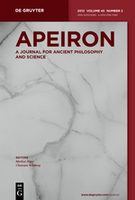
Apeiron-A Journal for Ancient Philosophy and Science
Navigating the Depths of Philosophy and Scientific ExplorationApeiron - A Journal for Ancient Philosophy and Science is a distinguished academic journal published by Walter de Gruyter GmbH, based in Berlin, Germany. As an essential platform for scholars in the fields of History and Philosophy of Science and Philosophy, this journal holds a prestigious Q1 ranking in both domains as of 2023, reflecting its significant impact and contribution to these disciplines. With its ISSN 0003-6390 and E-ISSN 2156-7093, Apeiron aims to foster interdisciplinary dialogue by publishing original research, reviews, and critical essays that explore the rich intersections of ancient thought and scientific inquiry. As the journal converges into its fifth year from 2019 to 2024, it offers a vital resource for researchers, professionals, and students seeking to deepen their understanding of classical philosophical traditions and their relevance to contemporary science. Although it operates under a subscription model, the rigorous peer-review process ensures that each publication maintains the highest academic standards, thus solidifying Apeiron's status as a pivotal resource in its field.

Acta Philosophica
Exploring the Depths of Philosophical InquiryActa Philosophica is a prestigious academic journal dedicated to the exploration and analysis of philosophical thought. Published by Fabrizio Serra Editore in Italy, this journal serves as a vital platform for scholars, presenting rigorous research that contributes to the field of philosophy. With an ISSN of 1121-2179 and an E-ISSN of 1825-6562, Acta Philosophica is indexed in prestigious databases, enhancing its visibility and impact within the academic community. Active since 2011, this journal has emerged as a significant player in the discipline, currently positioned in the Q3 quartile for Philosophy in 2023 and ranked #557 among 806 journals in the Arts and Humanities category on Scopus, placing it in the 30th percentile. Researchers and students alike will find valuable insights within its pages, as it covers a broad spectrum of philosophical inquiries. Although not an open-access journal, its rich content makes it essential reading for anyone invested in advancing philosophical discourse.

Eirene-Studia Graeca et Latina
Unveiling the Depths of Linguistic HeritageEirene-Studia Graeca et Latina, ISSN 0046-1628, is a prominent academic journal published by the Institute of Classical Studies, Academy of Sciences of the Czech Republic. Focusing on the fields of Classics, Linguistics, and Archaeology, this journal serves as a vital platform for scholarly discourse and research dissemination since its inception in 2002. Although it operates under a traditional access model, the journal has established itself within the academic community, evidenced by its placement in the Q4 category across multiple disciplines in 2023. This includes significant rankings in areas such as Archaeology and Language and Linguistics, where it finds itself within the 27th to 16th percentiles of its respective categories. Eirene aims to foster the advancement of research in the Humanities, providing a rigorous forum for scholars and practitioners interested in classical studies. Its contribution to the academic landscape is essential for those who aspire to explore the depths of ancient languages, cultures, and methodologies, making it a valuable resource for researchers, professionals, and students alike.
MONIST
Fostering Rigorous Inquiry and InsightMONIST is a prestigious academic journal published by Oxford University Press Inc, focusing on the intricate dialogues within the field of Philosophy. With an impressive impact factor that places it in the Q1 quartile of its category for 2023, MONIST stands as a leader in promoting high-quality research that bridges various philosophical traditions and methodologies. Established in 1973, the journal has consistently contributed to contemporary discussions by providing a platform for diverse philosophical inquiries and fostering rigorous scholarly debate. Although available through subscription options, MONIST engages a wide audience, including researchers, educators, and students who are deeply invested in advancing philosophical thought. Its Scopus ranking showcases its significant influence in the Arts and Humanities, positioning it at rank 119 out of 806 in its field, symbolizing an 85th percentile standing. With a commitment to excellence and innovation in philosophical scholarship, MONIST continues to be an essential resource for those seeking to deepen their understanding of philosophical issues in a rapidly evolving intellectual landscape.
Theoria-A Swedish Journal of Philosophy
Advancing the Boundaries of Philosophical ThoughtTheoria - A Swedish Journal of Philosophy, published by WILEY, stands as a significant contributor to the realm of philosophical discourse since its inception in 1935, with a continued commitment to advancing scholarly conversation up to 2024. With its ISSN 0040-5825 and E-ISSN 1755-2567, the journal holds a prestigious position in the field, ranking in Q2 among philosophy journals and achieving an impressive 66th percentile ranking in the Scopus Arts and Humanities category. Although it does not currently provide Open Access options, Theoria remains a vital resource for researchers, professionals, and students seeking in-depth analyses and innovative perspectives within contemporary philosophy. Its central objective is to foster rigorous academic dialogue that explores diverse philosophical inquiries, making it an essential platform for those invested in the pursuit of knowledge and critical thought.
JOURNAL OF INDIAN PHILOSOPHY
Bridging Cultures Through Philosophical InquiryThe Journal of Indian Philosophy, published by Springer, is an esteemed academic journal dedicated to the exploration and analysis of philosophical traditions and thought from the Indian subcontinent. With an impressive ISSN of 0022-1791 and E-ISSN of 1573-0395, this journal showcases a relentless commitment to scholarly excellence, as evidenced by its rankings within the top quartiles—Q1 in Cultural Studies and Q2 in Philosophy, as of 2023. Covering a breadth of topics from ancient texts to contemporary debates, this platform allows researchers and academics to contribute to and engage with philosophical discourse that shapes understanding across cultures. While it maintains strict subscription access, the journal's significant impact factor and Scopus rankings—positioning it in the 69th percentile for both the Arts and Humanities in Philosophy and the Social Sciences in Cultural Studies—underscore its influence and relevance in the field. With a publication history spanning from 1970 to 2024, the Journal of Indian Philosophy remains a vital resource for students, professionals, and scholars seeking to delve into the rich tapestry of Indian philosophical inquiry.

Journal of French and Francophone Philosophy
Bridging Historical Insights with Contemporary Issues.Journal of French and Francophone Philosophy is a prominent academic journal dedicated to the exploration and dissemination of scholarly work in the field of French and Francophone philosophy. Published by the University of Pittsburgh Library System, this journal has been a significant player in the discourse on philosophical thought since its inception in 1989, operating under an Open Access model to ensure broad accessibility to its content. With its ISSN 1936-6280 and E-ISSN 2155-1162, the journal highlights critical debates, methodologies, and cultural contexts that shape French and Francophone philosophical traditions. The journal's commitment to academic excellence is underscored by its adherence to high scholarly standards, making it an essential resource for researchers, professionals, and students eager to engage with contemporary philosophical issues and historical analyses alike. By facilitating dialogue among diverse philosophical perspectives, it continues to enhance the academic landscape and promote the relevance of French and Francophone thought in a global context.

Comparative Philosophy-An International Journal of Constructive Engagement of Distinct Approaches toward World Philosophy
Fostering Dialogue Across Philosophical TraditionsComparative Philosophy: An International Journal of Constructive Engagement of Distinct Approaches toward World Philosophy, published by SAN JOSE STATE UNIVERSITY, is a leading platform for scholarly dialogue in the realm of philosophical inquiry. With an Open Access format since 2010, the journal seeks to facilitate the exchange of ideas among philosophers across different traditions, thus promoting an enriched understanding of global philosophical perspectives. Designed to cater to the interests of researchers, professionals, and students, the journal emphasizes the constructive engagement of diverse philosophical methodologies, addressing pressing contemporary issues and fostering interdisciplinary discourse. By bridging cultural and ideological divides, Comparative Philosophy plays a pivotal role in advancing philosophical thought and inquiry, making it an invaluable resource for anyone invested in the study of world philosophies.