Indian Journal of Labour Economics
Scope & Guideline
Fostering Dialogue on Labor Market Challenges
Introduction
Aims and Scopes
- Labour Market Dynamics:
The journal emphasizes the analysis of labor market dynamics, including employment trends, unemployment rates, and the factors influencing labor force participation. This includes studies on formal and informal employment, labor migration, and the impact of economic policies on job creation. - Gender and Labor Issues:
A significant focus is placed on gender disparities in labor markets, examining women's participation, wage gaps, and the socio-economic barriers they face. The journal seeks to highlight the unique challenges and contributions of women in various sectors of the economy. - Impact of Technology on Employment:
The journal explores the implications of technological advancements on labor markets, including automation, skill requirements, and job displacement. It aims to assess how technology reshapes employment patterns and the necessary adaptations for the workforce. - Policy Analysis and Recommendations:
Research published in the journal often includes evaluations of labor policies and their effectiveness, providing evidence-based recommendations for improving labor rights, working conditions, and social security systems. - Migration and Mobility:
The journal addresses issues related to labor migration, including the motivations, experiences, and socio-economic impacts of migrants in both sending and receiving regions. This includes the examination of migrant workers' rights and the role of remittances. - Sectoral Studies in Labor Economics:
The Indian Journal of Labour Economics covers sector-specific studies, analyzing employment trends and labor conditions in industries such as agriculture, manufacturing, and services to understand sectoral disparities and opportunities.
Trending and Emerging
- Impact of COVID-19 on Labor Markets:
There is a significant increase in research analyzing the effects of the COVID-19 pandemic on labor markets, employment dynamics, and worker welfare. This theme is crucial as it addresses the immediate and long-term implications of the pandemic on various sectors. - Technological Changes and Employment:
Emerging studies are increasingly focusing on the relationship between technological advancements and employment patterns, particularly concerning automation and the skills needed for the future workforce. - Youth Employment and Aspirations:
Research on youth unemployment, particularly the aspirations of young job seekers, has gained traction, reflecting concerns about job creation for the younger demographic and the alignment of education with market needs. - Decent Work and Labor Rights:
There is a growing emphasis on the concepts of decent work and labor rights, particularly in the context of informal employment and the need for improved labor standards across sectors. - Social Protection and Welfare Policies:
Emerging themes include the analysis of social protection measures and welfare policies, reflecting a heightened awareness of the need for safety nets for vulnerable populations in the labor market.
Declining or Waning
- Child Labor Studies:
Research specifically focusing on child labor has decreased, possibly due to a broader societal shift towards addressing child welfare and educational access rather than labor market participation of children. - Rural Employment Schemes:
Studies centered on rural employment schemes, such as the Mahatma Gandhi National Rural Employment Guarantee Act (MGNREGA), have become less prominent, suggesting a potential saturation of research or a shift towards exploring more contemporary labor issues. - Historical Labor Studies:
The historical perspective on labor issues, while still relevant, is less frequently addressed in recent publications, indicating a movement towards contemporary analyses of labor economics rather than historical contexts. - Theoretical Frameworks in Labor Economics:
There has been a noticeable decline in papers focusing on theoretical frameworks and models of labor economics, with a growing preference for empirical research that addresses current labor market challenges. - Informal Sector Research:
Although still important, the volume of studies specifically targeting the informal sector has waned, possibly due to the increasing complexity of the formal sector's dynamics overshadowing informal employment discussions.
Similar Journals
BROOKINGS PAPERS ON ECONOMIC ACTIVITY
Advancing Knowledge in Economic Activity.BROOKINGS PAPERS ON ECONOMIC ACTIVITY, published by Johns Hopkins University Press, stands at the forefront of economic research, providing critical insights and analysis across the fields of economics and econometrics. With a prestigious Q1 ranking in both the Business, Management and Accounting (miscellaneous) and Economics and Econometrics categories for 2023, this journal is renowned for its scholarly contributions that shape public policy and debates within the economic community. Since its inception, the journal has consistently published high-impact research and innovative discussions surrounding economic activity, making it an essential resource for researchers, professionals, and students alike. Although it does not offer open access, its academic rigor and relevance continue to attract a broad readership, contributing to a deeper understanding of economic phenomena in the United States and beyond. For more information, visit the journal’s homepage or the Johns Hopkins University Press website.
ILR Review
Navigating the Complexities of Labor Relations and Innovation.ILR Review, published by SAGE PUBLICATIONS INC, is a leading journal in the fields of Management of Technology and Innovation, Organizational Behavior and Human Resource Management, and Strategy and Management. With an impressive ranking in the top quartile (Q1) for all its scopes in 2023, the journal signifies a pivotal resource for scholars and practitioners alike who seek to understand the intricate dynamics of labor relations, organizational strategies, and technological advancements. The journal's ISSN number is 0019-7939 and its E-ISSN is 2162-271X. Though it does not offer open access, its rigorous peer-reviewed articles and significant insights make it essential reading for those committed to the advancement of knowledge in business and management disciplines. With a history that dates back to 1978 and a tradition of excellence reflected in its Scopus rankings, ILR Review not only solidifies its position as a cornerstone of academic research but also fosters a vibrant dialogue among professionals looking to innovate and lead in today’s dynamic environment.

JOURNAL OF HUMAN RESOURCES
Advancing insights into workforce dynamics.JOURNAL OF HUMAN RESOURCES, published by the University of Wisconsin Press, stands as a premier platform for the dissemination of cutting-edge research in the domains of economics, management, and organizational behavior. With an esteemed Impact Factor and ranking in the Q1 category across multiple disciplines, including Economics and Econometrics and Human Resource Management, this journal serves as a critical resource for academics, practitioners, and students alike, delving into vital issues and innovations in workforce management and organizational effectiveness. Since its inception in 1976, the journal has consistently provided invaluable insights that bridge theory and practice, thereby advancing the understanding of human resources within a global context. While the journal operates under a subscription model, it embraces a robust archiving strategy to ensure that its contributions are accessible and enduring. For those engaging with the Journal of Human Resources, it offers a rich tapestry of research that informs best practices and strategic developments, making it an essential read for anyone interested in the evolving landscape of human resources and organizational management.
IZA Journal of Labor Policy
Empowering Research to Transform Labor MarketsThe IZA Journal of Labor Policy, published by SCIENDO, is a premier open-access academic journal dedicated to advancing the understanding of labor markets, labor policy, and their broader societal implications. Established in 2012, this journal embraces an interdisciplinary approach, engaging scholars from the domains of Economics, Industrial Relations, and Organizational Behavior, making it a vital resource for researchers, practitioners, and students alike. With an impact factor that reflects its scholarly influence and a ranking in the Q3 quartile for key categories, the journal provides a platform for high-quality research that addresses pressing issues in labor policy and economic efficiency. By encouraging open access to its content, the IZA Journal aims to democratize knowledge and foster informed discussion within the global academic community. Its commitment to rigorous peer review ensures that published articles contribute meaningfully to ongoing debates and advancements in the field, thereby enhancing its significance as a key reference point for contemporary labor research.
Economic and Labour Relations Review
Illuminating trends and analyses in labor market practices.Economic and Labour Relations Review, published by Cambridge University Press, is an esteemed journal that has been dedicated to advancing the fields of economics and labour relations since its inception in 1990. With an ISSN of 1035-3046 and an E-ISSN of 1838-2673, this journal has positioned itself within the Q2 category in both Economics and Econometrics, as well as Organizational Behavior and Human Resource Management in 2023 rankings. It boasts impressive Scopus ranks, achieving a 72nd percentile in Economics and Econometrics and a 65th percentile in Organizational Behavior. The journal aims to facilitate high-quality scholarly discourse by providing a platform for research that explores the dynamic interplay between economic theories and labor market practices. Although it does not currently offer open access, it remains a crucial resource for academics, practitioners, and students who seek in-depth analyses and current trends within the discipline. With a commitment to publishing rigorous studies from a diverse range of perspectives, the Economic and Labour Relations Review is a vital reference for anyone researching the complexities of economic behavior in the workplace.
INTERNATIONAL LABOUR REVIEW
Connecting theory and practice in organizational behavior.INTERNATIONAL LABOUR REVIEW is a prestigious academic journal published by WILEY that serves as a key resource for scholars and professionals in the fields of labour economics, human resource management, and organizational behavior. With a history dating back to 1945, the journal has evolved to publish cutting-edge research and insights, maintaining its relevance in a rapidly changing employment landscape. Its impact is illustrated by its recognition within category quartiles, placing it in Q2 for Management of Technology and Innovation, Organizational Behavior and Human Resource Management, and Strategy and Management in 2023. Researchers and practitioners especially value its empirical and theoretical contributions, which are crucial for understanding the complexities of labor and employment relations. While the journal operates under a subscription model, it is accessible to a broad audience seeking to enhance their knowledge in vital areas of labor dynamics. If you are looking to engage with influential research that shapes organizational strategies and labor policies, the INTERNATIONAL LABOUR REVIEW is an essential addition to your academic resources.
OXFORD ECONOMIC PAPERS-NEW SERIES
Bridging theory and practice in economic research.OXFORD ECONOMIC PAPERS-NEW SERIES is a prestigious academic journal published by Oxford University Press, dedicated to advancing the field of economics and econometrics. With an ISSN of 0030-7653 and an E-ISSN of 1464-3812, this journal has a rich history since its inception in 1938, and continues to play a vital role in disseminating impactful research through its convergence of years spanning from 1938 to 2024. Recognized as a Q2 journal in the 2023 category of Economics and Econometrics, it ranks #396 among 716 in its field according to Scopus, reflecting a commendable position within the academic community, particularly in global economic discussions. While the journal currently does not offer open access options, it remains committed to providing a platform for rigorous research and critical discourse. Researchers, professionals, and students will find the journal's articles to be essential reading, offering insights that are pivotal for understanding economic trends, policies, and methodologies. Its focus on high-quality scholarship ensures that contributions are both theoretically robust and practically relevant, making it a significant resource in the ever-evolving landscape of economic research.
Nordic Journal of Working Life Studies
Advancing the Dialogue on Working Life DynamicsThe Nordic Journal of Working Life Studies, published by Roskilde University in Denmark, is a leading open-access journal dedicated to advancing the understanding of working life dynamics. Established in 2011, this peer-reviewed journal addresses critical issues within the fields of Industrial Relations, Life-span and Life-course Studies, Organizational Behavior and Human Resource Management, and Public Health, Environmental and Occupational Health. With a commendable presence reflected in its 2023 Q3 ranking across multiple categories, the journal serves as a vital resource for researchers, professionals, and students interested in contemporary workplace challenges and solutions. The open access model facilitates wide dissemination of knowledge, fostering greater collaboration and innovation in working life studies. By focusing on a diverse range of topics pertinent to the changing nature of work, the journal plays an essential role in shaping scholarship and practice in the Nordic region and beyond.
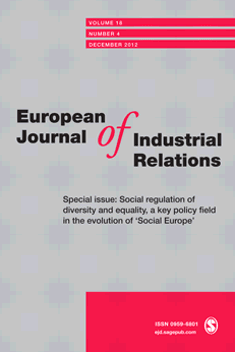
EUROPEAN JOURNAL OF INDUSTRIAL RELATIONS
Cultivating Knowledge for Effective Labor ManagementThe European Journal of Industrial Relations is a premier academic publication dedicated to advancing research in the field of industrial relations. Published by SAGE Publications Ltd in the United Kingdom, this journal provides a dynamic platform for the dissemination of innovative research, critical analysis, and scholarly discourse. With a strong commitment to quality, it proudly holds a Q1 ranking in multiple categories including Business, Management and Accounting, Organizational Behavior, and Strategy Management, reflecting its influence and significance in the academic community. The journal, with the ISSN 0959-6801 and E-ISSN 1461-7129, actively contributes to a deeper understanding of labor relations, organizational behavior, and management practices. Researchers, practitioners, and students benefit from its rich repository of insights, making it an invaluable resource for those engaged in the complexities of workforce dynamics. Over its convergence period from 1995 to 2024, the journal continues to inspire new directions in industrial relations scholarship and practice.

E-Journal of International and Comparative Labour Studies
Empowering research in industrial relations and organizational behavior.E-Journal of International and Comparative Labour Studies is an esteemed academic publication dedicated to advancing knowledge in the fields of industrial relations, law, and organizational behavior. Published by ADAPT UNIV PRESS in Italy, this journal has established itself as a notable resource for researchers, professionals, and students interested in comparative labour studies. With an ISSN of 2280-4056, the journal provides a platform for rigorous scholarly articles from 2018 to 2023, encompassing a diverse array of topics that reflect the complexities of modern labour environments. Although classified in the Q4 category within its relevant disciplines and ranked within the lower percentiles of Scopus, the journal remains committed to fostering dialogue and understanding of labour issues on both international and comparative scales. Readers can access a wealth of open research and policy analyses that are crucial for informed decision-making and academic discourse in this critical societal area.