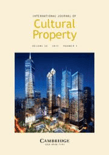
International Journal of Cultural Property
Scope & Guideline
Advancing Knowledge in Cultural Preservation.
Introduction
Aims and Scopes
- Cultural Heritage Law:
The journal extensively explores legal frameworks surrounding the protection of cultural heritage, including international treaties, national laws, and case studies that highlight the complexities of cultural property ownership and restitution. - Ethical Considerations in Collecting:
It delves into the ethical dimensions of collecting cultural heritage, examining the responsibilities of collectors, museums, and institutions in preserving authenticity and ensuring equitable practices. - Impact of Colonialism and Decolonization:
A significant focus is placed on the legacies of colonialism and the ongoing decolonization efforts in cultural heritage, including discussions on the return of artifacts to their countries of origin and the cultural implications of such actions. - Cultural Heritage in Conflict Zones:
The journal addresses the protection of cultural heritage in conflict areas, investigating the destruction, looting, and recovery of cultural property during and after conflicts. - Intangible Cultural Heritage:
There is an increasing emphasis on intangible cultural heritage, exploring how traditions, practices, and expressions contribute to cultural identity and heritage preservation. - Interdisciplinary Approaches to Heritage Studies:
The journal encourages interdisciplinary research that combines law, anthropology, archaeology, and cultural studies to provide a holistic understanding of cultural property issues.
Trending and Emerging
- Decolonization and Repatriation:
There is a marked increase in discussions surrounding the decolonization of cultural heritage and the repatriation of artifacts, emphasizing the ethical responsibilities of institutions and the need for restorative justice in cultural heritage. - Intersection of Cultural Heritage and Human Rights:
Recent articles explore the relationship between cultural heritage and human rights, focusing on how the protection of cultural property intersects with the rights of indigenous peoples and marginalized communities. - Intangible Cultural Heritage and Community Involvement:
Emerging themes highlight the significance of intangible cultural heritage, advocating for community involvement in heritage preservation and the recognition of cultural expressions as vital components of identity. - The Role of Technology in Heritage Preservation:
New trends indicate an increasing interest in how technology can aid in the preservation and documentation of cultural heritage, including digital archiving and virtual repatriation efforts. - Cultural Heritage and Climate Change:
The journal is beginning to address the impacts of climate change on cultural heritage sites, emphasizing the need for sustainable practices and policies to protect vulnerable cultural properties.
Declining or Waning
- Traditional Artifacts and Material Culture:
While the journal has historically addressed the protection of tangible cultural heritage, there seems to be a gradual decline in the number of articles focusing solely on traditional artifacts, as the discourse shifts towards more contemporary issues. - Historical Repatriation Cases:
There is a noticeable reduction in publications centered on historical cases of repatriation, as newer themes related to ethical collecting and modern implications of colonialism gain ground. - Static Legal Frameworks:
The exploration of static legal frameworks without considering their application in dynamic contexts is waning. Recent publications tend to emphasize the need for adaptable legal approaches that respond to contemporary challenges.
Similar Journals
JOURNAL OF CULTURAL HERITAGE
Cultivating Understanding of Our Cultural Roots.JOURNAL OF CULTURAL HERITAGE, published by Elsevier France - Éditions Scientifiques Médicales Elsevier, is a pivotal academic journal dedicated to the multifaceted study of cultural heritage, including its conservation, anthropology, archaeology, and related fields. With an impressive standing in the academic community, this journal has achieved a Q1 ranking in Anthropology, Archaeology, Conservation, and History, reflecting its critical influence and contribution to these disciplines. The journal serves as a vital resource for researchers, professionals, and students interested in innovative research and developments concerning cultural heritage practices and policies. Although it operates under a subscription model, it provides access to innovative research and insights from the field, making it essential for those engaged in the preservation and study of cultural artifacts and historical narratives.

Journal of Heritage Tourism
Advancing Knowledge in Heritage Tourism ScholarshipJournal of Heritage Tourism, published by Routledge Journals, part of Taylor & Francis Ltd, is a leading peer-reviewed journal dedicated to the interdisciplinary study of heritage tourism. As a vital resource for researchers, professionals, and students in the fields of History and Tourism, Leisure and Hospitality Management, this journal has consistently achieved high rankings, securing a Q1 quartile in History and Q2 in Tourism for 2023. With an impressive Scopus rank of #3 out of 1760 in Arts and Humanities - History and #42 out of 146 in Business - Tourism, it underscores the journal’s importance and relevance in contemporary scholarship. Spanning contributions from 2006 to 2024, the journal provides a platform for innovative research, critical discussions, and comprehensive analyses, fostering a greater understanding of the complex relationships between heritage and tourism. Although it does not currently offer open access, insights published within this journal remain accessible for institutional libraries and academic communities worldwide, ensuring that the ongoing discourse around heritage tourism flourishes.
Palestine Exploration Quarterly
Fostering Discourse on Palestine's Archaeological TreasuresPalestine Exploration Quarterly, published by Routledge Journals, Taylor & Francis Ltd, is a leading academic journal that has been at the forefront of archaeological, historical, and cultural studies concerning Palestine since its inception in 1865. With an impressive Q1 ranking in multiple categories including Archaeology, History, Religious Studies, and Visual Arts and Performing Arts, the journal is recognized for its rigorous peer-reviewed content that significantly contributes to the understanding of cultural heritage and societal dynamics in the region. The UK-based journal offers an array of scholarly articles, reviews, and reports aimed at researchers, professionals, and students in the humanities and social sciences. With a strong focus on advancing knowledge and fostering academic discourse, the Palestine Exploration Quarterly remains an invaluable resource for those engaged in the exploration and interpretation of Palestine's rich history and heritage, now accessible through various academic libraries worldwide.
Pflege
Exploring the frontiers of nursing and medicine.Pflege, published by HOGREFE AG-HOGREFE AG SUISSE, is a prominent scholarly journal dedicated to the field of nursing and medicine. Since its inception in 1991, the journal has served as a key platform for disseminating research findings, reviews, and advancements in nursing practices, addressing the myriad challenges and innovations shaping healthcare today. With an ISSN of 1012-5302 and an E-ISSN of 1664-283X, Pflege is indexed in Scopus, where it ranks #87 out of 139 in General Nursing, reflecting its moderate impact within the academic community, with a Q3 classification in both medicine and nursing fields for 2023. Through rigorous peer reviews and a commitment to quality scholarship, the journal aims to foster interdisciplinary dialogue, enhancing both educational and clinical practices among healthcare professionals. Although it is not an open-access publication, Pflege continues to be an essential resource for researchers and practitioners seeking to advance their knowledge in the dynamic field of nursing and enhance patient care.
Ge-Conservacion
Fostering Accessibility in Cultural Conservation ResearchGe-Conservacion, published by GRUPO ESPANOL I I C, stands as a pivotal journal in the fields of Conservation, Museology, and Visual Arts and Performing Arts, facilitating an open-access platform since 2009. Based in Spain, this journal serves as a vital repository for innovative research and scholarly dialogue, significantly impacting the community with its Q1 and Q2 rankings across several categories in 2023. With an objective to advance multidisciplinary understanding and practices related to cultural heritage conservation, it attracts a diverse readership of researchers, professionals, and students eager to engage with contemporary issues and methodologies. The journal's commitment to accessibility enhances its reach and influence, making it an essential resource for anyone passionate about preserving the integrity and significance of our artistic and historical treasures.

Heranca-Revista de Historia Patrimonio e Cultura
Preserving History, Enriching CultureHerança - Revista de História, Patrimonio e Cultura is a distinguished academic journal published by Ponteditora in Portugal, dedicated to the exploration and preservation of history, heritage, and culture. Since its inception in 2018, this open-access journal has established a strong foothold in the academic community, becoming a valuable resource for researchers, professionals, and students alike. With an impressive presence in the Scopus rankings—ranking Q3 in multiple categories such as *Arts and Humanities (Miscellaneous)* and *Cultural Studies*—the journal demonstrates its commitment to advancing interdisciplinary dialogue and fostering innovation in the humanities. By offering unrestricted access to its rich array of scholarly articles, Herança plays a vital role in disseminating knowledge and promoting further research in the fields of history, museology, and the arts. With an aim to bridge theoretical insights and practical applications, this journal stands as an essential contributor to the cultural landscape and heritage studies, making it a pivotal platform for contemporary issues in our understanding of cultural identity and heritage conservation.

International Journal of Intangible Heritage
Advancing the Dialogue on Intangible Heritage.The International Journal of Intangible Heritage, published by the NATL FOLK MUSEUM KOREA-NFMK, stands as a premier platform dedicated to the exploration and preservation of intangible cultural heritage. With an ISSN of 1975-3586 and an E-ISSN of 1975-4019, this journal has successfully carved a niche in the fields of Conservation, Cultural Studies, and Museology, achieving Q1 categorization across these disciplines in 2023. It ranks impressively in Scopus, being #17/83 in Museology and #33/103 in Conservation, highlighting its significant contribution to the academic discourse in these fields. Published in South Korea, this journal not only serves as a vital resource for researchers and professionals but also engages students aspiring to enhance their understanding of intangible heritage. Accessible without an open access model, it features a blend of scholarly articles, reviews, and case studies from 2011 through 2024, making it a robust repository for current and emerging practices in the safeguarding of cultural expressions. By fostering innovative dialogue among scholars and practitioners globally, the International Journal of Intangible Heritage plays a crucial role in the ongoing dialogue surrounding the value and significance of intangible cultural assets.
Anthropological Journal of European Cultures
Advancing Insight into European Cultural LandscapesAnthropological Journal of European Cultures, published by BERGHAHN JOURNALS, is a premier Open Access journal dedicated to the exploration and analysis of cultural dynamics within European societies. With an ISSN of 1755-2923 and an E-ISSN of 1755-2931, the journal has been providing a platform for critical discourse in anthropology and cultural studies since its inception in 2008. Catering to a diverse readership of researchers, professionals, and students, the journal plays a vital role in fostering a deeper understanding of European cultures through rigorous scholarship. It has garnered commendable rankings, including Q3 in Anthropology and Q2 in Cultural Studies for 2023, reflecting its growing influence and quality within the academic community. The journal is committed to Open Access since 2020, ensuring that cutting-edge research is freely available to all, thereby enhancing its reach and impact in the global discourse on culture and anthropology. With its comprehensive and interdisciplinary approach, the *Anthropological Journal of European Cultures* serves as an essential resource for advancing knowledge and promoting dialogue in these dynamic fields.
Journal of Cultural Heritage Management and Sustainable Development
Championing research that preserves and promotes our past.Journal of Cultural Heritage Management and Sustainable Development is a pioneering publication dedicated to advancing the fields of cultural heritage management and sustainable practices. Published by Emerald Group Publishing Ltd in the United Kingdom, this journal has established itself as a critical resource since its inception in 2011, with an ongoing commitment to quality research through 2024. The journal is notably recognized with a Q1 ranking in Conservation and boasts impressive Scopus rankings, highlighting its significant impact in the realm of arts and humanities. It also showcases a multidisciplinary approach, bridging gaps between business management and urban studies, thereby providing invaluable insights to researchers, professionals, and students. With diverse access options to engage a broad audience, the Journal of Cultural Heritage Management and Sustainable Development thrives at the intersection of scholarship and practical application, making it an essential read for those dedicated to fostering sustainable development in cultural heritage contexts.

TRANSACTIONS OF THE ANCIENT MONUMENTS SOCIETY
Illuminating the Intersection of History and PreservationTRANSACTIONS OF THE ANCIENT MONUMENTS SOCIETY is a distinguished journal published by the Ancient Monuments Society in the United Kingdom, focusing on the rich interplay between architecture, conservation, and religious studies as they pertain to ancient monuments and heritage. With an ISSN of 0951-001X, this journal serves as an essential platform for researchers, professionals, and students interested in exploring methodologies, case studies, and theoretical perspectives that enhance our understanding of historical preservation and cultural significance. Although it has been classified in Q4 quartiles in prominent categories such as Architecture, Conservation, and Religious Studies, the journal plays a vital role in fostering scholarly dialogue in these areas. Access options and updates are available, making it easier for enthusiasts and experts alike to engage with ongoing discussions surrounding ancient monuments. Despite its discontinued coverage in Scopus, the journal remains an invaluable resource for those aiming to contribute to the conservation discourse and to understand the relevance of ancient sites in contemporary society.