Journal of Chemical Metrology
metrics 2024
Pioneering Research in Spectroscopy and Electrochemistry
Introduction
Journal of Chemical Metrology is a vital resource in the evolving fields of Analytical Chemistry, Electrochemistry, Spectroscopy, and Toxicology, published by ACG PUBLICATIONS in Turkey. With a focus on advancing the understanding and application of chemical metrology, this journal aims to bridge gaps in quantitative analysis, offering researchers and professionals a platform to disseminate groundbreaking studies and methodologies. Although it operates under a traditional access model, readers can benefit from its insights as the journal continues to gain recognition with its 2023 rankings placing it in the Q3 and Q4 categories across various scientific disciplines. From its inception in 2019 to its projected convergence in 2024, the journal has been instrumental in fostering collaboration and innovation in chemical sciences, making it an essential tool for students and researchers dedicated to enhancing analytical techniques and ensuring safety through effective toxicological assessments.
Metrics 2024
 0.261.801.206
Metrics History
Rank 2024
Scopus
IF (Web Of Science)
JCI (Web Of Science)
Quartile History
Similar Journals
ChemistryMethods
Unlocking the Potential of Chemistry Through Methodological RigorChemistry Methods, published by WILEY, is an esteemed journal in the field of chemical sciences that serves as a vital platform for disseminating cutting-edge research and methodologies across various domains of chemistry. With a focus on practical approaches in areas such as fluid flow and transfer processes, spectroscopy, electrochemistry, and catalysis, this journal has achieved impressive ranks in Scopus—including a notable 15th position in both fluid flow and spectroscopy categories, which reflects its significant contribution to advancing the discipline. Although Chemistry Methods operates under a traditional access model, it remains crucial for researchers, professionals, and students who are eager to engage with high-quality original research and reviews. Since its inception in 2021, the journal's objective has been to bridge the gap between theoretical knowledge and practical application in chemistry, fostering innovation and collaboration within the global scientific community.
Analytical Science and Technology
Empowering researchers to share transformative findings.Analytical Science and Technology is a prominent journal dedicated to advancing the fields of analytical chemistry and technology, published by the Korean Society for Analytical Science. Based in South Korea, this journal serves as a vital platform for researchers, professionals, and students committed to exploring innovative analytical techniques and methodologies. Although it is classified under Q4 in various subject categories, including Agronomy and Crop Science, Environmental Chemistry, and Pharmacology, the journal aims to provide critical insights and contributions to the scientific community. With ISSN 1225-0163 and E-ISSN 2288-8985, it spans a converged timeline from 2019 to 2024. Despite its current standings in Scopus rankings, the journal is dedicated to improving its visibility and impact through rigorous peer review and high-quality publications, fostering knowledge sharing within its diverse academic fields. Researchers looking for a reliable outlet for their findings are encouraged to consider this journal as it continues to strive for excellence in analytical science.
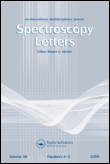
SPECTROSCOPY LETTERS
Pioneering Insights in Optics and Molecular StudiesSPECTROSCOPY LETTERS, published by Taylor & Francis Inc, is a pivotal journal that plays a significant role in the fields of Analytical Chemistry, Atomic and Molecular Physics, and Optics. With an ISSN of 0038-7010 and E-ISSN of 1532-2289, it provides a platform for the dissemination of cutting-edge research and developments in spectroscopy and its wide-ranging applications. As of 2023, the journal is ranked in the third quartile (Q3) across its relevant categories, reflecting its importance in these scientific domains. The journal has a continuous publication history from 1968 to 2024, establishing a rich legacy in academic literature. Although it currently does not offer Open Access options, SPECTROSCOPY LETTERS remains a valuable resource for researchers, professionals, and students seeking to advance their knowledge and applications in spectroscopy. For those in the arena of physics and chemistry, this journal is essential for keeping abreast of the latest findings and methodologies in the field.
Journal of Analytical Methods in Chemistry
Fostering collaboration in the vibrant world of analytical science.The Journal of Analytical Methods in Chemistry, published by HINDAWI LTD, stands as a premier platform dedicated to the dissemination of research in the vibrant field of analytical chemistry. With an ISSN of 2090-8865 and an E-ISSN of 2090-8873, this Open Access journal has been committed to providing unrestricted access to quality research since 1978, thereby fostering greater collaboration and innovation among researchers, professionals, and students globally. The journal showcases rigorous research insights spanning diverse categories, earning impressive Scopus rankings including Q2 in Chemical Engineering and Q3 in Analytical Chemistry for 2023, positioning itself effectively among respected peers. Its interdisciplinary approach also covers significant contributions in the realms of instrumentation and computer science applications, thus addressing contemporary challenges and advancements in analytical methodologies. By bridging theoretical underpinnings with practical applications, the Journal of Analytical Methods in Chemistry aims to catalyze knowledge exchange while enhancing the global discourse in analytical science.
JOURNAL OF ANALYTICAL TOXICOLOGY
Unveiling Insights in Toxicology and ChemistryJOURNAL OF ANALYTICAL TOXICOLOGY, published by Oxford University Press Inc, stands as a leading platform in the field of analytical chemistry and toxicology, focusing on the rigorous exploration of methodologies and advancements in the detection of toxic substances. Since its inception in 1977, this journal has continually contributed to the scientific community, providing researchers and professionals with vital insights into chemical health, safety, and environmental implications. With an impressive Q1 ranking in both Analytical Chemistry and Chemical Health and Safety, along with reputable Q2 rankings in Environmental Chemistry and Toxicology, the journal maintains its critical standing in vibrant academic communities, ensuring the dissemination of high-quality research. Although it currently does not offer open access, articles are made available via institutional subscriptions, allowing widespread access to its valuable findings. Located in the United States, the journal contains a wealth of knowledge poised to benefit scientists and scholars engaged in toxicological research, emphasizing its importance in enhancing public health and safety.
RUSSIAN JOURNAL OF GENERAL CHEMISTRY
Fostering Collaboration in the World of ChemistryThe Russian Journal of General Chemistry is a prominent scholarly publication dedicated to advancing the field of general chemistry. Published by MAIK NAUKA/INTERPERIODICA/SPRINGER, this journal contributes significantly to the global chemistry landscape, offering a platform for researchers and professionals to share their latest findings and methodologies. With an ISSN of 1070-3632 and an E-ISSN of 1608-3350, it has established itself as a resource for high-quality research articles since its inception in 1996. Though currently indexed in the Q4 category for chemistry (miscellaneous) and ranking #299 out of 408 in general chemistry according to Scopus, the journal remains an important venue for academic contributions that bridge gaps in traditional chemical disciplines. Desiring to cater to a diverse range of interests within chemistry, the journal actively encourages submissions that reflect significant scientific achievements, innovations, and collaborative studies. Although the journal does not currently offer open access, its role in disseminating crucial chemical research cannot be overstated. Researchers and students alike will find valuable insights and rigorous scientific discourse in its pages.
ANALYTICAL AND BIOANALYTICAL CHEMISTRY
Advancing the Frontiers of Chemical AnalysisANALYTICAL AND BIOANALYTICAL CHEMISTRY, published by SPRINGER HEIDELBERG, is a leading international journal that serves as a vital platform for innovative research in the fields of analytical and bioanalytical chemistry. With an impressive impact factor and ranking in the Q2 category for both Analytical Chemistry and Biochemistry, the journal highlights key advancements and methodologies that drive the discipline forward. Established in 1996 and continuing vigorously into 2024, it has gained significant recognition with Scopus rankings placing it in the 83rd and 78th percentiles within its categories, underscoring its impact and relevance. The journal's commitment to open access facilitates widespread dissemination of critical scientific knowledge, making it an essential resource for researchers, professionals, and students dedicated to exploring the complexities of chemical analysis. With its base in Heidelberg, Germany, ANALYTICAL AND BIOANALYTICAL CHEMISTRY continues to inspire and influence the global research community.
Acta Chemica Iasi
Fostering Collaboration in Cutting-Edge ChemistryActa Chemica Iasi is a distinguished open-access journal dedicated to advancing the field of chemistry, published by the esteemed ALEXANDRU IOAN CUZA UNIVERSITY PRESS located in Iasi, Romania. Since its inception, this journal has served as a vital platform for the dissemination of significant research findings, theoretical advancements, and methodological innovations in various chemistry disciplines. As an open-access publication since 2013, it provides unrestricted access to high-quality articles, fostering collaboration and knowledge sharing among researchers, professionals, and students globally. Although specific metrics such as H-Index and Scopus rankings may be forthcoming, the journal's commitment to rigor and excellence ensures that it remains an invaluable resource for those seeking to stay at the forefront of chemical research. With a focus on promoting scientific inquiry and innovation, Acta Chemica Iasi continues to uphold a legacy of scholarly excellence and contribution to the chemical sciences.
JOURNAL OF CHEMOMETRICS
Bridging Chemistry and Mathematics for Enhanced UnderstandingJOURNAL OF CHEMOMETRICS is a prestigious journal published by Wiley that has been a cornerstone in the fields of analytical chemistry and applied mathematics since its inception in 1992. With an ISSN of 0886-9383 and an E-ISSN of 1099-128X, this journal occupies a notable position, reflected in its Scopus rankings where it holds the 90th rank in Applied Mathematics and the 56th rank in Analytical Chemistry. The journal, based in the United Kingdom, spans a converged publication timeline through 2024, meticulously exploring the interplay between chemical data analysis and mathematical methodologies. Though currently not open access, it offers essential insights through high-quality research articles that significantly contribute to advancing the understanding of chemometric techniques and their applications. With an impact factor demonstrating robust academic recognition, the JOURNAL OF CHEMOMETRICS serves as an invaluable resource for researchers, professionals, and students aiming to excel in the ever-evolving landscape of chemical data interpretation.
ANALYTICAL CHEMISTRY
Leading Insights in Analytical ChemistryANALYTICAL CHEMISTRY, published by the American Chemical Society, is a leading journal in the field of analytical chemistry, with a significant impact factor reflecting its reputation and scholarly influence. With an impressive ranking of 14th out of 156 in its category, placing it in the 91st percentile among its peers, this journal is essential for researchers, professionals, and students alike who are looking to stay at the forefront of developments in analytical techniques and methodologies. Established in 1947, ANALYTICAL CHEMISTRY covers a broad range of topics within the discipline, all aimed at advancing the scientific community's understanding of complex chemical systems. Although currently not an Open Access journal, its rigorous peer-review process ensures the publication of high-quality research aimed at significant innovations in the analytical field. With its publication spanning up to 2024, it continues to be a valuable resource for those seeking to enhance their research and contribute to the global discourse in analytical chemistry.