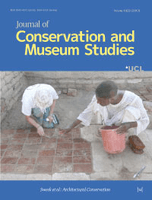
Journal of Conservation and Museum Studies
Scope & Guideline
Exploring the Intersection of Culture and Preservation
Introduction
Aims and Scopes
- Conservation Practices and Innovations:
This area emphasizes the latest techniques and methodologies in conservation, including the use of technology such as structured light scanning to detect forgeries, which reflects a commitment to preserving the integrity of cultural artifacts. - Cultural Heritage and Community Engagement:
Research in this scope explores the role of museums in engaging with diverse communities, such as the application of Māori holistic conservation approaches, highlighting the importance of inclusivity in heritage practices. - Exhibition and Display Strategies:
The journal examines evolving paradigms in museum displays, including the integration of intangible heritage and innovative exhibition designs, reflecting the need to adapt to contemporary audiences. - Impact of Global Events on Museums:
A focus on how global crises, such as the COVID-19 pandemic, have affected museum operations and visitor experiences, including adaptations made by institutions to ensure safety and accessibility. - Future Directions in Museology:
Exploring new organizational structures and practices within museums, this area aims to envision a progressive future for museum staffing and management.
Trending and Emerging
- Integration of Technology in Conservation:
The use of advanced technologies, such as structured light scanning, is increasingly recognized as essential for modern conservation practices, reflecting a trend towards embracing innovation in the preservation of cultural heritage. - Holistic and Indigenous Approaches to Conservation:
There is a growing focus on incorporating indigenous perspectives and holistic practices, such as Māori conservation methods, indicating a shift towards valuing diverse cultural approaches in heritage management. - Adaptive Strategies for Crisis Management:
Emerging themes related to how museums adapt to global crises, such as the COVID-19 pandemic, showcase a trend towards resilience and innovation in response to external challenges, emphasizing the importance of safety and accessibility. - Exhibition of Intangible Heritage:
The exploration of intangible heritage in museum exhibitions is gaining traction, emphasizing the need for museums to represent living cultures and practices, thus broadening the scope of what is considered worthy of preservation.
Declining or Waning
- Traditional Conservation Techniques:
There seems to be a decreasing emphasis on conventional conservation methods in favor of more innovative and technology-driven approaches, suggesting a shift towards modern practices. - Static Museum Experiences:
The focus on static displays and traditional exhibition formats has waned as the journal increasingly highlights dynamic, interactive, and community-engaged approaches to museology. - Historical Artifacts Alone:
Research that centers solely on the conservation of historical artifacts without considering their broader cultural context appears to be declining, indicating a move towards more holistic and inclusive narratives.
Similar Journals
JOURNAL OF CULTURAL HERITAGE
Preserving the Past, Shaping the Future.JOURNAL OF CULTURAL HERITAGE, published by Elsevier France - Éditions Scientifiques Médicales Elsevier, is a pivotal academic journal dedicated to the multifaceted study of cultural heritage, including its conservation, anthropology, archaeology, and related fields. With an impressive standing in the academic community, this journal has achieved a Q1 ranking in Anthropology, Archaeology, Conservation, and History, reflecting its critical influence and contribution to these disciplines. The journal serves as a vital resource for researchers, professionals, and students interested in innovative research and developments concerning cultural heritage practices and policies. Although it operates under a subscription model, it provides access to innovative research and insights from the field, making it essential for those engaged in the preservation and study of cultural artifacts and historical narratives.

Journal of Heritage Tourism
Cultivating a Deeper Understanding of Heritage and TourismJournal of Heritage Tourism, published by Routledge Journals, part of Taylor & Francis Ltd, is a leading peer-reviewed journal dedicated to the interdisciplinary study of heritage tourism. As a vital resource for researchers, professionals, and students in the fields of History and Tourism, Leisure and Hospitality Management, this journal has consistently achieved high rankings, securing a Q1 quartile in History and Q2 in Tourism for 2023. With an impressive Scopus rank of #3 out of 1760 in Arts and Humanities - History and #42 out of 146 in Business - Tourism, it underscores the journal’s importance and relevance in contemporary scholarship. Spanning contributions from 2006 to 2024, the journal provides a platform for innovative research, critical discussions, and comprehensive analyses, fostering a greater understanding of the complex relationships between heritage and tourism. Although it does not currently offer open access, insights published within this journal remain accessible for institutional libraries and academic communities worldwide, ensuring that the ongoing discourse around heritage tourism flourishes.
Journal of the Institute of Conservation
Innovating Solutions for Cultural and Natural HeritageJournal of the Institute of Conservation is a leading academic journal dedicated to advancing the field of conservation, published by Routledge Journals, Taylor & Francis Ltd. With an impressive Q1 ranking in Conservation and a Scopus rank of #21 out of 103 in the Arts and Humanities category, this journal plays a pivotal role in disseminating high-quality research that shapes conservation practices and policies. Spanning the years from 2009 to 2024, it serves as a vital platform for scholars and practitioners alike, offering innovative perspectives on materials science, museology, and media technology. Accessible solely through institutional subscriptions, the journal invites contributions that engage with contemporary issues in conservation, ensuring that all articles foster interdisciplinary dialogue and enhance professional standards within the field. The Journal of the Institute of Conservation is thus essential for those committed to preserving our cultural and natural heritage.
Conservation and Management of Archaeological Sites
Elevating Archaeological Conservation Standards.Conservation and Management of Archaeological Sites is a pivotal academic journal published by Routledge Journals, Taylor & Francis Ltd, focusing on the interdisciplinary fields of archaeology and conservation. With an ISSN of 1350-5033 and an E-ISSN of 1753-5522, this journal strives to publish high-quality research that addresses critical topics related to the conservation and management of archaeological sites, fostering dialogue between practitioners, researchers, and policymakers. Despite being categorized in the third quartile (Q3) across multiple relevant categories such as Archaeology and Conservation in the 2023 rankings, it remains a significant resource for professionals seeking to enhance their understanding and application of best practices in site management. The journal plays a crucial role in disseminating knowledge that contributes to the preservation of cultural heritage, making it an essential read for anyone involved in these vital fields. Published since 1995, the journal not only reflects the growing importance of archaeology in today's society but also provides a platform for emerging research that will shape future conservation strategies.
Museums & Social Issues-A Journal of Reflective Discourse
Fostering Critical Conversations in MuseologyMuseums & Social Issues: A Journal of Reflective Discourse, published by Routledge Journals, Taylor & Francis Ltd, is a distinguished platform for dialogue surrounding the intersection of museum practices and social discourse. With an ISSN of 1559-6893 and E-ISSN 2051-6193, the journal aims to reflect critically on the evolving role of museums in society, fostering discussions that engage with contemporary issues such as identity, representation, and community engagement. With a notable Q3 ranking in Cultural Studies and a Q2 ranking in Museology in 2023, it is positioned prominently within the academic landscape, inviting contributions from scholars, practitioners, and students alike. Spanning a convergence of years from 2015 to 2019 and 2021 to 2024, this journal serves as a vital resource for those invested in exploring innovative approaches and methodologies within museological practice. By promoting open discourse and reflection on social responsibilities, it plays a crucial role in shaping the future of museums as dynamic agents of change in their communities.
Museum Management and Curatorship
Shaping the Evolution of Museum ManagementMuseum Management and Curatorship is a leading academic journal dedicated to the exploration and advancement of museum practices, curatorial studies, and heritage management. Published by Routledge Journals, Taylor & Francis Ltd, this journal serves a diverse audience comprised of researchers, professionals, and students interested in the critical analysis of museum management strategies and the evolving role of curators in contemporary society. With its Q2 rankings in both Business and International Management and Tourism, Leisure and Hospitality Management, along with a prestigious Q1 classification in Visual Arts and Performing Arts, the journal underscores its importance in interdisciplinary research and showcases innovative practices within the sector. While operating under a subscription access model, it is committed to disseminating impactful findings and fostering a deeper understanding of museum dynamics from 1990 to the present, making it an essential resource in the field.
International Journal of Heritage Studies
Unveiling new perspectives in heritage studies.Welcome to the International Journal of Heritage Studies, a prestigious publication dedicated to advancing knowledge in the fields of heritage conservation, cultural studies, and museology. Published by Routledge Journals, Taylor & Francis Ltd in the United Kingdom, this journal boasts an impressive impact ranking, positioned in the Q1 category for multiple disciplines, including Conservation and Cultural Studies, and a remarkable HIndex indicative of its influence within academia. With a history spanning from 1994 and continuing to 2024, the journal serves as an essential platform for researchers, professionals, and students aiming to contribute to the dynamic discourse surrounding heritage preservation and cultural management. Although the journal does not offer open access, it remains a vital resource for those interested in the nuanced intersections of heritage and society, as evidenced by its high ranks in various academic categories. The International Journal of Heritage Studies is committed to fostering innovative research and critical analysis in its field, inviting submissions that explore diverse methodologies and theoretical perspectives.
Journal of the History of Collections
Illuminating the cultural dynamics of collecting.Journal of the History of Collections, published by Oxford University Press, serves as a vital resource for scholars and practitioners in the fields of conservation, museology, and visual arts. Established in 1989, this esteemed journal explores the intricate narratives of collections, addressing the historical, cultural, and social dynamics that influence collecting practices across various mediums. With an evolving publication span through 1994 and resuming in 1996 to the present day, the journal maintains a strong academic reputation, demonstrated by its impressive rankings in Scopus—placing it in the top quartiles for both Museology and Visual Arts and Performing Arts. Researchers and students will find engaging articles that not only contribute to academic discourse but also reflect on the conservation challenges faced by collections today. While currently not available as open access, the journal’s rigorous peer-review process ensures that only the highest quality research is published, making it an essential addition to any library dedicated to the arts and humanities.

PRESERVATION
Advancing the Dialogue on Cultural IntegrityPRESERVATION is a distinguished journal published by the NATL TRUST HISTORIC PRESERVATION, focusing on critical issues in historic preservation and conservation within the realm of arts and humanities. With an ISSN of 1090-9931, this journal served as a notable platform for research and discourse from 2002 to 2018, although its coverage was discontinued in Scopus, where it held ranks that reflected its niche but valuable contributions to both visual arts and conservation. Despite its cessation, the journal remains a key resource for professionals and academics dedicated to preserving cultural heritage and advancing the study of preservation practices. The importance of PRESERVATION lies in its commitment to fostering an understanding of the challenges in maintaining historical integrity amidst modern developments. Researchers, practitioners, and students alike will find a wealth of knowledge and inspiration through its past issues, making it an essential reference point for those engaged in the ongoing dialogue around preservation methodologies and impacts.
Museum Worlds
Connecting scholars and practitioners in museum studies.Museum Worlds is a distinguished academic journal published by BERGHAHN JOURNALS, dedicated to advancing scholarship in the fields of Museology and Conservation. With a strong impact within the academic community, evidenced by its 2023 Scopus rankings—#16 in Museology and #32 in Conservation—this journal offers an engaging platform for innovative research and discourse surrounding museum practices and cultural heritage. Since transitioning to Open Access in 2020, Museum Worlds has broadened its reach, making valuable insights available to researchers and practitioners globally. With its publication spanning from 2019 to 2023 and positioning in the top quartiles of respective categories, this journal is integral for those invested in the evolution of museum studies, providing a space for critical reflection, debate, and the sharing of pioneering methodologies in the stewardship of cultural institutions. Located in the heart of Brooklyn, NY, it stands as a hub for the scholarly community, inviting contributions that push the boundaries of knowledge in the ever-evolving landscape of museums.