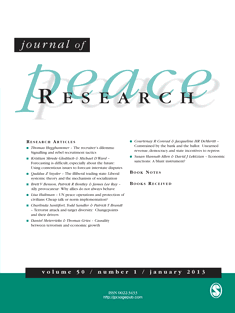
JOURNAL OF PEACE RESEARCH
Scope & Guideline
Advancing the discourse on global peace and conflict.
Introduction
Aims and Scopes
- Conflict Dynamics and Resolution:
The journal explores the various dimensions of conflict dynamics, including initiation, escalation, and resolution strategies. It provides insights into the processes that underlie peace negotiations, mediation efforts, and the factors influencing successful conflict resolution. - Human Rights and Security:
Research often intersects human rights issues with security studies, examining how violations of rights can lead to conflict and how security measures can impact rights. This area emphasizes the importance of ethical considerations in conflict and peacebuilding efforts. - Data-Driven Approaches:
The journal is notable for its commitment to introducing and utilizing new datasets that enhance the understanding of conflicts, peace processes, and security dynamics. This includes datasets on rebel governance, civil war mediation, and various forms of violence. - Interdisciplinary Perspectives:
The journal promotes interdisciplinary research that draws from political science, sociology, economics, and environmental studies, reflecting the complex nature of peace and conflict phenomena. - Impact of External Factors:
The influence of external actors, such as international organizations, states, and non-state actors on local and international conflicts is a recurring theme, highlighting the interconnectedness of global and local dynamics.
Trending and Emerging
- Cyber Conflict and Security:
The rise of cyber conflict as a significant area of research is evident, with studies examining the implications of cyber operations on international relations and domestic politics, highlighting the need for new frameworks to understand these dynamics. - Environmental Conflict and Cooperation:
Emerging research links environmental issues with conflict and cooperation, addressing how climate change and resource scarcity can drive violence while also exploring opportunities for collaboration through environmental initiatives. - Gender and Conflict:
The increasing focus on gender dynamics in conflict and peace processes is notable, with studies investigating the roles of women in conflict, the impact of gendered violence, and the importance of gender-inclusive peacebuilding. - Public Opinion and Political Violence:
There is a growing interest in how public perceptions shape responses to violence and conflict, including studies on electoral violence, societal reactions to terrorism, and the role of media in framing these issues. - Data Innovations and Methodological Advances:
The introduction of innovative datasets and advanced methodologies is on the rise, facilitating more robust analyses of conflict dynamics, including experimental designs and sophisticated statistical techniques.
Declining or Waning
- Traditional State-Centric Security:
Research focusing solely on state-centric security paradigms is becoming less frequent, as scholars increasingly recognize the importance of non-state actors and grassroots movements in conflict and peacebuilding. - Historical Conflict Analysis:
While historical analysis remains relevant, there is a noticeable decline in studies solely focused on historical conflicts without contemporary implications. The journal is shifting towards more immediate, data-driven analyses that address current conflicts. - Simplistic Approaches to Peacebuilding:
There is a waning interest in simplistic models of peacebuilding that do not account for the complexity of social, economic, and political factors. More nuanced approaches that consider multiple variables and stakeholder perspectives are gaining traction. - Focus on Military Solutions:
Research advocating for military solutions to conflicts appears to be decreasing, with a growing emphasis on diplomatic, humanitarian, and nonviolent strategies instead. - Homogeneous Case Studies:
There is a decline in the prevalence of case studies that do not incorporate diverse contexts or comparative analyses, as the journal encourages broader applicability and generalizability of findings.
Similar Journals
South African Journal of International Affairs-SAJIA
Elevating African Voices in International StudiesThe South African Journal of International Affairs (SAJIA), published by Routledge Journals under Taylor & Francis Ltd, is a leading academic publication dedicated to advancing the study of political science and international relations within the African context. Since its inception in 1993, SAJIA has distinguished itself in the academic community, achieving a Q3 ranking in 2023 among its peers, reflecting its commitment to high-quality research and scholarly discourse. With a current Scopus rank of #285 out of 706 within its field, SAJIA provides a platform for researchers, professionals, and students to engage with contemporary global issues, particularly those pertinent to Africa and its interactions on the world stage. Although it does not operate on an open access model, the journal's rigorous peer-review process ensures that published articles contribute significantly to the academic corpus. The journal's scope encompasses a wide array of topics, positioning it as an essential resource for anyone interested in the dynamics of international affairs.
Journal of Aggression Conflict and Peace Research
Pioneering research at the intersection of aggression and peace.Welcome to the Journal of Aggression Conflict and Peace Research, a pioneering platform dedicated to advancing the understanding of aggression, conflict resolution, and peace studies. Published by EMERALD GROUP PUBLISHING LTD, this esteemed journal is recognized for its significant contributions to interdisciplinary research, achieving a prominent position within the academic community with a 2023 ranking of Q2 in fields such as Law and Sociology and Political Science. Striding across various domains, including social psychology and health, the journal's scope extends from 2009 to 2024, illuminating contemporary challenges and innovative solutions to violence and disagreement in society. Although not currently open access, the journal remains accessible to a diverse readership keen on exploring the complex interplay of aggression and conflict with peace and reconciliation efforts. Stay informed with the latest research that shapes policy and promotes social welfare in a world facing rising tensions.

All Azimuth-A Journal of Foreign Policy and Peace
Empowering research for a peaceful future.All Azimuth - A Journal of Foreign Policy and Peace is a leading academic journal dedicated to the exploration and analysis of foreign policy dynamics, conflict resolution, and peace studies. Published by the CENTER FOREIGN POLICY & PEACE RESEARCH in Turkey, this journal serves as a crucial platform for scholars and practitioners aiming to address pressing global issues. With a prestigious Q1 category ranking in Political Science and International Relations, and a noteworthy Scopus rank of #263 out of 706 in its field, All Azimuth is recognized for its impactful contributions to the academic community. The journal, operating under an open access model, is committed to providing unrestricted access to high-quality research, fostering collaboration, and enhancing knowledge dissemination across disciplines. Since its inception in 2012, All Azimuth has become an essential resource for researchers, professionals, and students who seek to deepen their understanding of international relations and peace policies, making significant strides towards resolving global conflicts and promoting sustainable peace.

CIC-Cuadernos de Informacion y Comunicacion
Fostering Interdisciplinary Insights in Information SciencesCIC-Cuadernos de Informacion y Comunicacion is a leading academic journal published by the Universidad Complutense de Madrid, serving as a vital resource for scholars and practitioners in the fields of information and communication studies. Launched in 1995 as an Open Access journal, it provides an invaluable platform for disseminating innovative research and critical analysis related to communication theory, media studies, and information technology. With its focus on fostering interdisciplinary dialogue, CIC encourages submissions that explore contemporary challenges and advancements in the information landscape. Although the H-index and Scopus rankings are currently not specified, the journal’s commitment to excellence and accessibility positions it as an important contributor to academic discourse. The journal is based in Madrid, Spain, and aims to reach a global audience of researchers, professionals, and students dedicated to furthering knowledge in the rapidly evolving domains of communication and information sciences.
Ciudad Paz-Ando
Innovating Solutions for Peace and Social Equity.Ciudad Paz-Ando is an esteemed open-access journal published by UNIV DISTRITAL FRANCISCO JOSE DE CALDAS, dedicated to advancing the field of peace studies and urban development. Since its establishment in 2008, the journal has been committed to fostering scholarly dialogue around the intersection of societal transformation, cultural dynamics, and sustainable urban policies. Based in Bogotá, Colombia, Ciudad Paz-Ando serves as a vital platform for researchers, professionals, and students to publish and access innovative research aimed at addressing complex urban challenges in contemporary society. With a focus on interdisciplinary approaches, the journal encourages contributions that seek to generate knowledge and inspire action towards peace and social equity in urban contexts. The journal's open-access model ensures that research is freely available to a global audience, thereby enhancing its impact and reach within the academic community and beyond.
Global Change Peace & Security
Transforming Global Challenges into Opportunities for PeaceGlobal Change Peace & Security is a prominent scholarly journal published by Routledge Journals, Taylor & Francis Ltd, focusing on the intricate interplay between global change and peace efforts within the realms of political science and international relations. With an ISSN of 1478-1158 and an E-ISSN of 1478-1166, this esteemed journal spans from 2008 to 2024, consistently contributing to critical discourse in its field. Ranked in the second quartile (Q2) for both Political Science and International Relations as well as Sociology, it occupies a distinguished position with a Scopus ranking of 134 out of 706 and a percentile standing of 81st in Political Science. The journal’s objective is to bridge the gap between theoretical frameworks and functional policy discussions, thereby fostering dialogue that addresses contemporary challenges in global governance and human security. By offering rich, research-based insights and analysis, Global Change Peace & Security serves as a vital resource for academics, practitioners, and policy-makers committed to advancing peace and security amidst pervasive global transformations.
INTERNATIONAL SECURITY
Pioneering insights into the dynamics of international affairs.INTERNATIONAL SECURITY is a premier academic journal published by MIT PRESS, dedicated to advancing scholarly discourse in the fields of Law, Political Science, and International Relations. With an ISSN of 0162-2889 and an E-ISSN of 1531-4804, this highly regarded publication has established itself as a critical resource for researchers, professionals, and students since its inception in 1984. Renowned for its rigorous peer-review process and impactful articles, INTERNATIONAL SECURITY consistently ranks within the top quartile across multiple disciplines, achieving a remarkable Q1 classification in the latest 2023 metrics. Notably, it holds impressive positions in Scopus Ranks, including Rank #24 in Law and Rank #25 in Political Science and International Relations, reflecting its significant contribution to the field. Unfortunately, the journal does not currently offer open access options, but its comprehensive analyses of global security issues make it an invaluable tool for those seeking to deepen their understanding of contemporary challenges in the international arena. Whether you are a seasoned researcher or an emerging scholar, INTERNATIONAL SECURITY serves as a vital platform for exploring the intersections of security, policy, and global affairs.

International Journal of Conflict and Violence
Empowering knowledge exchange in the study of conflict and violence.International Journal of Conflict and Violence is a distinguished scholarly publication dedicated to fostering interdisciplinary research and discourse in the realms of law, sociology, and political science. Published by INST INTERDISCIPLINARY RES in Germany, this Open Access journal has been a vital platform for knowledge exchange since its inception in 2007, allowing unrestricted access to crucial research findings. With a significant E-ISSN of 1864-1385, it aims to address complex issues surrounding conflict and violence, contributing to the understanding and resolution of societal disputes. As of 2023, it proudly holds a Q1 ranking in Law and a Q2 ranking in Sociology and Political Science, underscoring its impact and relevance within the academic community, evidenced by its impressive 95th percentile rank in Social Sciences - Law and 87th percentile rank in Sociology and Political Science according to Scopus metrics. Researchers, professionals, and students alike will find the journal’s commitment to high-quality research and its comprehensive scope essential for advancing their understanding of conflict dynamics and their implications for society.

African Journal on Conflict Resolution
Advancing Peace: Uniting Perspectives on African Conflict ResolutionAfrican Journal on Conflict Resolution, published by the AFRICAN CENTRE FOR CONSTRUCTIVE RESOLUTION OF DISPUTES (ACCORD), serves as a pivotal platform for interdisciplinary research focusing on conflict resolution dynamics across the African continent. With its ISSN 1562-6997 and E-ISSN 2309-737X, this journal aims to foster innovative discussions and knowledge exchange related to peacebuilding, mediation, and conflict prevention. Aimed at researchers, practitioners, and policymakers, the journal is committed to addressing contemporary issues surrounding conflicts within a diverse and evolving African landscape. Though an open-access option is not currently available, the journal's contributions to the field of conflict studies and resolution remain crucial, illustrated through rigorous peer-reviewed articles that enrich academic and practical understanding. The significance of this journal in promoting effective conflict resolution strategies makes it an invaluable resource for those engaged in the pursuit of peace and stability in Africa.

Revista UNISCI
Elevating Academic Conversations on Global ChallengesRevista UNISCI is a distinguished open-access journal published by UNIV COMPLUTENSE MADRID, SERVICIO PUBLICACIONES, dedicated to advancing the discourse in the fields of Political Science and International Relations. Since its inception in 2005, it has established a platform for emerging scholars and seasoned researchers alike to share innovative ideas and findings. With an E-ISSN of 2386-9453, Revista UNISCI is accessible to a global audience, facilitating knowledge dissemination in an increasingly interconnected world. The journal has been categorized in Q4 quartile for 2023, highlighting its relevance in the competitive landscape of academic publishing, while its Scopus rank of 566 out of 706 positions it among the prominent voices in the discipline. As the journal enters its converged years from 2015 to 2024, it aims to foster interdisciplinary dialogue and contribute to ongoing research debates, ultimately enriching the academic community’s understanding of critical global issues.