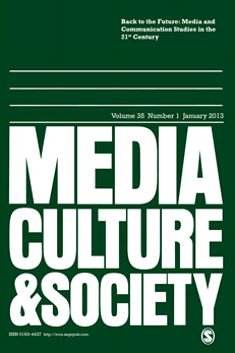
MEDIA CULTURE & SOCIETY
Scope & Guideline
Exploring the Intersections of Media and Cultural Dynamics
Introduction
Aims and Scopes
- Critical Media Studies:
The journal focuses on critical analyses of media practices, including how media operates within societal structures, influences public opinion, and shapes cultural narratives. - Digital Culture and Technology:
Research on the impact of digital technologies on communication, identity, and social interactions is central to the journal's scope, particularly in the context of evolving platforms and user-generated content. - Global Communication:
The journal emphasizes global perspectives in media studies, exploring how communication practices and media systems vary across different cultural and political contexts. - Cultural Representation and Identity:
Exploring the representation of various identities (gender, race, sexuality) in media is a core focus, particularly how these representations influence societal norms and individual experiences. - Media and Social Change:
Research that examines the role of media in facilitating or resisting social change, including activism, political movements, and public discourse, is a significant aspect of the journal's contributions. - Interdisciplinary Approaches:
MEDIA CULTURE & SOCIETY encourages interdisciplinary methodologies, integrating insights from sociology, cultural studies, political science, and communication studies to enrich the understanding of media phenomena.
Trending and Emerging
- Platform Studies:
There is a growing emphasis on the analysis of digital platforms, including their governance, user interactions, and impact on cultural consumption, reflecting the central role these platforms play in contemporary media. - Media and Mental Health:
Research exploring the relationship between media consumption and mental health, particularly in the context of social media and digital communication, is increasingly prominent, highlighting concerns about well-being in a digital age. - Disinformation and Misinformation:
As concerns about fake news and misinformation rise, the journal is seeing more studies addressing the implications of disinformation on public discourse, trust in media, and democratic processes. - Environmental Communication:
Emerging themes around the intersection of media, environmental issues, and activism are gaining traction, reflecting a broader societal concern for climate change and ecological narratives. - Intersectionality in Media Representation:
There is a notable trend towards exploring intersectional identities and their representation in media, focusing on how various social categories interact to shape experiences and narratives. - Digital Activism and Social Movements:
Research on the role of social media in facilitating activism and social movements is increasingly significant, reflecting the changing dynamics of political engagement in the digital age.
Declining or Waning
- Traditional Media Criticism:
While still relevant, the focus on traditional media forms (e.g., print journalism, television) is less prominent compared to the exploration of digital platforms and their impact on society. - Single-Narrative Analysis:
There has been a decline in studies that focus on singular narratives or case studies without broader contextualization, as the journal increasingly favors comprehensive analyses that consider multiple perspectives. - Local vs. Global Dynamics:
Research that strictly emphasizes local media practices without consideration of global influences is becoming less frequent, as the journal prioritizes studies that integrate global contexts. - Static Representations of Identity:
The exploration of identity in media has shifted from static representations to more dynamic, intersectional analyses, leading to a waning interest in traditional identity categories without context. - Historical Media Studies:
While historical contexts remain important, there is a noticeable decline in papers solely focused on historical media studies without a critical connection to contemporary issues.
Similar Journals
Mass Communication and Society
Innovating Perspectives on Mass Communication and Its EffectsMass Communication and Society is an esteemed journal published by Routledge Journals, Taylor & Francis Ltd, focusing on the dynamic field of communication studies. With its ISSN 1520-5436 and E-ISSN 1532-7825, the journal has established itself as a leading platform for high-quality research since its inception. With a prestigious positioning in the Q1 category of Communication as of 2023, it ranks impressively at #45 out of 511 in Scopus within the social sciences communication sector, boasting a 91st percentile in its field. The journal serves as a vital resource for researchers, professionals, and students interested in emergent issues, theories, and methodologies related to mass communication and its impact on society. Although it does not offer Open Access options, the journal remains committed to advancing scholarly discourse and providing rigorous insights into how communication shapes social dynamics. Since its converged years from 2008 to 2024, Mass Communication and Society continues to push the boundaries of knowledge in a rapidly evolving academic landscape, making it a must-read for anyone invested in the communication discipline.
Signs and Society
Fostering Dialogue on Cultural Expression and CommunicationSigns and Society is an acclaimed academic journal published by University of Chicago Press, specializing in the interdisciplinary exploration of semiotics, cultural representations, and communication practices. With an impressive ISSN of 2326-4489 and E-ISSN 2326-4497, this journal has established itself as a credible source of research and insight within its fields. It operates under a robust framework with a convergence of topics from 2015 to 2024, and has achieved notable rankings, including Q1 placements in Cultural Studies, Linguistics and Language, and Visual Arts and Performing Arts in 2023, elevating it to a leading status among its peers. The journal’s impact is reflected in its Scopus rankings, positioning it in high percentiles across diverse categories, making it a vital resource for scholars, practitioners, and students interested in the intricate relationships between signs, society, and culture. Although not an open access publication, Signs and Society remains essential for those seeking to deepen their understanding of communication dynamics and the multifaceted dimensions of cultural expression.
Discourse-Journal for Theoretical Studies in Media and Culture
Decoding media's role in shaping societal narratives.Discourse: Journal for Theoretical Studies in Media and Culture, published by Wayne State University Press, serves as a vital academic platform dedicated to advancing the theories and critical discussions surrounding the complex interplay of media, culture, and society. With an ISSN of 1522-5321 and an E-ISSN of 1536-1810, this journal aims to foster interdisciplinary dialogue among researchers, professionals, and students alike. Although not an open-access journal, it provides a wealth of peer-reviewed articles that delve into contemporary issues in media theory and cultural studies, reflective of its commitment to intellectual rigor and scholarly excellence. With its emphasis on innovative perspectives and critical analysis, Discourse is essential for anyone engaged in exploring the implications of media in our cultural landscape, making it a pivotal resource in the field.

Media International Australia
Illuminating Contemporary Media IssuesMedia International Australia is a leading journal that occupies a unique position at the intersection of communication and cultural studies. Published by SAGE Publications Ltd, this journal has established itself as a vital platform for scholarly discourse since its inception, now converging efforts from 2008 to 2024. With an impressive Q1 ranking in both the Communication and Cultural Studies categories, it ranks 12th out of 1304 in Cultural Studies and 42nd out of 511 in Communication, placing it within the 99th and 91st percentiles respectively according to Scopus metrics. The journal is committed to providing access to rigorous research that reflects contemporary issues in media, making it essential reading for researchers, professionals, and students keen on advancing their understanding of media's role in society. Despite not being fully Open Access, it ensures that quality research remains accessible through institutional subscriptions, allowing a broad audience to benefit from its insightful contributions.
Popular Communication
Advancing Scholarship in Popular CommunicationPopular Communication, published by Routledge Journals, Taylor & Francis Ltd, is a leading academic journal in the field of Communication, recognized for its Q1 ranking in the 2023 Scopus category. With an ISSN of 1540-5702 and an E-ISSN of 1540-5710, this journal has been converging significant research from 2010 to 2024, highlighting contemporary trends and evolving dynamics in popular communication practices. The journal is based in the United Kingdom and focuses on the intersection of media, culture, and communication, making it a vital resource for researchers, professionals, and students interested in understanding the impact of communication in society today. Although it does not offer Open Access options, it remains a cornerstone for scholarly discourse, with an impressive rank of #96 out of 511 in Social Sciences Communication, placing it in the 81st percentile. Contributions to this journal play a critical role in advancing knowledge and encouraging further scholarship in the diverse realm of popular communication.

China Information
Exploring the Nexus of Culture, Economy, and Society in ChinaChina Information, published by SAGE Publications Inc, stands as a premier academic journal in the realms of the Arts and Humanities, Economics, and Social Sciences. With an ISSN of 0920-203X and an E-ISSN of 1741-590X, this journal has established itself as a significant resource for scholars interested in the interplay of culture, economy, and society within the context of China. Ranking in the Q1 category across multiple disciplines, including General Arts and Humanities (4th out of 173), Economics, and General Social Sciences (both holding the 63rd and 64th positions in their respective categories), the journal upholds a distinguished impact in academic research, making it a valuable repository of knowledge. Collectively peer-reviewed contributions since its inception in 1986 enrich its comprehensive coverage and facilitate cutting-edge discussions relevant to contemporary China and its global interactions. While it does not offer Open Access, the journal continues to thrive as a beacon for dedicated researchers, professionals, and students seeking to deepen their understanding of China's evolving landscape and its implications.
Information & Culture
Innovating the Future of Cultural StudiesInformation & Culture is a respected journal published by University of Texas Press, focusing on the rich intersections between conservation, history, and library and information sciences. With a robust E-ISSN of 2166-3033, this journal has established itself as a vital resource for researchers, professionals, and students alike, providing a platform for innovative scholarship since its inception in 2012. The journal has garnered admirable rankings, achieving a Q2 category in both Conservation and History, alongside a Q3 ranking in Library and Information Sciences, reflecting its quality and relevance in the academic community. Its placement within the Scopus rankings further highlights its significance, with notable positions in the 79th percentile for Arts and Humanities and the 63rd percentile for Conservation. As a testament to its commitment to accessible knowledge, the journal offers various access options, catering to a wide audience eager to explore the evolving landscape of information and cultural studies.
Middle East Journal of Culture and Communication
Advancing Understanding of Communication PathwaysMiddle East Journal of Culture and Communication is a vital scholarly platform published by BRILL, dedicated to fostering an understanding of cultural dynamics and communication pathways within the Middle East. Established in 2008, this journal delivers a rich array of interdisciplinary research spanning the fields of Arts and Humanities, Communication, Cultural Studies, Political Science, and Sociology. With an impact factor reflective of its commitment to high-quality scholarship, it currently ranks in various quartiles, including Q3 in Arts and Humanities (miscellaneous) and Q4 in Communication and Political Science, demonstrating its importance in the academic discourse surrounding these disciplines. The journal's open access policy ensures that critical insights and analyses are widely disseminated, catering to a global audience of researchers, professionals, and students alike. The Middle East Journal of Culture and Communication stands as an essential resource for those seeking to explore the intricate tapestry of cultural interactions in the region through rigorous academic inquiry.
JOURNAL OF POPULAR CULTURE
Illuminating the Intersection of Culture and SocietyThe Journal of Popular Culture, published by Wiley, stands as a pivotal platform for the exploration and analysis of cultural phenomena since its inception in 1967. With its ISSN 0022-3840 and E-ISSN 1540-5931, the journal deeply engages with themes encompassing literature, history, and the broader arts and humanities landscape, further categorized in 2023 into distinct quartiles reflected by its superior rankings: Q3 in Arts and Humanities (miscellaneous), Q2 in History, and Q1 in Literature and Literary Theory. This journal not only ranks competitively in Scopus—positioned at the 73rd percentile in Literature and Literary Theory and achieving a significant recognition in History—but also cultivates a rich dialogue aimed at researchers, educators, and students alike. Through its non-open access model, the journal maintains a robust collection of scholarly articles that contribute to the understanding of popular culture's impact on society, making it an essential resource for academics and practitioners committed to this dynamic field.
Obra Digital-Revista de Comunicacion
Fostering dialogue in the digital age.Obra Digital-Revista de Comunicacion is a leading academic journal in the field of communication studies, published by UNIV VIC in Spain. Since its establishment in 2011, it has embraced an Open Access model, ensuring that research outputs are freely available to a global audience, thus fostering greater accessibility and collaboration among scholars. With an ISSN of 2014-5039, the journal aims to provide a pivotal platform for the dissemination of innovative research that addresses contemporary issues in communication theory and practice. The journal’s scope encompasses a wide range of topics, including digital media, interpersonal communication, and cultural studies, making it an essential resource for researchers, professionals, and students alike. Despite the absence of an HIndex and specific ranking metrics, Obra Digital stands out as a valuable forum for critical dialogue and scholarly exploration in the evolving landscape of communication. As the field continues to grow, this journal remains committed to advancing knowledge and fostering academic discourse.