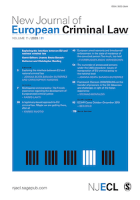
New Journal of European Criminal Law
Scope & Guideline
Advancing the discourse in European criminal law.
Introduction
Aims and Scopes
- European Criminal Law Frameworks:
The journal emphasizes the analysis and critique of existing EU criminal law frameworks, including the European Arrest Warrant, mutual recognition of judgments, and the role of the European Public Prosecutor's Office (EPPO). - Human Rights in Criminal Justice:
A significant focus is placed on the protection of human rights within the criminal justice system, particularly in relation to judicial cooperation, procedural rights, and the treatment of vulnerable populations, such as victims and marginalized groups. - Impact of Technology on Criminal Law:
The journal addresses the implications of emerging technologies, such as AI and digital evidence, on criminal investigations and legal processes, highlighting the challenges and opportunities presented by technological advancements. - Cross-Border Criminal Issues:
The journal explores issues related to cross-border crime, including the criminalization of migration, the role of Europol, and the complexities of jurisdictional conflicts in a European context. - Data Protection and Criminal Law:
A critical area of discussion involves the balance between law enforcement needs and data protection rights, particularly in light of GDPR and other relevant legal frameworks.
Trending and Emerging
- Environmental Crime and Corporate Responsibility:
An emerging focus is on the intersection of environmental crime and corporate governance, particularly how sustainability frameworks impact criminal liability and enforcement. - Rights of Marginalized Groups:
There is a growing emphasis on the rights of marginalized populations, such as transgender individuals in prison systems, reflecting broader societal movements towards inclusivity and human rights advocacy. - AI and Law Enforcement:
Research on the implications of artificial intelligence in law enforcement is gaining traction, exploring both the opportunities for enhanced efficiency and the ethical dilemmas posed by algorithmic decision-making. - Digital Transformation of Criminal Investigations:
The trend towards digital criminal investigations is increasingly prevalent, with legal analyses focusing on the challenges posed by cybersecurity, data protection, and the use of digital evidence in criminal proceedings. - Cross-Border Cooperation in Counter-Terrorism:
The journal is also seeing a rise in discussions surrounding cross-border cooperation in counter-terrorism efforts, highlighting the need for coordinated responses to transnational threats.
Declining or Waning
- Traditional Extradition Law:
While extradition remains a vital aspect of international criminal law, discussions specifically centered on traditional extradition mechanisms have decreased, possibly due to the increasing focus on mutual recognition frameworks and the role of the EPPO. - State Sovereignty in Criminal Matters:
The discourse surrounding state sovereignty and its implications for criminal law cooperation has waned, as EU integration and collaboration frameworks take precedence over nationalistic approaches. - Historical Perspectives on Criminal Justice:
Papers focusing on historical analyses of criminal law practices in Europe have become less frequent, indicating a shift towards contemporary issues and practical applications of law rather than historical context.
Similar Journals
Journal of Contemporary Criminal Justice
Exploring the Intersection of Law and Society.Journal of Contemporary Criminal Justice is a leading academic publication within the field of criminal justice, published by SAGE Publications Inc. This esteemed journal, bearing the ISSN 1043-9862 and E-ISSN 1552-5406, has been contributing significantly to the discourse on contemporary issues in justice systems since its inception in 1978. Renowned for its rigorous peer-reviewed articles, the journal holds an impressive 2023 ranking within the Q1 quartile in Law, further affirmed by its Scopus rank of #110 out of 1025 in the field of Social Sciences - Law, placing it in the 89th percentile. Though not an open access journal, it provides a vital platform for scholars, practitioners, and students seeking to explore and disseminate pioneering research and practical insights into the evolving criminal justice landscape. The journal covers a wide array of topics, from policy analysis to sociological perspectives, ensuring its relevance across multiple disciplines. With a commitment to advancing the understanding of justice in contemporary society, the Journal of Contemporary Criminal Justice is an essential resource for anyone engaged in the fields of criminology, criminal law, and social policy.
International Community Law Review
Advancing Understanding of International Law.International Community Law Review, published by MARTINUS NIJHOFF PUBLISHERS, is a distinguished journal that contributes significantly to the fields of law and international relations. With an ISSN of 1871-9740 and an E-ISSN of 1871-9732, this journal serves as a vital platform for scholarly discourse on issues pertaining to international law, promoting a deeper understanding and engagement with complex legal frameworks and global challenges. Currently classified in the Q3 quartile for Law and Political Science and International Relations, the International Community Law Review ranks 475 out of 1025 in the Law category and 386 out of 706 in Political Science, reflecting a moderate impact in the academic community. Though it does not currently offer Open Access, the journal's extensive coverage from 2007 through 2024 ensures that it remains a relevant resource for researchers, professionals, and students. Published in the Netherlands, this journal aims to foster the development of international legal thought, support academic research, and facilitate discussions that shape modern international legal practices.

COMMON MARKET LAW REVIEW
Pioneering Research in European and International LawCOMMON MARKET LAW REVIEW is a premier scholarly journal published by KLUWER LAW INTERNATIONAL, dedicated to the rigorous analysis of legal and policy issues related to the European Union and broader international frameworks. With an ISSN of 0165-0750 and E-ISSN 1875-8320, this esteemed publication holds a distinguished position in the field, recognized in the Q1 category for both Law and Political Science and International Relations as per the 2023 rankings. Its impressive Scopus rankings—#131 out of 1,025 in Law and #151 out of 706 in Political Science—underscore the journal's significance, placing it within the top percentiles of its categories. Operating without open access, the journal presents articles that contribute to scholarly discourse from 1996 through 2024, making it an invaluable resource for researchers, legal practitioners, and students keen on advancing their understanding of European law and regulatory regimes. The COMMON MARKET LAW REVIEW is essential reading for those engaged in rigorous research and the evolution of legal thought in a rapidly changing global context.
Criminal Law and Philosophy
Exploring the Boundaries of Justice and MoralityCriminal Law and Philosophy, published by SPRINGER in the Netherlands, is an esteemed peer-reviewed journal that explores the intricate intersections of law and philosophical inquiry. With an ISSN of 1871-9791 and an E-ISSN of 1871-9805, this journal is a vital resource for researchers, professionals, and students interested in the ethical, theoretical, and practical dimensions of criminal law. Renowned for its rigorous contributions and innovative perspectives, the journal has achieved a commendable Q2 ranking in both the fields of Law and Philosophy as of 2023, and demonstrates a strong commitment to fostering critical dialogue in these disciplines. With a Scopus rank placing it in the top 25% of Philosophy journals and above the 56th percentile in Law, Criminal Law and Philosophy continues to expand its influence and accessibility within the academic community and beyond, making it an indispensable platform for advancing scholarship at the confluence of law and moral theory.

Revista General de Derecho Penal
Bridging theory and practice in criminal law.Revista General de Derecho Penal, published by IUSTEL, is a premier academic journal dedicated to the dynamic field of criminal law. With an ISSN of 1698-1189, this journal serves as a crucial platform for researchers, legal professionals, and students to share their insights and findings related to penal law and its evolving applications in contemporary society. Although it is not an open access journal, it maintains high scholarly standards, helping to advance discourse in legal studies. The journal's address is C PRINCESA NO 29, 2A DCHA, MADRID 28008, SPAIN, positioning it within a vibrant academic community. With a focus on current legal challenges and theoretical advancements, Revista General de Derecho Penal plays an essential role in fostering understanding and developing effective legal frameworks in criminal justice, making it an invaluable resource for those engaged in the study and practice of law.

Revista General de Derecho Europeo
Exploring the Frontiers of European LawRevista General de Derecho Europeo is a prestigious academic journal dedicated to the study of European law, published by IUSTEL, a notable publisher recognized for its commitment to legal scholarship. This journal serves as a vital platform for the dissemination of cutting-edge research, fostering dialogue among scholars, practitioners, and policymakers in the field of European legal studies. With an ISSN of 1696-9634, it provides no-cost access to a diverse range of articles, ensuring that the latest developments in European jurisprudence are readily available to a broad audience. Although specific impact metrics such as the H-index are not detailed, the journal’s emphasis on quality and relevance positions it as an essential resource for anyone engaged in exploring the complexities of European law, its implications, and its evolution within a global context. Revista General de Derecho Europeo not only contributes to academic discourse but also equips its readers with critical insights necessary for navigating contemporary legal challenges in Europe.

PSYCHOLOGY CRIME & LAW
Illuminating the Psychology Behind Criminal JusticePSYCHOLOGY CRIME & LAW, published by Routledge Journals, Taylor & Francis Ltd, is a premier academic journal dedicated to the intersection of psychology, criminology, and the law. With an ISSN of 1068-316X and an E-ISSN of 1477-2744, this journal provides a critical platform for the dissemination of cutting-edge research and innovative methodologies in the fields of psychology, forensic medicine, and legal studies. Spanning over three decades (1994 to 2024), it holds impressive Scopus rankings, placing it in Q1 and Q2 quartiles for its contributions to law and forensic medicine, highlighting its standing within the academic community. PSYCHOLOGY CRIME & LAW is particularly noted for addressing contemporary issues at the crossroads of human behavior and legal standards, making it essential reading for scholars, practitioners, and students alike. While the journal is not open access, it offers valuable insights into a variety of topics, from criminal psychology to the implications of mental health in legal contexts, ensuring that it remains an influential resource for those engaged in research and professional practice.
Anuario Iberoamericano de Derecho Internacional Penal
Advancing legal scholarship in the Ibero-American context.Anuario Iberoamericano de Derecho Internacional Penal is a distinguished open-access journal dedicated to the field of international criminal law, published by UNIV ROSARIO, EDITORIAL. Since its inception in 2013, this journal has provided a platform for rigorous research and scholarly discussions related to the complexities of international penal law, enhancing understanding and application across Ibero-American jurisdictions. With an ISSN of 2346-3120, it caters to an audience of researchers, legal practitioners, and students who are keen to explore contemporary issues, case law, and reforms within the realm of international criminal justice. The journal aims to foster interdisciplinary dialogue, promote legal scholarship, and contribute to the development of international law principles in the Spanish-speaking world. As an essential resource for those engaged in the study and practice of international law, Anuario Iberoamericano de Derecho Internacional Penal continues to uphold a commitment to accessibility and academic excellence.

Vestnik of Saint Petersburg University-Law-Vestnik Sankt-Peterburgskogo Universiteta-Pravo
Pioneering Research in the Heart of Russian LawVestnik of Saint Petersburg University-Law, published by St Petersburg University Press, is a vital academic resource in the field of law, particularly significant within the Russian legal landscape. With an ISSN of 2074-1243 and an E-ISSN of 2587-5833, this journal serves as a platform for rigorous research, critical analysis, and scholarly discourse, contributing to the advancement of legal knowledge and practice. Although currently classified in the Q4 quartile for the year 2023 by Scopus rankings, it holds a unique position within the academic community, catering to a diverse audience of researchers, legal professionals, and students, especially those interested in the evolving nuances of law in Russia. You can explore comprehensive studies and articles that reflect the contemporary challenges and developments in law, while benefiting from the journal's focus on fostering a deep understanding of legal principles. The journal runs from 2019 to 2024, encapsulating emerging trends and insights in law that are critical for continuous learning and growth in this discipline.

Justicia
Advancing the discourse on law and justice.Justicia, a distinguished academic journal published by UNIV SIMON BOLIVAR, serves as a vital platform for the dissemination of research within the fields of law, political science, and social justice. Since its transition to Open Access in 2014, it has broadened its reach, enabling scholars, practitioners, and students from around the globe to engage with high-quality research unrestricted by subscription barriers. Located in Barranquilla, Colombia, the journal aims to foster interdisciplinary dialogue and innovation by publishing original articles, reviews, and case studies that reflect contemporary legal challenges and social issues. With its commitment to elevating discussions on justice and governance, Justicia plays a crucial role in shaping legal scholarship and influences policy-making, making it an essential resource for anyone dedicated to understanding and contributing to the field.