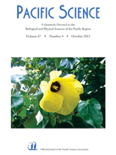
PACIFIC SCIENCE
metrics 2024
Bridging Disciplines for a Deeper Understanding of the Pacific
Introduction
PACIFIC SCIENCE is a prestigious multidisciplinary journal published by University of Hawaii Press, dedicated to advancing knowledge across diverse fields of study related to the Pacific region. With a robust ISSN of 0030-8870 and an E-ISSN of 1534-6188, this journal serves as a vital platform for researchers, professionals, and students to disseminate and access influential research findings that contribute to the understanding of ecological, cultural, and social dynamics in the Pacific. The journal has steadily maintained its relevance since its inception in 1947 and features a commendable Scopus Rank of #74 out of 171 in the multidisciplinarity category, placing it in the 57th percentile of its field, and is recognized as having a Q2 quartile ranking in 2023. Although lacking open access options, PACIFIC SCIENCE offers in-depth analysis and scholarly discourse, effectively bridging various disciplines to foster collaboration and innovation. With its commitment to high-quality research and its significant impact on Pacific studies, the journal continues to play an important role in informing policy, conservation efforts, and community engagement within this vital region.
Metrics 2024
 0.240.700.8046
Metrics History
Rank 2024
Scopus
IF (Web Of Science)
JCI (Web Of Science)
Quartile History
Similar Journals

AUSTRALIAN JOURNAL OF ZOOLOGY
Innovating Conservation Through Research and DiscoveryAustralian Journal of Zoology, published by CSIRO PUBLISHING, serves as a premier platform for research in the fields of animal science and zoology, with a profound commitment to advancing our understanding of wildlife and ecosystems. Featuring an ISSN of 0004-959X and an E-ISSN of 1446-5698, this esteemed journal encompasses a wide range of topics relevant to ecology, evolution, behavior, and systematics. For the year 2023, it holds a commendable Q2 ranking in both Animal Science and Zoology and Ecology, Evolution, Behavior, and Systematics, demonstrating its significant impact within the academic community. With a rich publication history spanning from 1952 to 2024, the journal caters to researchers, professionals, and students by disseminating crucial findings and methodologies that contribute to effective conservation efforts and informed ecological practices. Although not an open access journal, it continues to foster collaboration and discussion among scholars in Australia and beyond. Located in Clayton, Victoria, the journal remains dedicated to its objective of enhancing knowledge in zoological sciences and addressing vital environmental challenges.
ECOLOGICAL APPLICATIONS
Exploring the intersection of ecology and application.ECOLOGICAL APPLICATIONS, published by WILEY, is a leading journal in the field of ecology, providing a platform for innovative research that addresses the understanding and management of ecological systems. With an ISSN of 1051-0761 and E-ISSN of 1939-5582, it has established itself as a vital resource for ecologists and environmental scientists since its inception in 1991. Ranked in the top quartile (Q1) for Ecology in 2023 and with a Scopus ranking of 40 out of 461 in Environmental Science, ECOLOGICAL APPLICATIONS boasts an impressive impact factor, attesting to its significance and influence in the field. The journal's mission is to publish peer-reviewed articles that contribute to ecological theory and its applications in conservation and environmental management. Researchers, professionals, and students alike will find invaluable insights and the latest developments in ecological research through its comprehensive scope and rigorous scholarship, ensuring a crucial role in shaping future ecological practices and policies.
JOURNAL OF ECOLOGY
Unraveling the complexities of ecological interactions.JOURNAL OF ECOLOGY, published by Wiley, stands as a leading publication in the field of ecology, evolution, behavior, and plant science, currently positioned in the prestigious Q1 quartile across these categories. Established in 1976, the journal has consistently provided a platform for innovative research and critical discourse related to ecological patterns, processes, and interactions. With its robust Scopus ranking—31st out of 721 in Ecology, Evolution, Behavior and Systematics, and 26th out of 516 in Plant Science—this journal notably reflects the high impact and influence of its articles in the scientific community. Although it does not offer open access options, the journal ensures comprehensive dissemination of pivotal findings to researchers, professionals, and students alike. Located in the United Kingdom at 111 River St, Hoboken, NJ, the JOURNAL OF ECOLOGY remains an essential resource for those dedicated to advancing our understanding of ecological systems and their complexities.
AUSTRAL ECOLOGY
Advancing ecological insights from the Southern Hemisphere.AUSTRAL ECOLOGY, published by WILEY, is a key journal in the field of ecology, with a focus on ecological research from the Southern Hemisphere and beyond. With an ISSN of 1442-9985 and an E-ISSN of 1442-9993, this journal serves as a vital platform for the dissemination of significant findings related to ecology, evolution, behavior, and systematics. Currently holding a commendable Q2 ranking in both Ecology and Ecology, Evolution, Behavior and Systematics categories as of 2023, AUSTRAL ECOLOGY is recognized for its rigorous peer-review process and impactful research contributions, as evident from its Scopus rankings in the 56th percentile for both Agricultural & Biological Sciences and Environmental Science. Researchers, professionals, and students engaged in ecological studies can benefit from the journal's open access options, enabling wider accessibility to critical ecological insights and advancements in the field. Established in 1981, with an evolving legacy through its converged years from 1996 to 2024, AUSTRAL ECOLOGY remains committed to advancing ecological knowledge and fostering a deeper understanding of ecological dynamics in our ever-changing environment.
NEW ZEALAND JOURNAL OF ZOOLOGY
Fostering Excellence in Zoological Research Since 1974.NEW ZEALAND JOURNAL OF ZOOLOGY, published by Taylor & Francis Ltd, offers a crucial platform for the dissemination of high-quality research in the field of zoology and animal science. With an ISSN of 0301-4223 and an E-ISSN of 1175-8821, this journal has been a valuable resource since its inception in 1974 and continues to contribute significantly to the academic community, with a converged years span extending to 2024. The journal holds a commendable Q3 ranking in the 2023 category of Animal Science and Zoology, and ranks #175 out of 490 in Scopus, placing it in the 64th percentile of its category. While it is not an Open Access journal, researchers can still access a wide range of studies that delve into various aspects of zoology. With its robust editorial standards and commitment to advancing knowledge in animal science, the NEW ZEALAND JOURNAL OF ZOOLOGY serves as an essential resource for researchers, professionals, and students interested in the complexities of wildlife and ecological studies.
JOURNAL OF INSECT CONSERVATION
Championing the Study of Insect BiodiversityJOURNAL OF INSECT CONSERVATION, published by SPRINGER in Switzerland, is a leading peer-reviewed journal that focuses on the preservation and study of insect biodiversity and ecology. With an ISSN of 1366-638X and E-ISSN 1572-9753, this journal represents a vital resource for researchers and practitioners in the fields of Animal Science, Ecology, and Insect Science. The journal consistently ranks among the top quartiles, achieving Q1 status in Animal Science and Zoology and Q2 in other pertinent categories in 2023, according to Scopus rankings. This reflects its significant influence in the academic community, with a solid impact factor that highlights its importance in advancing the discourse on insect conservation. Though not an open access journal, it provides critical insights and innovative research findings from 1997 to 2024, making it an essential platform for those involved in the conservation of insect species and their habitats. As a scholarly resource, the JOURNAL OF INSECT CONSERVATION is dedicated to fostering knowledge dissemination and inspiring future research in pressing environmental issues.

NEW ZEALAND JOURNAL OF ECOLOGY
Illuminating the Path to Ecological UnderstandingNEW ZEALAND JOURNAL OF ECOLOGY, published by the New Zealand Ecological Society, stands as a premier platform for disseminating research in the field of ecology, with a notable impact factor reflected in its Q2 ranking in multiple ecology categories for 2023. Established in 1980 and actively publishing since 1982, this journal provides a vital resource for ecologists and environmental scientists, fostering the exchange of innovative ideas and methodologies. The journal covers a wide range of ecological topics, ensuring a comprehensive overview of the current trends and research developments in both ecological theory and practical applications specific to New Zealand and beyond. Researchers, professionals, and students will find in this journal an authoritative source to advance their understanding of ecological dynamics and contribute to the growing field of ecological science. The journal is accessible to the community without open access, providing critical insights that underpin the ecological landscape of New Zealand and inform sustainable practices worldwide.
STUDIES ON NEOTROPICAL FAUNA AND ENVIRONMENT
Advancing Knowledge on Fauna and Environmental DynamicsSTUDIES ON NEOTROPICAL FAUNA AND ENVIRONMENT is a distinguished academic journal published by Taylor & Francis Ltd, dedicated to advancing the fields of Animal Science, Zoology, and Ecology. With an ISSN of 0165-0521 and an E-ISSN of 1744-5140, this journal has been a significant outlet for scholarly research since its inception in 1976, continuing to provide critical insights into neotropical biodiversity and the environmental intricacies of this rich ecological region through 2024. Recognized in the Q3 category for both Animal Science and Ecology, the journal ranks at #232/490 in Animal Science and Zoology and #402/721 in Ecology, marking it as a valuable resource for researchers, professionals, and students interested in ecological and zoological studies. By offering a platform for innovative research and comprehensive reviews, the journal aims to bridge the gap between theory and practical application, facilitating a deeper understanding of the unique challenges and conservation strategies relevant to neotropical ecosystems. Although not an open-access journal, it plays a crucial role in fostering academic discourse and knowledge dissemination in its field, ensuring that critical advancements in understanding neotropical fauna and environmental dynamics reach a diverse and engaged audience.

AFRICAN JOURNAL OF MARINE SCIENCE
Connecting researchers to Africa's aquatic treasures.AFRICAN JOURNAL OF MARINE SCIENCE is a premier academic journal dedicated to advancing the field of aquatic sciences and ecological studies, published by Taylor & Francis Ltd. Established in 2003 and based in South Africa, this journal provides a vital platform for researchers, professionals, and students interested in the diverse and dynamic marine ecosystems of Africa. With an impressive impact factor reflected in its Q2 quartile ranking in both Aquatic Science and Ecology, Evolution, Behavior and Systematics categories, the journal showcases innovative research that addresses pressing environmental challenges. Open access options facilitate broad dissemination of knowledge, ensuring that cutting-edge findings are accessible to all stakeholders in the marine research community. As it converges towards its impressive milestone year of 2024, the AFRICAN JOURNAL OF MARINE SCIENCE serves as an essential resource for fostering scientific discourse and collaboration across the continent and beyond.
Marine Biology Research
Exploring the depths of aquatic knowledge.Marine Biology Research is a premier journal published by Taylor & Francis, focusing on the dynamic field of marine biology and its intersecting realms of aquatic science, ecology, and oceanography. Since its inception in 2005, this journal has served as a crucial platform for researchers and professionals to disseminate their findings, with a vision extending to 2024 and beyond. The journal is recognized with a Q3 quartile ranking in both Aquatic Science and Ecology, Evolution, Behavior and Systematics, underscoring its growing influence in these fields as evidenced by its Scopus rankings. Located in the United Kingdom, Marine Biology Research aims to foster collaboration and innovation through open access options, facilitating knowledge exchange among the academic community. With a steady commitment to advancing marine sciences, this journal is an invaluable resource for those dedicated to understanding and preserving our ocean ecosystems.