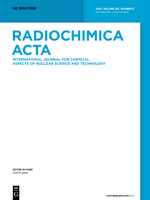
RADIOCHIMICA ACTA
metrics 2024
Unveiling the Complexities of Radioactivity in Chemical Contexts
Introduction
RADIOCHIMICA ACTA, published by Walter de Gruyter GmbH, is a leading journal in the field of Physical and Theoretical Chemistry, with a storied history dating back to 1962. Based in Berlin, Germany, this esteemed journal serves as a vital platform for researchers, professionals, and students interested in the intricate interactions between radioactivity and chemical processes. With an impressive *Scopus rank* of 125 out of 189 and a *Category Quartile* ranking of Q3 for 2023, it is recognized for contributing significant findings to the scientific community. Although it currently does not provide open access options, RADIOCHIMICA ACTA continues to enrich the field through its commitment to disseminating high-quality research and critical reviews. As it converges toward its milestone year of 2024, the journal remains an essential resource for advancing knowledge in radioch Chemistry, shaping the future of theoretical explorations and practical applications alike.
Metrics 2024
 0.291.401.6073
Metrics History
Rank 2024
Scopus
IF (Web Of Science)
JCI (Web Of Science)
Quartile History
Similar Journals
Nuclear Engineering and Technology
Unleashing Potential: Your Gateway to Nuclear ResearchNuclear Engineering and Technology, published by the Korean Nuclear Society, is a premier Open Access journal dedicated to the rapidly evolving fields of nuclear energy and engineering. Established as a significant platform for scholarly communication since 2008, this journal has consistently anchored itself in the academic community, achieving a Q2 ranking in its category as of 2023, reflecting its influence and quality within the domain of Nuclear Energy and Engineering. With an impressive Scopus ranking of #15 out of 77, positioning it in the 81st percentile, the journal publishes cutting-edge research that addresses both fundamental and applied aspects of nuclear technology. Nuclear Engineering and Technology embraces an open access model since 2013, ensuring that valuable research is accessible to a global audience, thereby enhancing collaboration among researchers, professionals, and students passionate about advancing nuclear technology. The journal serves as an essential resource for those aiming to innovate and push the boundaries of knowledge in nuclear sciences.

Izvestiya Vuzov-Prikladnaya Khimiya i Biotekhnologiya
Catalyzing Collaboration in Scientific DiscoveryIzvestiya Vuzov-Prikladnaya Khimiya i Biotekhnologiya, published by Irkutsk National Research Technical University, is a prominent open-access journal dedicated to advancing the fields of applied chemistry and biotechnology. Since its inception in 2011, this journal has provided a platform for the dissemination of significant research findings, innovative techniques, and technological advancements that bridge the gap between theoretical frameworks and practical applications. The journal is indexed in various databases, ensuring that published works reach a global audience of researchers, professionals, and students eager to explore the latest developments in these critical disciplines. With its commitment to open-access publishing, Izvestiya Vuzov-Prikladnaya Khimiya i Biotekhnologiya plays a vital role in fostering collaboration and knowledge sharing within the scientific community, thus contributing to the advancement of both fields in a rapidly evolving technological landscape.

JOURNAL OF ENVIRONMENTAL RADIOACTIVITY
Navigating the complexities of radioactive environments.JOURNAL OF ENVIRONMENTAL RADIOACTIVITY, published by Elsevier Science Ltd, is a prestigious peer-reviewed journal dedicated to the field of environmental science with a particular focus on the implications and management of radioactivity in the environment. Since its inception in 1984, the journal has served as a vital platform for researchers, scientists, and professionals to disseminate new findings that intersect with areas such as environmental chemistry, health, toxicology, pollution, and waste management. With a strong reputation reflected in its 2023 Q2 rankings across multiple categories and respectable Scopus rankings, it offers valuable insights and rigorous research that shape the discourse on environmental safety and public health. Although it does not operate under an open-access model, subscribers benefit from high-impact articles that push forward the boundaries of knowledge in the management and understanding of radioactive contaminants. This journal is essential for anyone involved in environmental research or policy-making who seeks to stay informed about the latest developments in this critical area of study.

Nuclear Physics and Atomic Energy
Unveiling the potential of high-energy physics.Nuclear Physics and Atomic Energy is a reputable open-access journal that focuses on the fields of nuclear physics and high-energy physics, providing a forum for researchers, professionals, and students to share their findings and advancements. Published by the Institute of Nuclear Research, National Academy of Sciences of Ukraine, this journal has been committed to disseminating knowledge since its inception in 2006, ensuring that scientific advancements remain accessible to a global audience. With an ISSN of 1818-331X and an E-ISSN of 2074-0565, the journal features a diverse array of articles that span the continued exploration and application of nuclear phenomena. Although currently categorized in the Q4 quartile for Nuclear and High Energy Physics in 2023, the journal is steadily working towards increasing its impact and engagement within the academic community. With a Scopus rank of #74 out of 87 in its category, it serves as a valuable resource for advancing crucial research in a vital scientific area. Researchers are encouraged to contribute their innovative studies to foster collaboration and knowledge sharing in this dynamic field.
BULLETIN OF THE CHEMICAL SOCIETY OF ETHIOPIA
Driving Knowledge Forward in the World of ChemistryBULLETIN OF THE CHEMICAL SOCIETY OF ETHIOPIA (ISSN: 1011-3924; E-ISSN: 1726-801X), published by the Chemical Society of Ethiopia, serves as a pivotal platform for the dissemination of innovative research and developments within the field of chemistry. Since its inception in 1996 and now an open access journal since 2012, it has provided researchers, academics, and students with unrestricted access to critical studies and findings, thus fostering collaboration and the advancement of knowledge in the discipline. The journal's current standing in the Q3 quartile in the 2023 Chemistry category underlines its commitment to maintaining high academic standards, while its Scopus ranking, positioned at #250 out of 408 in general chemistry, showcases its growing influence and contribution to the scientific community. Hailing from Ethiopia and targeted toward a global readership, the journal aims to highlight local and international research, engaging scholars and practitioners alike in discussions that propel the science of chemistry forward.
Bulletin of Chemical Reaction Engineering and Catalysis
Catalyzing Change through Open Access ResearchBulletin of Chemical Reaction Engineering and Catalysis is a distinguished open-access journal published by UNIV DIPONEGORO, focusing on pivotal advancements in the fields of chemical reaction engineering and catalysis. Since its inception in 2008, this journal has served as a vital platform for disseminating cutting-edge research, catering to a diverse readership that includes researchers, professionals, and students in chemical engineering and related disciplines. With its dedication to publishing valuable insights, the journal has been indexed in Scopus and boasts respectable rankings across various categories, including Q3 in Chemical Engineering (miscellaneous) and Q4 in Catalysis as of 2023. It continues to foster scholarly dialogue and collaboration by providing an accessible means for contributors to share their findings. Operating from Semarang, Indonesia, this journal underscores its commitment to advancing knowledge in chemical sciences, making it an essential resource for those engaged in the study and application of chemical processes.

INDIAN JOURNAL OF CHEMICAL TECHNOLOGY
Transforming Ideas into Solutions in ChemistryThe Indian Journal of Chemical Technology, published by the Natl Inst Science Communication-NISCAIR, is a pivotal platform for the dissemination of innovative research in the field of chemical technology. With an ISSN of 0971-457X and an E-ISSN of 0975-0991, this journal has been serving the academic community since its inception in 1994, and is set to continue through 2024. The journal holds a Q4 ranking in both the Chemical Engineering and Chemistry categories as of 2023, though it showcases a significant breadth of research, making it a valuable resource for both emerging and established scholars. Although it currently operates without an open-access model, the journal aims to facilitate knowledge exchange through rigorous peer-reviewed publications, allowing researchers and professionals to stay updated with the latest advancements and practices in chemical technology. Located in New Delhi, India, the journal not only contributes to national scientific dialogue but also plays a key role in the global conversation around chemical sciences by addressing unique challenges and innovations pertinent to the region.
Radiation Effects and Defects in Solids
Bridging Theory and Application in Radiation ResearchRadiation Effects and Defects in Solids is a prestigious academic journal published by TAYLOR & FRANCIS LTD that has been at the forefront of research related to the impacts of radiation on various solid materials since its inception in 1989. With an ISSN of 1042-0150 and an E-ISSN of 1029-4953, this journal serves as an essential resource for researchers and professionals in the fields of Condensed Matter Physics, Materials Science, and Nuclear and High Energy Physics. Despite its current categorization in the Q4 quartile across these disciplines, Radiation Effects and Defects in Solids remains critical for advancing knowledge of material responses to radiation, which is vital for applications in nuclear energy, space exploration, and radiation therapy. The journal publishes original research articles, reviews, and letters that provide insights into material properties, radiation dosimetry, and defect structures, fostering collaboration and innovation within the scientific community. As the field evolves, Radiation Effects and Defects in Solids continues to play a significant role in disseminating valuable research findings and keeping pace with emerging trends in materials science and radiation physics.
SOLVENT EXTRACTION AND ION EXCHANGE
Advancing the Frontiers of Chemical SeparationSOLVENT EXTRACTION AND ION EXCHANGE is a prominent academic journal dedicated to the field of Chemical Engineering and Chemistry, published by Taylor & Francis Inc. With its ISSN 0736-6299 and E-ISSN 1532-2262, the journal serves as a vital resource for researchers and practitioners seeking to advance their understanding and application of solvent extraction and ion exchange methodologies. Recognized for its impact, the journal holds respectable rankings, placed in Q2 for Chemical Engineering and Q3 for Chemistry as of 2023, reflecting its significant contribution to the academic community. The journal covers a wide range of topics from fundamental studies to innovative applications, enhancing both theoretical perspectives and practical implementations. With a robust readership spanning across the globe, SOLVENT EXTRACTION AND ION EXCHANGE not only facilitates the dissemination of critical research findings but also encourages interdisciplinary collaboration and knowledge sharing among scientists, engineers, and students alike. Researchers are invited to contribute to this esteemed journal, which works to illuminate the evolving landscape of chemical processing and separation technologies.
ISOTOPES IN ENVIRONMENTAL AND HEALTH STUDIES
Transforming Environmental Science with Isotope ExpertiseISOTOPES IN ENVIRONMENTAL AND HEALTH STUDIES is a pivotal journal published by Taylor & Francis Ltd, focused on disseminating cutting-edge research within the fields of environmental science and health. With an established history since its inception in 1995 and a convergence period extending to 2024, the journal plays a significant role in advancing the understanding of isotopic applications in environmental and health-related studies. Currently classified within the Q3 category in Environmental Chemistry and Q2 in both Environmental Science (miscellaneous) and Inorganic Chemistry, it ranks favorably among its peers, holding a position that highlights its academic relevance and impact. Although the journal does not operate on an open access model, it remains a crucial resource for researchers and professionals seeking in-depth analysis and findings that underpin the relationship between isotopes and environmental processes. Its contributions cater to a diverse audience keen on exploring innovative methodologies and interdisciplinary approaches that foster sustainability and public health.