Revista Internacional de Sociologia
Scope & Guideline
Illuminating the complexities of contemporary society.
Introduction
Aims and Scopes
- Sociological Analysis of Contemporary Issues:
The journal focuses on current societal issues such as gender dynamics, migration, and public health, offering insights into how these challenges shape social relations and structures. - Quantitative and Qualitative Methodologies:
It employs a range of research methodologies, including statistical analyses, qualitative studies, and mixed-method approaches, to provide robust evidence and diverse perspectives on sociological topics. - Exploration of Social Change:
The journal investigates processes of social change, including the impacts of economic crises, technological advancements, and cultural shifts, particularly within the Spanish and broader European contexts. - Interdisciplinary Approaches:
By integrating perspectives from economics, political science, and cultural studies, the journal enriches sociological discourse and encourages cross-disciplinary dialogue. - Focus on Marginalized Groups:
It highlights issues affecting marginalized communities, including women, immigrants, and youth, contributing to discussions on social justice and equity.
Trending and Emerging
- Impact of Technology on Social Relationships:
Recent publications increasingly explore how digital technologies shape social interactions, relationships, and community dynamics, particularly in the context of the COVID-19 pandemic. - Gender Studies and Intersectionality:
There is a growing emphasis on gender issues, particularly intersectional analyses that consider how gender intersects with class, race, and other axes of identity in societal contexts. - Health Sociology:
The journal is seeing an upsurge in research related to health, particularly the social determinants of health and the implications of public health crises, reflecting a broader societal concern with health equity. - Youth and Activism:
Emerging themes around youth activism, political engagement, and the role of young people in societal change are gaining traction, highlighting the importance of generational perspectives in sociology. - Migration and Transnationalism:
There is an increasing focus on migration patterns, experiences of immigrants, and transnational social ties, reflecting global mobility trends and their implications for social integration and identity.
Declining or Waning
- Traditional Sociological Theories:
There has been a noticeable decline in papers heavily relying on classical sociological theories, such as those by Marx and Weber, as contemporary research increasingly favors applied and empirical approaches. - Focus on Historical Analysis:
The journal has seen fewer studies dedicated solely to historical sociological analysis, suggesting a shift towards more immediate, contemporary issues rather than retrospective examinations of societal evolution. - Conventional Surveys and Questionnaires:
Research utilizing traditional survey methods is less frequent, indicating a move towards innovative data collection techniques that reflect the complexities of modern sociological phenomena. - Narrowly Defined Cultural Studies:
Papers focusing solely on specific cultural practices or phenomena without broader sociological implications appear to be decreasing, as the journal emphasizes interdisciplinary and systemic analyses. - Static Views on Social Capital:
There is a waning interest in static models of social capital, with research increasingly exploring dynamic interactions and contemporary shifts in social networks.
Similar Journals

Annual Review of Sociology
Unveiling Insights into Social DynamicsAnnual Review of Sociology, published by Annual Reviews, is a premier academic journal that plays a critical role in advancing the field of sociology. Established as a leading publication since its inception in 1975, the journal brings together the highest quality scholarly reviews, summarizing key developments and trends within the discipline. With a notable Q1 ranking in both Sociology and Political Science and a remarkable 99th percentile Scopus rank among over 1400 journals, it consistently showcases cutting-edge research and invites contributions from preeminent scholars. The journal's rigorous review process ensures that articles provide comprehensive insights and critical analyses, making it an essential resource for researchers, professionals, and students alike. Although it is not an open-access publication, its influential content is crucial for anyone looking to deepen their understanding of social structures, relationships, and dynamics. Located in the heart of Palo Alto, California, the Annual Review of Sociology continues to be a cornerstone in the academic fabric of the social sciences.

Revista de Ciencias Humanas da Universidade de Taubate
Fostering Intellectual Discourse in Human SciencesRevista de Ciências Humanas da Universidade de Taubate is a prominent academic journal dedicated to advancing knowledge in the field of Human Sciences, published by the esteemed Universidade de Taubate in Brazil. With an ISSN of 2179-1120, this journal plays a crucial role in disseminating scholarly research and fostering intellectual discourse among researchers, professionals, and students alike. Although currently not indexed in major databases, its commitment to open access ensures that vital insights and findings are readily available to a global audience. The journal encompasses a wide scope of topics within Human Sciences, including psychology, sociology, and education, making it an invaluable resource for those seeking to understand human behavior and societal dynamics. As the academic landscape continues to evolve, the Revista de Ciências Humanas remains a key player in promoting innovation and collaboration within the academic community.
ARCHIVES EUROPEENNES DE SOCIOLOGIE
Fostering Critical Thought in Social ResearchArchives Européennes de Sociologie, published by Cambridge University Press, serves as a vital platform for scholarly discourse in the field of sociology and political science. With an ISSN of 0003-9756 and an E-ISSN of 1474-0583, this esteemed journal has been contributing to the academic landscape since its inception in 1960, and continues to shape the future of research in the social sciences through 2024. Ranking in the Q3 category for Sociology and Political Science and positioned at #589 out of 1466 in Scopus, it reflects a commitment to quality and relevance. The journal provides a robust forum for innovative research, critical theory, and comprehensive analyses, catering to the needs of researchers, professionals, and students alike. While it does not offer open access, its rigorous peer-review process ensures that published articles maintain high academic standards, making it an indispensable resource for those invested in sociological and political studies.

SOCIOLOGICAL PERSPECTIVES
Exploring the dynamics of society and politics with rigor.Sociological Perspectives is a premier academic journal published by SAGE Publications Inc that serves as a vital platform for the dissemination of high-quality research in the fields of sociology and political science. Established in 1958, the journal has become a crucial resource for scholars, professionals, and students alike, actively contributing to the evolution of sociological thought and understanding. With its robust Q1 quartile ranking in both Sociology and Political Science as of 2023, it stands at the forefront of academic discourse, fostering interdisciplinary dialogue and innovative perspectives. Dedicated to ensuring academic rigor and relevance, the journal prioritizes articles that address contemporary social issues, theoretical advancements, and methodological innovations. While currently not offering Open Access, it remains accessible through various institutional subscriptions, enriching the academic community with insights that challenge conventional paradigms and encourage thoughtful engagement with emerging social phenomena. Situated in the heart of the United States, specifically at 2455 Teller Rd, Thousand Oaks, CA 91320, Sociological Perspectives continues to shape the future of sociological inquiry and influence policy and practice.

Papers-Revista de Sociologia
Exploring the dynamics of society and politics.Papers-Revista de Sociologia is a distinguished academic journal published by the Universitat Autònoma de Barcelona, dedicated to advancing the field of sociology and political science. Since its establishment in 1973, this open access journal has been a vital platform for researchers and scholars, providing a wide array of peer-reviewed articles that contribute to the understanding of social dynamics. With an ISSN of 0210-2862 and an E-ISSN of 2013-9004, the journal is accessible worldwide, promoting free dissemination of knowledge in the social sciences. Papers-Revista de Sociologia currently holds a Q3 ranking in both Social Sciences (miscellaneous) and Sociology and Political Science categories for 2023, reflecting its competitive standing in the academic community. Its Scopus ranking further underscores its relevance, positioned within the 53rd percentile. The journal’s commitment to scholarly excellence establishes it as an essential resource for researchers, professionals, and students eager to engage with contemporary sociological issues and political analyses.

Revista Rupturas
Empowering Voices, Shaping Futures.Revista Rupturas is a pioneering academic journal in the field of social sciences, published by UNIV ESTATAL DISTANCIA in Costa Rica. With its Open Access model established in 2011, the journal aims to create a platform for the dissemination of innovative research and critical discourse within the rapidly evolving socio-political landscape of Latin America and beyond. Through its commitment to accessibility, Revista Rupturas enables researchers, professionals, and students to engage with cutting-edge findings and theoretical advancements. Although specific metrics such as the HIndex and Scopus rankings are currently unlisted, the journal aspires to contribute significantly to scholarly discussions, foster collaboration among scholars, and serve as a valuable resource for those interested in contemporary social issues.
SOCIOLOGY-THE JOURNAL OF THE BRITISH SOCIOLOGICAL ASSOCIATION
Fostering theoretical innovation in the social sciences.Sociology: The Journal of the British Sociological Association, published by SAGE Publications Ltd, stands as a premier platform for the dissemination of cutting-edge sociological research since its inception in 1967. With an impressive impact factor and recognized as a Q1 journal in the fields of Sociology and Political Science as of 2023, this journal is a respected leader in its discipline, ranked #159 out of 1466 journals in its category on Scopus, placing it in the 89th percentile. The journal aims to foster understanding of social phenomena while promoting rigorous methodological and theoretical advancements. Although the journal does not currently provide open access options, it remains an essential resource for academicians, researchers, and students aiming to engage deeply with contemporary sociological issues. Addressed from the heart of London, the journal's commitment to the British Sociological Association’s mission makes it a vital contact point for fostering dialogue within the sociological community and beyond.
CONTEMPORARY SOCIOLOGY-A JOURNAL OF REVIEWS
Advancing Knowledge through Rigorous Review.CONTEMPORARY SOCIOLOGY: A JOURNAL OF REVIEWS, published by SAGE Publications Inc, is a pivotal platform within the field of sociology that has been contributing to the academic discourse since its inception in 1979. With a focus on providing comprehensive reviews of recent sociological literature, this journal plays an essential role in bridging the gap between theoretical frameworks and empirical research, thereby enhancing the understanding of socio-political dynamics. Although it currently holds a Q4 ranking in Sociology and Political Science, the journal invites submissions that challenge the status quo and broaden the academic conversation. Positioned within the competitive Scopus rankings, this journal serves as an invaluable resource for researchers, professionals, and students aiming to stay abreast of emerging trends and significant developments in sociology. With rigorous peer-review practices, CONTEMPORARY SOCIOLOGY ensures that readers engage with high-quality, impactful research. It is available in print and electronic formats, fostering access to the latest reviews from the forefront of sociological inquiry.

SOTSIOLOGICHESKIE ISSLEDOVANIYA
Innovating Research for a Deeper Understanding of SocietySOTSIOLOGICHESKIE ISSLEDOVANIYA, published by the esteemed Russian Academy of Sciences and the State Academy University of Humanities (GAUGN), is a pivotal journal in the field of sociology and political science. With a rich publishing history dating back to 1981 and continuing through controlled converged years until 2024, the journal provides a platform for innovative research and discourse. Although currently not open access, it holds a respectable position in academic circles, as evidenced by its 2023 Scopus rank of #864 out of 1466, placing it in the 41st percentile of its category. As a Q3 quartile journal, it serves as an essential resource for researchers, professionals, and students seeking to engage with contemporary sociological and political issues within the Russian context and beyond. With the journal's focus on meaningful contributions to social sciences, it encourages the dissemination of knowledge and fosters a deeper understanding of societal dynamics.
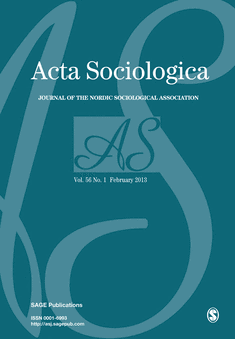
ACTA SOCIOLOGICA
Advancing Sociological Insight for a Complex WorldACTA SOCIOLOGICA, published by SAGE Publications Ltd, stands as a prominent journal in the fields of sociology and political science, holding a distinguished Q1 category ranking in the 2023 Scopus quartiles. With its inception dating back to 1956, this peer-reviewed journal offers a platform for innovative research, theoretical developments, and critical discussions that shape contemporary sociological discourse. Operating from the United Kingdom, ACTA SOCIOLOGICA reflects the dynamic interplay of social structures, political involvements, and cultural transformations, engaging scholars, practitioners, and students alike in a global context. Because it does not currently offer Open Access, readers benefit from institutional subscriptions to access cutting-edge sociology research, furthering knowledge and enlightenment within the academic community. With an impressive Scopus rank of #291 out of 1466 in the social sciences, the journal continues to influence the scholarly landscape, encouraging rigorous analysis and diverse perspectives essential for understanding the complexities of modern society.