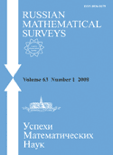
RUSSIAN MATHEMATICAL SURVEYS
metrics 2024
Connecting scholars with the latest mathematical insights.
Introduction
RUSSIAN MATHEMATICAL SURVEYS is a leading scholarly journal published by the Steklov Mathematical Institute of the Russian Academy of Sciences, dedicated to advancing the field of mathematics since its inception in 1970. With an ISSN of 0036-0279 and E-ISSN of 1468-4829, this journal publishes comprehensive surveys and research papers that span a variety of mathematical disciplines, offering insights into new theories and methodologies. Ranked in Q2 of the mathematics category and positioned at the 62nd percentile among general mathematics journals in Scopus, it serves as an essential resource for mathematicians, researchers, and students alike. While it currently does not offer open access options, its significant impact on the mathematical community is reflected in its rigorous publication standards and wide readership. The journal plays a crucial role in disseminating cutting-edge research and promoting mathematical discourse within the global academic community, making it a must-read for anyone invested in the dynamics of modern mathematics.
Metrics 2024
 0.421.401.4045
Metrics History
Rank 2024
Scopus
IF (Web Of Science)
JCI (Web Of Science)
Quartile History
Similar Journals
BULLETIN OF THE AMERICAN MATHEMATICAL SOCIETY
Fostering dialogue in the evolving landscape of mathematics.BULLETIN OF THE AMERICAN MATHEMATICAL SOCIETY is a premier peer-reviewed journal published by the American Mathematical Society, dedicated to advancing the field of mathematics since its inception in 1891. With its rigorous focus on both applied and theoretical mathematics, the journal has achieved a notable Q1 ranking in both Applied Mathematics and Mathematics (miscellaneous) categories for 2023, reinforcing its significance in the academic community. With an ISSN of 0273-0979 and an E-ISSN of 1088-9485, it serves as a vital resource for researchers and practitioners, facilitating dissemination of high-quality mathematical research and insights. Despite not offering Open Access, the journal continues to attract a wide readership, spotlighting important developments and emerging trends in the discipline. Its robust Scopus rankings—placing it in the 82nd percentile for General Mathematics and the 62nd percentile for Applied Mathematics—underscore its role as a critical avenue for scholarly communication and innovation. As the field of mathematics evolves, the BULLETIN OF THE AMERICAN MATHEMATICAL SOCIETY remains committed to fostering dialogue and disseminating significant findings that shape the future of mathematical research.
EXPERIMENTAL MATHEMATICS
Empowering Research through Experimental MethodologiesEXPERIMENTAL MATHEMATICS is a distinguished journal published by Taylor & Francis Inc, dedicated to the burgeoning field of mathematics with a special focus on experimental methodologies that illuminate mathematical theories and applications. With an ISSN of 1058-6458 and an E-ISSN of 1944-950X, this journal has been pivotal in advancing research from 1992 to 2024, achieving an impressive Q2 ranking in the Mathematics category for 2023. It serves as a vital platform for researchers and practitioners to share innovative experimental results that contribute to mathematical understanding and training. Although it operates on a subscription basis, the journal is accessible to a broad audience within the mathematical community, boasting a Scopus rank of #153 out of 399 in General Mathematics, placing it in the 61st percentile. Research published in EXPERIMENTAL MATHEMATICS not only enhances academic discourse but also fosters collaboration between theoretical and applied mathematicians, making it an essential resource for students, professionals, and researchers alike.
Missouri Journal of Mathematical Sciences
Elevating Mathematical Insights for Tomorrow's ChallengesThe Missouri Journal of Mathematical Sciences, published by the CENTRAL MISSOURI STATE UNIVERSITY, DEPARTMENT OF MATHEMATICS & COMPUTER SCIENCE, serves as an essential platform for disseminating innovative research and advancements in the field of mathematics. Since its inception in 2001, this journal has provided a space for scholars, professionals, and students to exchange ideas and present their findings, contributing to the growing body of knowledge in mathematics. Despite its current category quartile ranking of Q4 in Mathematics (miscellaneous), the journal aims to enhance its impact further, encouraging contributions that push the boundaries of mathematical sciences. Although it operates without an open-access model, it is dedicated to fostering academic discourse and making a meaningful impact through its publications. Researchers interested in exploring mathematical concepts will find this journal to be a valuable resource as it continues to evolve through the years up to 2024, aiming to attract high-quality submissions that showcase significant and practical advancements in mathematics.

Enseignement Mathematique
Empowering educators through innovative teaching methodologies.Enseignement Mathematique, published by the European Mathematical Society, is a prominent open-access journal dedicated to advancing the field of mathematics education and research. Launched in its new format as an open-access publication in 2023, this journal aims to provide a platform for researchers, educators, and practitioners to share innovative methodologies, research findings, and best practices in mathematics teaching and learning. With a commitment to enhancing the accessibility of mathematical knowledge, Enseignement Mathematique encourages contributions that explore theoretical and practical aspects of mathematics education, making it a vital resource for those involved in mathematical pedagogy. Based in Berlin, Germany, the journal fosters a global discussion on educational practices and policies, playing a key role in shaping the future of mathematics education worldwide. By embracing an open-access model, the journal aims to reach a diverse audience, ensuring that its valuable insights and research findings are freely available to all.
COMMUNICATIONS ON PURE AND APPLIED MATHEMATICS
Unveiling New Dimensions in Pure and Applied MathematicsCommunications on Pure and Applied Mathematics, published by Wiley, is a prestigious journal in the field of mathematics, recognized for its rigorous exploration of both theoretical and applied mathematical concepts. With an ISSN of 0010-3640 and an E-ISSN of 1097-0312, this journal has been a cornerstone of mathematical research since its inception in 1948 and will continue to serve the academic community until 2024. Ranked in the Q1 category for both Applied Mathematics and Miscellaneous Mathematics in 2023, it holds a commendable position among its peers, as evidenced by its Scopus rankings—#9 out of 399 for General Mathematics, placing it in the 97th percentile, and #55 out of 635 for Applied Mathematics, at the 91st percentile. The journal promotes the dissemination of high-quality research and fosters advancements in the mathematical sciences, making it an invaluable resource for researchers, professionals, and students alike, who are eager to stay at the forefront of mathematical innovation and application.

COLLOQUIUM MATHEMATICUM
Engaging minds with groundbreaking mathematical concepts.COLLOQUIUM MATHEMATICUM, published by ARS POLONA-RUCH, serves as an essential platform for the dissemination of innovative research in the field of mathematics. With an ISSN of 0010-1354 and a dedicated E-ISSN of 1730-6302, this journal plays a crucial role in advancing mathematical knowledge and fostering collaboration within the academic community. Although it is categorized in the Q3 quartile for miscellaneous mathematics, its content consistently attracts a diverse readership, reflecting a wide array of mathematical disciplines. Spanning publication years from 2001 to 2009 and resuming from 2011 to the present, *COLLOQUIUM MATHEMATICUM* offers researchers, professionals, and students the unique opportunity to engage with groundbreaking concepts and methodologies. With its home base in Warsaw, Poland, this journal not only contributes to the regional mathematical landscape but also impacts the broader global community. While currently not adopting an open access model, the journal remains committed to quality research, evidenced by its Scopus ranking within the general mathematics category. Engage with *COLLOQUIUM MATHEMATICUM* to be at the forefront of mathematical exploration.
Sao Paulo Journal of Mathematical Sciences
Exploring the frontiers of mathematical sciences with rigor.Welcome to the Sao Paulo Journal of Mathematical Sciences, a pivotal platform dedicated to advancing the field of mathematics, published by Springer International Publishing AG. Established in 2015 and running until 2024, this journal serves as a vital resource for researchers, professionals, and students interested in a plethora of mathematical topics, including computational theory, statistics, and general mathematics. While the journal holds a current Q4 quartile ranking in its categories, it provides an opportunity for contributors to disseminate innovative findings in an accessible manner. Although not an open-access publication, the journal is committed to ensuring that high-quality research is available to the academic community, fostering collaboration and growth within the discipline. Researchers seeking to publish in a dynamic and developing journal should consider the Sao Paulo Journal of Mathematical Sciences as an essential avenue for their work.
AMERICAN MATHEMATICAL MONTHLY
Advancing Pedagogy and Research in MathematicsAMERICAN MATHEMATICAL MONTHLY, published by Taylor & Francis Inc, is a prominent journal in the field of mathematics, recognized for its contribution to the dissemination of mathematical knowledge and pedagogy. With its ISSN 0002-9890 and E-ISSN 1930-0972, this journal has been a cornerstone for mathematicians since its inception, continuing to provide scholarly articles, educational materials, and insights into contemporary mathematical research. Although it follows a subscription model without Open Access options, its Q2 ranking in the Mathematics (miscellaneous) category reflects its reputable standing among peers, emphasized by its Scopus rank in the 22nd percentile. Based in the United States at 530 Walnut Street, Ste 850, Philadelphia, PA 19106, the journal spans topics that cater to both advanced researchers and aspiring students, facilitating an engaging dialogue within the mathematical community.

Publications de l Institut Mathematique-Beograd
Fostering a vibrant community of mathematical thinkers.Publications de l Institut Mathematique-Beograd is a distinguished journal in the field of mathematics, published by Publications L Institut Mathematique Matematicki in Serbia. With an ISSN of 0350-1302, it aims to disseminate high-quality research across various domains of mathematics, fostering academic discourse and innovation. Despite its open access status being unspecified, the journal is accessible to a wide audience, supporting an inclusive environment for knowledge sharing. The journal's impact is reflected in its 2023 category quartile ranking of Q3 in Mathematics (Miscellaneous), verifying its contribution to the mathematical community. With a Scopus ranking placing it in the 22nd percentile of general mathematics, it serves as a vital resource for researchers, professionals, and students eager to stay abreast of contemporary mathematical advancements. Since its convergence in 2002, and with ongoing publications continuing through 2024, this journal remains a crucial platform for sharing innovative mathematical ideas and results.

BOLETIN DE LA SOCIEDAD MATEMATICA MEXICANA
Fostering Collaboration in the World of MathematicsBOLETIN DE LA SOCIEDAD MATEMATICA MEXICANA, published by Springer International Publishing AG, is a pivotal journal in the field of mathematics, particularly recognized for its contributions to the miscellaneous mathematics category, holding a commendable Q2 ranking as of 2023. With an ISSN of 1405-213X and an E-ISSN of 2296-4495, the journal serves as a platform for disseminating high-quality research and innovations from both national and international scholars. Operating from Switzerland, the journal encompasses a broad range of topics within mathematics, supporting the development and communication of mathematical knowledge. Although it is not open access, it remains a respected source for researchers, professionals, and students seeking to deepen their understanding of mathematical concepts and applications. Published continuously and rigorously since its converged years, BOLETIN DE LA SOCIEDAD MATEMATICA MEXICANA plays a crucial role in advancing mathematical discourse and collaboration across disciplines.