
SOCIETES
Scope & Guideline
Connecting scholars to enrich the understanding of our societies.
Introduction
Aims and Scopes
- Cultural Sociology:
The journal frequently addresses themes of culture, including representations in media, art, and literature, exploring how these cultural elements shape social identities and experiences. - Impact of Technology and Media:
A consistent focus on the influence of emerging technologies, particularly artificial intelligence and digital media, on societal structures, individual behavior, and cultural practices. - Emotional and Relational Dynamics:
Research often delves into the sociology of emotions, examining how emotional experiences shape social interactions and community dynamics. - Urban Sociology and Space:
The journal explores urban environments and the social dynamics within them, including issues of public space, urban planning, and the emotional resonance of urban experiences. - Vulnerability and Social Justice:
Addressing themes of vulnerability, the journal considers the socio-political implications of social inequalities and the experiences of marginalized communities. - Interdisciplinary Approaches:
The journal encourages interdisciplinary methodologies, drawing from sociology, psychology, cultural studies, and other fields to enrich sociological discourse.
Trending and Emerging
- Artificial Intelligence and Society:
A significant increase in discussions surrounding artificial intelligence, exploring its impact on human agency, social structures, and cultural narratives, reflecting the growing relevance of AI in everyday life. - Emotional Urbanism:
Emerging research focuses on the emotional dimensions of urban experiences, examining how feelings and sensory perceptions shape interactions within urban spaces. - Vulnerability and Resilience:
Growing attention to the concepts of vulnerability and resilience, particularly in the context of crises, social inequalities, and public health, highlighting the need for sociological insights into these pressing issues. - Digital Culture and Social Dynamics:
An increasing exploration of digital culture, especially how social media and digital technologies influence identity, community building, and social interactions. - Sociology of the Imaginary:
A trend towards examining the role of imagination and representation in shaping social realities, indicating a nuanced understanding of how cultural narratives influence societal beliefs and practices.
Declining or Waning
- Traditional Sociological Theories:
There is a noticeable decrease in publications centered around classical sociological theories, indicating a possible shift towards more contemporary, applied, and interdisciplinary approaches. - Focus on Purely Quantitative Studies:
The journal has moved away from strictly quantitative sociological research, with fewer studies relying solely on statistical analysis, favoring qualitative and mixed-method approaches instead. - Historical Sociological Analysis:
Themes centered on historical sociological analysis have diminished, suggesting a trend towards more immediate and contemporary issues rather than retrospective studies. - Conventional Media Studies:
The focus on traditional media studies has waned, with a shift towards discussions on new media and its implications for society, indicating a transformation in how media is conceptualized within sociological research.
Similar Journals

LIBERTE
Nurturing Critical Voices in the Academic LandscapeLIBERTE is a distinguished academic journal that serves as a platform for critical thinking and scholarly discourse across various fields including Literature and Literary Theory, Philosophy, Sociology and Political Science, and Visual Arts and Performing Arts. Established in Canada and published by LIBERTE, this journal aims to foster intellectual exchange and explore the nuances of cultural and social narratives. Although it currently falls in the Q4 quartile across its categories, it is dedicated to advancing the conversation in the arts and humanities, providing a rich resource for researchers, educators, and students alike. With an ISSN of 0024-2020 and an active publication cycle running from 2002 to 2024, LIBERTE welcomes contributions that challenge prevailing ideologies and reflect innovative perspectives. While the journal is not open access, its value in promoting academic inquiry within its communities cannot be overstated.
BRITISH JOURNAL OF SOCIOLOGY
Illuminating contemporary social issues with peer-reviewed excellence.The British Journal of Sociology, published by Wiley, stands as a premier publication in the field of sociology, reflecting over five decades of scholarly discourse since its inception in 1965. With an impressive Q1 ranking in both Sociology and Political Science and a notable Scopus percentile of 84, it serves as a leading platform for innovative research and critical debates, drawing contributions from esteemed academics worldwide. Although it does not offer Open Access, the journal ensures that each issue is enriched with high-quality, peer-reviewed articles that advance understanding of social phenomena, making it indispensable for researchers, professionals, and students alike. The journal's mission is to foster interdisciplinary dialogue and facilitate new theoretical frameworks, thereby contributing to the evolution of sociological thought and practice. For those committed to exploring contemporary social issues, the British Journal of Sociology is an essential resource, promising to enhance your academic and professional endeavors.
REVUE FRANCAISE DE SOCIOLOGIE
Innovative Research at the Intersection of Society and PoliticsREVUE FRANCAISE DE SOCIOLOGIE, published by PRESSES SCIENCES PO, is a prominent journal dedicated to the fields of sociology and political science, characterized by its rich historical contributions since its inception in 1977. With a commitment to scholarly excellence, the journal currently holds a Q3 ranking in its category for 2023, illustrating its relevance within the academic community. This esteemed publication offers a platform for innovative research and critical discourse, catering to both established scholars and emerging voices in the social sciences. The journal seeks to explore contemporary sociological issues through rigorous empirical analysis and theoretical reflection, fostering a deeper understanding of socio-political dynamics. Although it does not offer Open Access options, REVUE FRANCAISE DE SOCIOLOGIE remains a vital resource for researchers and students alike, providing access to cutting-edge scholarship that shapes the conversation around societal structures and political frameworks.
Middle East Journal of Culture and Communication
Exploring the Tapestry of Culture and CommunicationMiddle East Journal of Culture and Communication is a vital scholarly platform published by BRILL, dedicated to fostering an understanding of cultural dynamics and communication pathways within the Middle East. Established in 2008, this journal delivers a rich array of interdisciplinary research spanning the fields of Arts and Humanities, Communication, Cultural Studies, Political Science, and Sociology. With an impact factor reflective of its commitment to high-quality scholarship, it currently ranks in various quartiles, including Q3 in Arts and Humanities (miscellaneous) and Q4 in Communication and Political Science, demonstrating its importance in the academic discourse surrounding these disciplines. The journal's open access policy ensures that critical insights and analyses are widely disseminated, catering to a global audience of researchers, professionals, and students alike. The Middle East Journal of Culture and Communication stands as an essential resource for those seeking to explore the intricate tapestry of cultural interactions in the region through rigorous academic inquiry.

Digithum
Exploring the Frontiers of Arts, Humanities, and Social Sciences.Digithum is an esteemed open access journal published by Universitat Oberta de Catalunya since 1999, dedicated to fostering interdisciplinary discourse within the realms of Arts and Humanities as well as Social Sciences. With an ISSN of 1575-2275, this journal provides a platform that bridges academic inquiry and contemporary societal issues, earning recognition with a Q3 ranking in Arts and Humanities and a Q4 ranking in Social Sciences as of 2023. Based in Barcelona, Spain, Digithum is indexed in key databases and holds a prestigious position in Scopus rankings, particularly noted for its impact in the arts and humanities with a 76th percentile standing. The journal promotes unrestricted access to its articles, ensuring that valuable research reaches a broad audience, thus empowering scholars, practitioners, and students to engage deeply with the challenges and narratives of our time. With the evolving landscape of academic research, Digithum remains a vital resource for those seeking to explore the intersections of culture, technology, and society.
Nordic Journal of Religion and Society
Unveiling the Dynamics of Belief and Community Across the NordicsThe Nordic Journal of Religion and Society is a leading academic journal dedicated to the interdisciplinary study of religion within societal contexts, published by Scandinavian University Press - Universitetsforlaget AS. With its ISSN 0809-7291 and E-ISSN 1890-7008, this journal proudly occupies a significant position in the field, reflected by its Q2 ranking in Religious Studies (2023) and a commendable Scopus percentile of 77, ranking 147 out of 644 in its category. The Nordic Journal of Religion and Society aims to publish high-quality, original research that explores how religious beliefs and practices intersect with societal transformations across the Nordic context. The journal emphasizes the importance of diverse methodological approaches and theoretical frameworks, fostering scholarly dialogue that enhances understanding of contemporary socio-religious phenomena. Though it operates under a subscription model, the journal’s commitment to academic excellence makes it an essential resource for researchers, professionals, and students keen on advancing knowledge within this dynamic and evolving field.
ADMINISTRATIVE SCIENCE QUARTERLY
Leading the Way in Administrative Science DiscourseADMINISTRATIVE SCIENCE QUARTERLY, published by SAGE Publications Inc, is a prestigious journal in the fields of Public Administration, Sociology, Political Science, and Arts and Humanities. Established in 1975, this quarterly journal has maintained a reputation for excellence, as reflected in its 2023 Q1 category rankings, where it stands at the forefront of associated disciplines, holding the 1st rank in Arts and Humanities (miscellaneous), Public Administration, and 2nd in Sociology and Political Science. With an impressive Scopus ranking, particularly a 99th percentile in both Sociology and Public Administration, the journal serves as an essential platform for researchers and practitioners looking to advance theoretical and practical knowledge in administrative science. Although not open access, the journal provides exclusive access to a wealth of high-impact research, making it an invaluable resource for those in academia and beyond. The journal's commitment to scholarly rigor and its extensive coverage from 1975 to 2024 underscore its significance in shaping contemporary discourse and policy in the administrative domain.
THEORY AND SOCIETY
Advancing Interdisciplinary Dialogue for a Better Tomorrow.THEORY AND SOCIETY is a prestigious academic journal published by Springer that has been at the forefront of interdisciplinary dialogue in the fields of History, Sociology, and Political Science since its inception in 1974. With an impressive impact factor and categorized in the top quartile (Q1) of both History and Sociology & Political Science for 2023, it occupies a distinguished position within the academic community, evidenced by its high rankings in Scopus—ranked 5 out of 1,760 in History (99th percentile) and 110 out of 1,466 in Sociology and Political Science (92nd percentile). The journal serves as a vital platform for scholars to explore rigorous theoretical frameworks and their implications for contemporary societal issues, ensuring comprehensive access to quality research without the constraints of open access. Located in Dordrecht, Netherlands, THEORY AND SOCIETY continues to provide critical insights and foster discussions that shape and redefine our understanding of theoretical approaches to social phenomena.
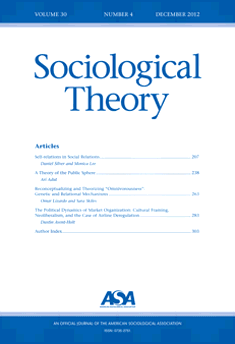
SOCIOLOGICAL THEORY
Challenging paradigms to redefine the landscape of sociology.Sociological Theory, published by SAGE Publications Inc, is a premier journal dedicated to advancing the field of sociology through innovative theoretical approaches and empirical research. With an impressive impact factor and recognized as a Q1 journal in both Sociology and Political Science, it ranks 86 out of 1466 in its category, placing it in the 94th percentile according to Scopus metrics. This journal seeks to foster rigorous debate and insight on contemporary sociological issues, welcoming contributions that challenge existing paradigms and offer new perspectives. Founded in 1996, Sociological Theory continues to push the boundaries of sociological inquiry through its commitment to quality and relevance, making it an essential resource for researchers, professionals, and students alike. Based in the United Kingdom, this journal is not an open-access publication, but it remains widely accessible through institutional subscriptions, ensuring that its valuable content reaches a global audience interested in the dynamics of social life.

Social Analysis
Connecting Ideas, Cultures, and DisciplinesSocial Analysis, an esteemed academic journal published by BERGHAHN JOURNALS, is at the forefront of interdisciplinary research, focusing on the dynamic intersections of anthropology, cultural studies, sociology, and the arts and humanities. Since its inception in 2002 and having transitioned to an Open Access model in 2020, the journal ensures that critical social research is widely accessible to scholars and the public alike. With an impressive Q1 ranking in Anthropology and cultural studies and holding a notable Q2 in Sociology and Political Science, it garners attention from a large academic audience, as evidenced by its high Scopus rankings: 10th in general arts and humanities and 153rd in cultural studies. This signifies its influential role in shaping contemporary discourse and providing a platform for innovative ideas and methodologies in understanding social phenomena. Based in Brooklyn, NY, the journal is dedicated to fostering scholarly dialogue and advancing the field, making it an essential resource for researchers, professionals, and students eager to engage with and contribute to the field of social analysis.