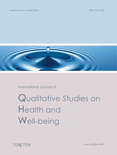
International Journal of Qualitative Studies on Health and Well-Being
Scope & Guideline
Unlocking the narratives of health and well-being.
Introduction
Aims and Scopes
- Qualitative Research Methodologies:
The journal emphasizes diverse qualitative methodologies such as phenomenology, grounded theory, ethnography, and narrative inquiry, allowing for rich, context-sensitive explorations of health and well-being. - Focus on Lived Experiences:
A core aim is to capture and analyze the lived experiences of individuals regarding various health issues, including chronic illness, mental health, caregiving, and health interventions, thereby giving voice to underrepresented populations. - Interdisciplinary Approaches:
The journal promotes interdisciplinary research that intersects health, psychology, sociology, and education, fostering a comprehensive understanding of health-related challenges and solutions. - User-Centered Perspectives:
Research published in the journal often centers around user experiences, aiming to inform health policy and practice by integrating the perspectives of patients, caregivers, and healthcare professionals. - Cultural and Contextual Sensitivity:
The journal values research that takes into account cultural, social, and environmental contexts, recognizing the diversity of experiences and understanding of health across different populations.
Trending and Emerging
- Mental Health and Well-Being:
There is an increasing focus on mental health, particularly in relation to the impacts of the COVID-19 pandemic, emphasizing the need to explore the subjective experiences of individuals facing mental health challenges. - Experiences of Vulnerable Populations:
Emerging themes include the lived experiences of vulnerable populations, such as refugees, individuals with disabilities, and marginalized communities, highlighting the importance of inclusive research that addresses social determinants of health. - Technology in Health Care:
Research exploring the role of technology in health care, including telehealth, eHealth, and mobile health applications, is gaining traction, reflecting the integration of digital tools in health management and patient support. - Intersectionality in Health Research:
There is a noticeable trend towards applying intersectional frameworks in health research, examining how overlapping identities (e.g., gender, race, socioeconomic status) influence health experiences and outcomes. - Narrative and Storytelling Approaches:
An increase in the use of narrative and storytelling methodologies is evident, with researchers emphasizing the power of personal stories in understanding health journeys and fostering empathy in health care.
Declining or Waning
- Traditional Clinical Perspectives:
There has been a noticeable decrease in studies focusing solely on traditional clinical perspectives without incorporating patient narratives or qualitative insights, indicating a shift towards more holistic and patient-centered research. - Generalized Health Interventions:
The journal appears to be publishing fewer studies that describe generalized health interventions without specific qualitative insights or contextual analysis, as the focus moves towards understanding the nuances of individual experiences. - Homogeneous Populations:
Research involving homogeneous populations, such as studies limited to specific demographic groups without consideration of intersectionality, is becoming less frequent, reflecting a broader trend towards inclusivity and diversity in research. - Mechanistic Explanations:
There seems to be a waning interest in studies that prioritize mechanistic explanations of health conditions over qualitative explorations of personal and social factors influencing health and well-being. - Single-Dimensional Outcomes:
Research focusing on single-dimensional outcomes, such as purely physical health metrics, is declining in favor of studies examining multifaceted aspects of well-being, including emotional, social, and psychological dimensions.
Similar Journals

Australian Community Psychologist
Fostering collaboration for impactful community interventions.The Australian Community Psychologist, published by the Australian Psychological Society, is a premier journal focused on the diverse field of community psychology in Australia and beyond. With the ISSN 1835-7393, this journal aims to bridge research, practice, and theory, providing a platform for scholars and practitioners to share innovative ideas and practices in community mental health. Although it currently does not offer Open Access options, its high standard of peer-reviewed articles ensures that only quality research is disseminated, contributing significantly to the body of knowledge within psychology and social science. The journal engages with pressing social issues, advocating for evidence-based interventions that promote community well-being and social justice. As an essential resource for researchers, professionals, and students alike, The Australian Community Psychologist fosters collaboration and dialogue among individuals dedicated to advancing community psychological principles.
Asian Nursing Research
Transforming healthcare through evidence-based nursing research.Asian Nursing Research is a prestigious open access journal published by ELSEVIER SCIENCE INC, located in South Korea. Since its inception in 2007, this journal has served as an essential platform for disseminating high-quality research in the field of nursing and healthcare, boasting a notable impact factor and categorized within the top quartiles of both Q1 in Nursing (miscellaneous) and Q2 in Medicine (miscellaneous) for 2023. It holds a commendable rank of #27 out of 139 in the general nursing category, placing it in the 80th percentile according to Scopus rankings. The journal's comprehensive scope encompasses a wide range of topics relevant to nursing practice and research, thereby addressing pressing healthcare challenges and promoting evidence-based clinical practices. By offering open access since 2007, Asian Nursing Research ensures that researchers, professionals, and students have unrestricted access to valuable insights and advancements in the nursing discipline, making it a critical resource for advancing knowledge and improving patient care across Asia and beyond.

Salmand-Iranian Journal of Ageing
Pioneering insights into gerontology and geriatrics.Salmand-Iranian Journal of Ageing is a pioneering open-access publication dedicated to advancing the knowledge and understanding of ageing and geriatric health. Launched in 2006 by NEGAH INST SCIENTIFIC COMMUNICATION, this journal serves as a vital resource for researchers, professionals, and students within the fields of Geriatrics and Gerontology. Published in Iran, it aims to provide a platform for disseminating innovative research and clinical findings pertaining to ageing, with a commitment to accessibility and scholarly excellence. The journal holds recognition in its category with a Q4 designation in Aging and a Q3 classification in Geriatrics and Gerontology (2023), indicating its growing influence in academic circles. Despite a current H-index designation of '-', the journal's impact within its scope continues to develop. As it converges research efforts from 2018 to 2024, it seeks to address the pressing challenges faced by the ageing population. With no cost barriers for readers, the Salmand-Iranian Journal of Ageing remains an essential tool for fostering dialogue and collaboration in the quest for improved senior health outcomes.
HEALTH EXPECTATIONS
Connecting research to real-world health improvements.HEALTH EXPECTATIONS is a reputable academic journal published by Wiley, focusing on critical developments and research in the fields of public health and health policy. Established in 1999, the journal has gained significant recognition in its discipline, reflected by its impressive Q1 quartile ranking in the 2023 public health category, along with a Scopus rank of 178 out of 665, positioning it in the 73rd percentile. The journal has embraced open access since 2016, ensuring that its valuable content is readily available to researchers, professionals, and students worldwide. HEALTH EXPECTATIONS aims to publish high-quality research that informs health expectations and outcomes, addressing emerging trends and challenges in healthcare systems. By fostering a greater understanding of health literacy and patient engagement, it contributes to the ongoing discourse in health improvement and policy formulation. Its commitment to accessibility and scholarly rigor makes HEALTH EXPECTATIONS an essential resource for anyone invested in advancing public health knowledge.
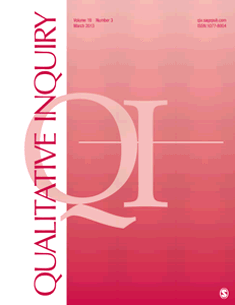
QUALITATIVE INQUIRY
Advancing Knowledge Through Qualitative InsightsQUALITATIVE INQUIRY is a leading academic journal published by SAGE Publications Inc, dedicated to advancing the field of qualitative research within the domains of Anthropology and Social Sciences. With an impressive Q1 ranking in both categories for 2023, the journal holds a prominent position in the academic community, recognized for its high-quality contributions and influential research. The journal, available in print with the ISSN 1077-8004 and electronically with the E-ISSN 1552-7565, showcases innovative methodologies and critical analyses that deepen our understanding of social phenomena. Researchers, professionals, and students will find a wealth of knowledge as the journal publishes insightful studies that push the boundaries of qualitative inquiry. Situated in the vibrant academic landscape of the United States and operating from its headquarters in Thousand Oaks, CA, QUALITATIVE INQUIRY plays a crucial role in shaping discussions and fostering new perspectives in the social sciences, underscoring its importance in the scholarly community.
HEALTH PSYCHOLOGY
Pioneering Research at the Intersection of Mind and HealthHEALTH PSYCHOLOGY, published by the American Psychological Association, is a premier academic journal dedicated to advancing the understanding of the psychological aspects of health and illness. With an ISSN of 0278-6133 and an E-ISSN of 1930-7810, this journal has earned its reputation as a leader in the field, boasting a 2023 Q2 ranking in Applied Psychology and Q1 rankings in both Medicine (miscellaneous) and Psychiatry and Mental Health. Spanning from 1984 to 2024, HEALTH PSYCHOLOGY serves as a vital resource for researchers, professionals, and students interested in the intersection of behavior and health outcomes. Although not an open-access journal, it offers a wealth of cutting-edge research, reviews, and practical applications aimed at improving psychological well-being and advancing healthcare practices. The journal's significant contributions make it an essential publication for anyone involved in health psychology and related disciplines.

SSM-Qualitative Research in Health
Advancing qualitative insights in health and social sciences.SSM-Qualitative Research in Health, published by Elsevier, is an innovative open-access journal dedicated to advancing the field of qualitative research within health and social sciences. With an ISSN of 2667-3215 and an E-ISSN of the same number, this journal has quickly established itself since its inception in 2021, achieving a commendable Q2 ranking in Health (Social Science) and a Q1 ranking in Social Sciences (Miscellaneous) by 2023. Located in the United Kingdom with its publishing office in Amsterdam, the journal aims to provide a platform for researchers, professionals, and students to explore and publish impactful qualitative studies that address the complexities of health issues through rich narrative and contextual understanding. With a focus on fostering interdisciplinary dialogue and innovation, SSM-Qualitative Research in Health is positioned as an essential resource for those seeking to deepen their insights and contribute meaningfully to the conversation surrounding health and social science research.
Empirical Studies of the Arts
Fostering Insightful Discourse in the Empirical Study of the ArtsEmpirical Studies of the Arts is a prominent academic journal published by SAGE Publications Inc, specializing in the interdisciplinary fields of Literature, Music, and Visual Arts and Performing Arts. With an impressive Q1 ranking in multiple categories for 2023, this journal serves as a crucial platform for scholars, researchers, and practitioners engaged in the empirical exploration of arts and their influence on society. Established to foster rigorous inquiry, the journal features peer-reviewed articles that delve into both qualitative and quantitative research methodologies. This commitment to maintaining a high academic standard is evident in its Scopus rankings, which place it in the 99th percentile in Literature, 96th percentile in Visual Arts, and 92nd percentile in Music, making it a vital resource for those seeking to enrich their understanding of arts-related phenomena. While the journal does not currently offer open access options, it remains dedicated to advancing knowledge through comprehensive research, contributing significantly to the ongoing discourse in the arts.

Departures in Critical Qualitative Research
Exploring the Depths of Qualitative InquiryDepartures in Critical Qualitative Research, published by University of California Press, is an influential journal dedicated to advancing knowledge within the realms of Communication and Linguistics and Language. With its commitment to exploring the complexities and nuances of qualitative research, this journal has quickly established itself as a vital resource for scholars and professionals alike. Although it currently resides in the fourth quartile in Communication and the third quartile in Linguistics, its notable Scopus rankings, including a 64th percentile in Language and Linguistics, highlight its growing significance in the academic discourse. Covering a converged period from 2019 until 2024, the journal seeks to foster innovative and critical perspectives on qualitative methodologies, offering invaluable insights that address contemporary social issues. Access to its content is available to a wide audience, contributing to the journal's reputation as a beacon for those engaged in critical qualitative research.
KONTAKT-JOURNAL OF NURSING AND SOCIAL SCIENCES RELATED TO HEALTH AND ILLNESS
Advancing interdisciplinary insights in health and illness.KONTAKT - JOURNAL OF NURSING AND SOCIAL SCIENCES RELATED TO HEALTH AND ILLNESS is a pioneering peer-reviewed open-access journal, published by the Faculty of Health and Social Sciences at the University of South Bohemia, Ceske Budejovice, Czech Republic. Since its inception in 2014, the journal has been dedicated to advancing knowledge in the fields of nursing and social sciences as they relate to health and illness, fostering interdisciplinary collaboration and innovative research. With a current impact factor that positions it within the Q4 category across diverse health-related fields like Nursing and Public Administration, it serves as a valued resource for researchers, practitioners, and students alike. The journal’s commitment to open access ensures that high-quality research is accessible to a global audience, enhancing its relevance and impact within the academic community. Researchers are encouraged to contribute their findings to address pressing health issues and contribute to the ongoing dialogue in this vital area of study. For more information, please visit the journal's website or reach out to the editorial team directly at their address: J Boreckeho 27, Ceske Budejovice, Czech Republic.