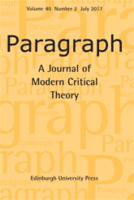
PARAGRAPH
Scope & Guideline
Illuminating Insights in Literature and Visual Arts.
Introduction
Aims and Scopes
- Interdisciplinary Critical Theory:
The journal actively promotes research that draws from various disciplines, including philosophy, psychoanalysis, and cultural studies, to examine the underlying theoretical frameworks that shape our understanding of literature and art. - Exploration of Identity and Subjectivity:
A consistent focus on themes related to identity, gender, and subjectivity is evident, often engaging with feminist, queer, and posthumanist perspectives to challenge traditional notions of the self. - Cultural and Historical Contextualization:
The journal emphasizes the importance of contextualizing literary and artistic works within their cultural and historical frameworks, thereby enhancing the understanding of their significance and impact. - Engagement with Contemporary Issues:
Research published in "PARAGRAPH" frequently addresses contemporary social, political, and technological issues, reflecting the journal's commitment to engaging with the challenges of modern society. - Innovative Methodologies:
The journal encourages the use of innovative methodologies, including psychoanalytic, deconstructive, and phenomenological approaches, to deepen the analysis of texts and cultural phenomena.
Trending and Emerging
- Digital Culture and Technology:
There is a growing interest in the implications of digital culture and technology on identity and society, as evidenced by discussions around virtual realities, digital apparitions, and the impact of AI on human experience. - Intersectionality and Inclusivity:
Emerging themes increasingly focus on intersectionality, addressing how various identities interact and shape experiences, particularly in relation to gender, race, and class. - Embodiment and Corporeality:
Research exploring the concepts of embodiment and corporeality is on the rise, indicating a renewed interest in how physicality and sensation inform identity and artistic expression. - Critical Engagement with Contemporary Politics:
The journal is increasingly publishing works that critically engage with contemporary political issues, including academic freedom, cultural wars, and the role of art in social critique. - Posthumanism and Nonhuman Perspectives:
An emerging focus on posthumanism and nonhuman perspectives reflects a shift towards understanding the interconnectedness of human and nonhuman entities, challenging anthropocentric views in literature and theory.
Declining or Waning
- Traditional Literary Criticism:
There is a noticeable decrease in articles that employ traditional literary criticism methods, suggesting a movement away from conventional analyses towards more experimental and interdisciplinary approaches. - Historical Literary Studies:
Themes centered around historical literary studies seem to be waning, as the journal increasingly prioritizes contemporary relevance and theoretical innovation over historical context. - Fixed Gender Norms:
Discussions that rely on binary or fixed notions of gender appear less frequently, indicating a possible shift towards more fluid and intersectional understandings of gender identity. - Psychoanalytic Approaches:
While psychoanalysis has been a staple in literary theory, its prominence seems to be declining in favor of other theoretical frameworks, such as posthumanism and digital theory. - Static Notions of Art and Aesthetics:
The journal appears to be moving away from static definitions of art and aesthetics, focusing instead on dynamic interactions between culture, technology, and subjectivity.
Similar Journals
WORD & IMAGE
Bridging Disciplines: Where Words Meet ImagesWORD & IMAGE is a distinguished journal published by Routledge Journals, Taylor & Francis Ltd, focusing on the dynamic interplay between visual and verbal communication. Established in 1985, this esteemed journal covers a wide array of topics within linguistics, literature, and visual arts, contributing significantly to these interdisciplinary fields. With a commitment to fostering scholarly dialogue and innovation, WORD & IMAGE presents qualitative research, critical analyses, and theoretical explorations that illuminate the complex relationships between text and image. The journal's current impact factor reflects its role in nurturing academic discourse, making it a vital resource for researchers, professionals, and students alike. Although currently not open access, the journal maintains a rigorous peer-review process to ensure the highest academic standards. As it continues to engage a global audience, WORD & IMAGE serves as a key platform for advancing knowledge at the intersection of language and visual culture.
GERMAN QUARTERLY
Connecting Scholars Through German Literary DiscourseGERMAN QUARTERLY, published by Wiley, is a distinguished academic journal that serves as a vital platform for scholarly discourse in the fields of Cultural Studies, Literature and Literary Theory, and Visual Arts and Performing Arts. With an ISSN of 0016-8831 and an E-ISSN of 1756-1183, this journal is committed to exploring the complexities of German literature and culture from a multi-faceted perspective. It stands out in its categories, ranking Q3 in Cultural Studies and Q2 in both Literature and Literary Theory and Visual Arts and Performing Arts, as of 2023. Its Scopus ranking highlights its relevance and contribution to ongoing dialogues within the arts and humanities, making it an essential read for researchers and professionals alike. Although not an open-access journal, GERMAN QUARTERLY maintains a rigorous peer-review process, ensuring that published works meet the highest standards of academic quality. With converged contributions from 2002 to 2024, it continues to provide valuable insights and foster a deeper understanding of German heritage and its impact on contemporary culture. The journal is an indispensable resource for students and researchers seeking to broaden their knowledge and engage with the latest scholarship in these vital areas of study.
OCTOBER
Challenging Boundaries, Inspiring DialogueOCTOBER is a seminal journal published by MIT PRESS that spans a diverse array of interdisciplinary themes within the humanities, specifically focusing on literature and literary theory, music, and the visual arts and performing arts. Established in 2002, this journal has become a cornerstone for scholars and practitioners seeking critical discourse and innovative research across its converged fields, maintaining a respectable impact factor that attests to its influence in academic circles. While OCTOBER currently does not offer open access, it provides valuable insights and analysis that drive contemporary thought and discussion, positioned in the Q2 and Q3 quartiles of Scopus rankings. The journal’s commitment to high-quality scholarship makes it an essential resource for those looking to deepen their understanding of cultural and artistic practices, reflecting the evolving landscape of the arts and humanities from a rigorously theoretical perspective.
Journal of Victorian Culture
Advancing Interdisciplinary Insights into Victorian LifeThe Journal of Victorian Culture, published by Oxford University Press, is an esteemed academic journal that explores the multifaceted cultural landscape of the Victorian era. With a publication history spanning from 1996 to 2024, this journal serves as a critical platform for scholars and practitioners in the fields of Cultural Studies, History, Literature and Literary Theory, and Visual Arts and Performing Arts. It currently holds notable rankings, including Q3 in Cultural Studies and History, and Q2 in Literature, making it a prominent resource in these disciplines. Targeted at an audience that includes dedicated researchers, professionals, and students, the journal promotes interdisciplinary exploration and innovation, encouraging contributors to engage deeply with Victorian themes and their influence on contemporary culture. For those interested in cutting-edge discussions and insights, the Journal of Victorian Culture provides access to rich, scholarly content that is indispensable for understanding the era's impact on modern artistic and social paradigms.

Co-herencia
Advancing interdisciplinary dialogue in arts and humanities.Co-herencia, an esteemed academic journal published by UNIV EAFIT, is dedicated to advancing the fields of History, Literature and Literary Theory, Music, Philosophy, as well as the Visual Arts and Performing Arts. Since its launch as an Open Access journal in 2004, it has provided a platform for innovative research and interdisciplinary dialogue, facilitating the dissemination of knowledge from its base in Medellín, Colombia. With a commendable range of Scopus rankings, including a Q2 category in Literature and Literary Theory and Visual Arts and Performing Arts, Co-herencia is recognized as a vital resource for scholars aiming to explore cultural narratives and theoretical frameworks. It not only enriches academic discourse but also serves as a significant conduit for emerging ideas that connect art, culture, and social consciousness. Researchers, professionals, and students alike will find Co-herencia a necessary addition to their scholarly pursuits, emphasizing its critical role in the evolving landscape of the arts and humanities.
Explorations in Renaissance Culture
Bridging Disciplines in Renaissance StudiesExplorations in Renaissance Culture, published by BRILL, is a pivotal academic journal that delves into the multifaceted aspects of Renaissance studies, encompassing Cultural Studies, History, Literature and Literary Theory, Music, Philosophy, and the Visual Arts. Established in 1976 and operating without an open access model, the journal has evolved as a critical platform for scholars and enthusiasts alike, providing rigorous analysis and innovative perspectives on the cultural currents of the Renaissance era. With an ISSN of 0098-2474 and an E-ISSN of 2352-6963, it has garnered a respectable standing among academic peers, evidenced by its quartile ranking in the Q4 category across multiple fields as of 2023 and its Scopus rankings, which acknowledge its role within the broader arts and humanities disciplines. Based in the Netherlands, the journal plays a vital role in fostering scholarly dialogue and advancing research, making it an essential resource for researchers, professionals, and students committed to expanding their understanding of this transformative period in history.

REVISTA DE OCCIDENTE
Fostering Critical Dialogue Across Disciplines.REVISTA DE OCCIDENTE, published by the FUNDACION JOSE ORTEGA Y GASSET, is a distinguished scholarly journal based in Spain that explores a myriad of topics within the realms of Cultural Studies, History, Literature and Literary Theory, and Visual Arts and Performing Arts. With its ISSN 0034-8635, the journal has made significant contributions to the discourse in these fields from its established years of convergence spanning from 2002 to 2004 and 2007 to the present. Although designated in the lower quartiles of the Scopus rankings, with notable distinctions in Q4 and Q3 categories as of 2023, REVISTA DE OCCIDENTE is recognized for its commitment to fostering critical dialogue and interdisciplinary research. Readers can delve into rich analyses and diverse perspectives that engage with contemporary cultural phenomena and historical narratives, aiming to enrich academic pursuits and professional practice. Located at REVISTA DE OCCIDENTE, FORTUNY 53, 28010 MADRID, SPAIN, the journal seeks submissions from scholars worldwide eager to contribute to its mission, despite operating under a traditional access model, thus ensuring content rigor and quality.
REVIEW-LITERATURE AND ARTS OF THE AMERICAS
Exploring the Cultural Tapestry of the Americas.REVIEW-LITERATURE AND ARTS OF THE AMERICAS, published by Routledge Journals, Taylor & Francis Ltd, serves as a vital platform for the exploration of literary and artistic expressions across the Americas. With an ISSN of 0890-5762 and an E-ISSN of 1743-0666, this journal has been dedicated to fostering scholarly discussion since its inception in 1968, addressing interdisciplinary themes that span literature, visual arts, and performing arts. Despite its current Q4 rankings in both Literature and Literary Theory as well as Visual Arts and Performing Arts, the journal remains committed to elevating critical discourse and offering a nurturing environment for emerging voices in the field. Access to the journal is through subscription, highlighting its focused audience of researchers, professionals, and students who seek to deepen their understanding of the cultural dynamics of the Americas. By engaging with diverse scholarly perspectives, REVIEW-LITERATURE AND ARTS OF THE AMERICAS aims to contribute to the ongoing dialogue about the significance of art and literature in societal contexts, making it an important resource for anyone interested in this rich and vibrant area of study.
South Central Review
Navigating the Complexities of Southern NarrativesSouth Central Review, a distinguished academic journal published by Johns Hopkins University Press, serves as a vital platform for scholarly discourse in the fields of cultural studies, literature and literary theory, philosophy, and the visual and performing arts. With an ISSN of 0743-6831 and an E-ISSN of 1549-3377, this journal is dedicated to highlighting innovative research and critical analyses that explore the complexities of Southern culture and its broader implications. Although it operates without an open access option, the journal is recognized for its rigorous peer-review process and contributions to contemporary academic dialogue, holding Q3 and Q4 rankings across several disciplines as of 2023. The convergence of ideas and perspectives from diverse academic backgrounds positions the South Central Review as an essential resource for researchers, professionals, and students seeking to deepen their understanding of the cultural narratives shaping our world today.
POSTMODERN CULTURE
Exploring the Depths of Contemporary CulturePOSTMODERN CULTURE, published by Johns Hopkins University Press, is a pivotal journal in the fields of Cultural Studies, Literature and Literary Theory, and the Visual Arts and Performing Arts. With a focus on the nuances of postmodern theory and its interdisciplinary applications, the journal has established itself as an essential resource for researchers and scholars seeking to explore contemporary cultural phenomena through innovative critical lenses. Compiling works from 2002 to 2023, it is indexed with notable rankings, including Q2 in Literature and Literary Theory and Q3 in Cultural Studies, reflecting its significant contribution to persistent academic discourse. While not open access, the journal ensures that access to groundbreaking research is available to libraries and institutions, reinforcing its importance in the scholarly community. POSTMODERN CULTURE serves not only as a repository of academic inquiry but also as a catalyst for new ideas, stimulating dialogue among professionals and students alike in understanding the complexities of today's cultural landscape.