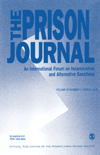
PRISON JOURNAL
Scope & Guideline
Navigating the Intersection of Justice and Society
Introduction
Aims and Scopes
- Interdisciplinary Research on Incarceration:
The journal publishes studies that utilize various disciplines, including sociology, psychology, criminology, and public health, to explore the intricacies of prison life and the experiences of incarcerated individuals. - Focus on Rehabilitation and Reintegration:
A significant emphasis is placed on rehabilitation programs and reintegration strategies for incarcerated individuals, examining their effectiveness and challenges faced during the transition back to society. - Impact of Family and Social Relationships:
Research often highlights the role of familial relationships and social networks in the lives of incarcerated individuals, discussing how these dynamics influence mental health, recidivism, and overall well-being. - Mental Health and Emotional Well-Being:
The journal frequently addresses mental health issues within the prison population, exploring the prevalence of mental disorders and the effects of imprisonment on psychological well-being. - Innovative Interventions and Program Evaluations:
There is a strong focus on evaluating innovative interventions within prison settings, including therapeutic programs, educational initiatives, and artistic endeavors aimed at improving inmate outcomes. - Policy Analysis and Criminal Justice Reform:
The journal contributes to discussions around policy, advocating for evidence-based reforms in the criminal justice system, including critiques of existing practices and suggestions for improvement.
Trending and Emerging
- Impact of COVID-19 on Prisons:
Recent publications have increasingly explored the ramifications of the COVID-19 pandemic on prison operations, health outcomes, and inmate experiences, highlighting the need for adaptive policies in crisis situations. - Intersectionality in Incarceration:
There is a growing trend towards examining the intersectionality of gender, race, and socio-economic status within the prison system, reflecting a deeper understanding of how these factors shape the experiences of incarcerated individuals. - Mental Health and Trauma Informed Care:
An emerging focus on trauma-informed care and mental health support for incarcerated individuals has gained prominence, with research investigating effective strategies for addressing psychological needs within correctional settings. - Family Engagement and Support Systems:
Research on family engagement policies and the role of social support in reducing recidivism has become more prevalent, emphasizing the importance of maintaining family connections during incarceration. - Innovative Rehabilitation Programs:
There is a notable increase in studies evaluating innovative rehabilitation programs, including arts-based interventions and therapeutic community models, as effective means of facilitating inmate rehabilitation and reducing recidivism.
Declining or Waning
- Traditional Punitive Approaches to Incarceration:
There appears to be a reduced emphasis on studies endorsing traditional punitive measures, as the journal increasingly favors research advocating for rehabilitation and restorative justice. - General Studies on Inmate Misconduct:
Research specifically focused on inmate misconduct without a rehabilitative context has declined, as newer studies prioritize understanding the underlying causes and implementing preventative measures. - Overly Broad Analyses of Crime Rates:
The journal has shifted away from broad analyses of crime rates in favor of more nuanced examinations that consider individual experiences and systemic factors influencing incarceration. - Static Views of Prison Culture:
There is a noticeable decrease in articles depicting a static view of prison culture. Instead, the focus has moved towards dynamic analyses that consider changes in culture and the impact of external societal factors.
Similar Journals
South African Crime Quarterly-SACQ
Connecting researchers and policymakers for impactful dialogue.South African Crime Quarterly (SACQ) is an esteemed open-access journal dedicated to the comprehensive examination of crime and justice issues in South Africa. Published by the Institute for Security Studies, SACQ aims to provide a platform for researchers, practitioners, and policymakers to disseminate innovative research, case studies, and theoretical discussions that address the complexities of crime in the region. Since its transition to open access in 2015, the journal has fostered a wider dissemination of knowledge, promoting accessibility for students and professionals alike. With an ISSN of 1991-3877, SACQ stands out as an essential resource, driving informed dialogue and enhancing the understanding of security challenges in South Africa. The journal encourages submissions that contribute to evidence-based practices and policies, making it a vital tool for those committed to addressing crime and improving safety within communities.
Criminal Behaviour and Mental Health
Shedding Light on the Shadows of Criminal BehaviorCriminal Behaviour and Mental Health, published by WILEY, is a pivotal journal that investigates the intricate relationships between criminal behavior and psychological health. With its ISSN 0957-9664 and E-ISSN 1471-2857, this journal serves as a vital resource for researchers and professionals in the fields of forensic psychology, psychiatry, and pathology. As a recognized publication in the Q3 category across multiple disciplines, including Medicine, Psychiatry, and Psychology as of 2023, it provides an essential platform for disseminating cutting-edge research and discussions pertinent to the intersection of criminality and mental health. Although currently not available as Open Access, the journal remains an influential part of the global academic landscape with a commitment to advancing understanding in this critical area. Its historical span from 1992 to 2024 signifies a long-standing dedication to exploring the complexities of mental health in the context of criminal behavior, making it an invaluable tool for students, practitioners, and researchers alike.

LEGAL AND CRIMINOLOGICAL PSYCHOLOGY
Shaping the Future of Criminological Understanding.LEGAL AND CRIMINOLOGICAL PSYCHOLOGY, published by WILEY, serves as a cornerstone in the interdisciplinary fields of criminal justice and psychological research. With an ISSN of 1355-3259 and an E-ISSN of 2044-8333, this journal has maintained a strong presence in academic discourse since its inception in 1996 and continues to publish vital research through 2024. Renowned for its rigorous approach, it ranks in the Q1 category for Pathology and Forensic Medicine and Q2 in Applied Psychology as of 2023, illustrating its pivotal role in advancing knowledge within these crucial areas. Researchers and practitioners benefit from the latest insights into the psychological facets of legal processes, with a Scopus rank that positions it among the top journals in both applied psychology (Rank #112/249) and pathology (Rank #71/208). The journal acts as an indispensable resource for those interested in the integration of psychological principles within legal frameworks, making it essential reading for academics, professionals, and students aiming to deepen their understanding of criminological psychology.

Justice Evaluation Journal
Pioneering research in legal evaluation.Welcome to the Justice Evaluation Journal, a leading publication in the field of law, published by Taylor & Francis Ltd, renowned for its commitment to advancing scholarly discourse. With an ISSN of 2475-1979 and an E-ISSN of 2475-1987, this journal has established itself as a pivotal resource for researchers, practitioners, and students from its inception in 2018 through to its ongoing contributions in 2024. Achieving a prestigious Q1 ranking in the law category, and earning a remarkable 90th percentile rank in Scopus, the journal is dedicated to evaluating and disseminating critical insights on justice systems and reform. Although not an open-access journal, it continues to foster deep scholarly engagement through a rigorous peer-review process. The Justice Evaluation Journal serves as an essential platform for those committed to improving the effectiveness and fairness of legal institutions worldwide, making it indispensable in your academic and professional journey.

Women & Criminal Justice
Bridging Gender Studies and Legal ResearchWomen & Criminal Justice, published by Routledge Journals, Taylor & Francis Ltd, stands as a prominent platform for scholarly discourse in the intertwined realms of gender studies and legal research. Since its inception in 1989, this journal has been pivotal in addressing the unique challenges and perspectives of women within the criminal justice system, making substantial contributions to the field. With a commendable impact factor reflected in its Q1 ranking in Law and Q2 ranking in Gender Studies, it offers both researchers and practitioners rigorous and insightful analyses. The journal covers a wide spectrum of topics, aligning contemporary issues with legal frameworks, while advocating for a nuanced understanding of gender-related injustices. Though it operates under a traditional access model, its invaluable insights foster essential discussions among academics, policymakers, and social advocates. By engaging with themes of societal crime, victimization, and justice reform, Women & Criminal Justice continues to underscore the importance of integrating gender awareness into legal scholarship and practice, thereby enriching the broader academic community.
Journal of Criminal Psychology
Exploring the psychological dimensions of crime and justice.Journal of Criminal Psychology, an esteemed publication by EMERALD GROUP PUBLISHING LTD, serves as a pivotal resource in the interdisciplinary study of criminal behavior through the lenses of psychology and law. Since its inception in 2011, this journal has significantly contributed to the understanding of psychological principles as they apply to crime, law enforcement, and social justice, making it a vital source for both researchers and practitioners. With a commendable ranking of Q1 in Law and Q3 in Applied and Social Psychology for 2023, the journal guarantees high-quality research findings that can influence policy and practice across these domains. Although it does not offer open access, its rigorous peer-review process ensures that every published article adheres to the highest academic standards. The Journal of Criminal Psychology not only fosters academic discourse but also drives innovation in criminal justice practices, making it essential reading for anyone dedicated to the enhancement of ethical standards in legislation and law enforcement.

Criminologie
Elevating Criminology through Rigorous ResearchCriminologie is a leading journal dedicated to advancing the field of criminology and criminal justice, published by PRESSES UNIV MONTREAL. With its ISSN 0316-0041, this Canadian journal serves as a critical platform for researchers, academics, and practitioners to disseminate original research, theoretical discussions, and empirical studies that enrich our understanding of crime and justice. Operating within the scope of legal studies, it is ranked Q3 in Law according to the 2023 category quartiles, reflecting its reputable standing among peers. Notably, Criminologie holds a Scopus ranking of 610 out of 1025 in the Social Sciences Law category, placing it within the 40th percentile. The journal publishes contributions that inform policy and practice, aiming to bridge the gap between theory and application in the criminal justice system. Although it does not provide open access options, the journal is committed to upholding rigorous academic standards and fostering scholarly discourse within the criminology community.
American Journal of Criminal Justice
Elevating Scholarly Discourse on Justice IssuesAmerican Journal of Criminal Justice is an esteemed publication within the realm of law and criminal justice, recognized for its significant contributions to the understanding and advancement of this vital field. Published by Springer, the journal has established itself as a leading platform for rigorous academic research and scholarly discourse since its inception in 1975. With its impressive 2023 Q1 ranking in the Law category and its 98th percentile ranking in Scopus among social sciences, the journal showcases cutting-edge research that addresses pivotal issues in criminal justice. Though it does not offer open access, its wealth of content is accessible to academic institutions and professionals seeking to deepen their knowledge. The journal aims to foster interdisciplinary collaboration and to provide a forum for innovative methodologies, policy evaluations, and theoretical perspectives, making it a critical resource for researchers, practitioners, and students dedicated to the evolution of criminal justice.

Journal of Criminological Research Policy and Practice
Transforming Policy through Cutting-Edge Criminological StudiesJournal of Criminological Research Policy and Practice is a pioneering platform dedicated to the exploration and dissemination of knowledge in the interdisciplinary field of criminology. Published by Emerald Group Publishing Ltd, this journal features high-quality research that addresses contemporary issues and innovative practices in areas such as law, public administration, and social psychology. With an ISSN of 2056-3841 and an E-ISSN of 2056-385X, the journal has garnered a notable presence in the academic community, showcasing a Q3 ranking in Law and Sociology & Political Science as of 2023. The journal provides valuable insights for researchers and practitioners alike, advancing the discourse on criminological policy and its implications for society. It serves as an essential resource for those invested in enhancing social justice, informing policy-making, and understanding the complexities of crime within a broader social context. Encompassing research from 2015 to the present and extending into 2024, the journal stands as a critical reference point for future studies and professional practice in criminology.

Annual Review of Criminology
Illuminating Trends in Criminal Research.The Annual Review of Criminology is a premier academic journal dedicated to advancing the field of criminology through comprehensive reviews of the latest research and emerging trends. Published by Annual Reviews, this journal is highly regarded within the legal realm, boasting a prestigious Q1 ranking in the Law category and an impressive Scopus rank of #13 out of 1025, indicating its significant influence with a 98th percentile standing. The journal focuses on synthesizing key developments from various branches of criminology, making it an essential resource for researchers, professionals, and students alike. Although it does not offer open access, readers can engage with high-quality, peer-reviewed articles that not only address contemporary issues but also provide foundational knowledge for future inquiries. With volumes converging from 2018 to 2021 and 2023 to 2024, the Annual Review of Criminology underscores its commitment to scholarly excellence and the dissemination of critical insights in the evolving landscape of criminal justice.