
PSYCHOLOGICAL INQUIRY
Scope & Guideline
Connecting Theory and Practice in Psychology
Introduction
Aims and Scopes
- Autobiographical Memory and Digital Influence:
Research focusing on how technology affects autobiographical memory processes, including the role of digital media in shaping personal narratives and memory retention. - Psychological Constructs and Theoretical Models:
Exploration of foundational psychological constructs, their definitions, and the theoretical models that explain human behavior, particularly in social and moral contexts. - Social and Political Psychology:
Investigation into the dynamics of social beliefs, ideologies, and political behaviors, emphasizing how these factors influence group dynamics and individual cognition. - Implicit Bias and Cognition:
Studies examining implicit bias, its measurement, and its implications for understanding human behavior in various social contexts. - Identity and Self-Perception:
Research on identity formation, self-enhancement, and the psychological mechanisms that protect individual self-views and social identities.
Trending and Emerging
- Impact of Digital Technology on Memory and Identity:
An increasing number of studies are examining how digital technology reshapes memory processes and identity construction, acknowledging the profound implications of living in a digital age. - Complexity of Implicit Bias:
There is a growing focus on the multifaceted nature of implicit bias, with research delving into its various forms and the conditions under which it manifests, moving beyond simplistic interpretations. - Integration of Psychological and Sociopolitical Constructs:
The intersection of psychology and political science is gaining traction, with more research exploring how psychological principles can inform our understanding of political behaviors and ideologies. - Narrative Identity and Personal Storytelling:
Research is increasingly emphasizing the role of narrative in identity formation, particularly how individuals construct and reconstruct their personal stories in light of social and technological changes. - Dynamic Models of Social Behavior:
There is a trend towards developing dynamic models that account for the complexities of human behavior in social contexts, reflecting a shift from static analyses to more fluid and adaptable frameworks.
Declining or Waning
- Traditional Constructs in Psychological Research:
There has been a reduction in papers strictly adhering to traditional psychological constructs without integrating contemporary issues, indicating a shift towards more dynamic and contextual analyses. - Overly Simplistic Models of Social Behavior:
The journal has moved away from simplistic models that do not account for the complexities of social behavior, reflecting a growing preference for nuanced, multidimensional approaches. - Static Definitions of Morality:
Previous discussions centered around rigid definitions of morality are less frequent, as the journal now favors more fluid and context-dependent explorations of moral psychology. - Focus on Individualism in Psychological Studies:
Themes emphasizing individualistic approaches to psychology have waned, giving way to discussions that prioritize social interdependence and collective behavior. - Prescriptive Norms in Political Psychology:
There is a declining emphasis on prescriptive norms regarding political behavior, as the focus shifts towards descriptive and empirical analyses of political ideologies.
Similar Journals

JOURNAL OF EXPERIMENTAL PSYCHOLOGY-APPLIED
Illuminating the Path of Human CognitionThe JOURNAL OF EXPERIMENTAL PSYCHOLOGY-APPLIED, published by the American Psychological Association, is a premier outlet for cutting-edge research in the field of Experimental and Cognitive Psychology. With an impressive impact factor indicated by its Q1 ranking in 2023, this journal stands as a leading resource for scholars and practitioners, fostering a deeper understanding of the applications of psychological principles. With its extensive coverage from 1995 to 2024, the journal delivers a wealth of empirical studies, theoretical discussions, and methodological innovations that inform both academic learning and practical implementations in psychology. Although the journal does not offer open access options, researchers can gain insights into its influential findings through libraries or institutional subscriptions. Located in Washington, DC, it serves as a critical platform for disseminating high-quality research that bridges the gap between theory and real-world applications, supporting the advancement of knowledge in the vital area of human cognition and behavior.

European Review of Social Psychology
Illuminating the Science of Social BehaviorThe European Review of Social Psychology, published by Routledge Journals, Taylor & Francis Ltd, stands as a premier journal in the field of social psychology. With an impressive impact factor and a distinguished Q1 ranking in Social Psychology, this journal is essential for researchers, practitioners, and students looking to delve into cutting-edge psychological theories and practices. Since its inception in 1990, the journal has evolved to encompass a wide array of topics that explore the complexities of human behavior and social interaction. The European Review of Social Psychology is instrumental in disseminating influential research, thus fostering academic discourse and collaboration within the community. Although it does not currently offer open access, the high caliber of its published work ensures that it remains a critical resource for advancing knowledge and understanding in social psychology.
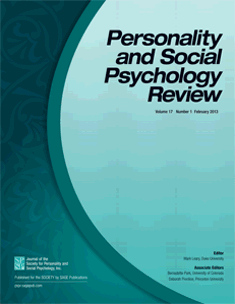
PERSONALITY AND SOCIAL PSYCHOLOGY REVIEW
Transforming Understanding of Social InteractionsPERSONALITY AND SOCIAL PSYCHOLOGY REVIEW, published by SAGE Publications Inc., stands as a leading journal in the field of social psychology, boasting an impressive impact factor that places it in the prestigious Q1 category for 2023. With its Scopus ranking of #4 out of 310 in the psychology domain, the journal is recognized for its rigorous research and groundbreaking insights, catering to a diverse audience that spans researchers, professionals, and students alike. Since its inception in 1997, the journal has provided a vital platform for the dissemination of high-quality articles that advance understanding of complex psychological phenomena related to individual and group dynamics. Although it does not currently offer open access, the journal’s wide readership and esteemed contributions make it an indispensable resource for those seeking to remain at the forefront of personality and social psychology. With the convergence of years extending through to 2024, the journal promises continued innovation and exploration in the dynamic intersections of human behavior.
Eksperimentalnaya Psikhologiya
Illuminating the pathways of cognitive exploration.Eksperimentalnaya Psikhologiya is a prominent open-access journal published by the Moscow State University of Psychology and Education, dedicated to advancing the field of psychology. Since its inception, the journal has offered a platform for the dissemination of innovative research in Experimental and Cognitive Psychology, as well as Neuropsychology and Physiological Psychology. The journal's commitment to open access, initiated in 2015, ensures that valuable research findings are freely available to scholars and practitioners worldwide. Although currently categorized in the Q4 quartile for 2023 within several psychology disciplines, it plays a vital role in promoting a diverse range of psychological studies and fostering interdisciplinary collaboration. With a focus on experimental methodology and cognitive processes, Eksperimentalnaya Psikhologiya provides a valuable resource for researchers, professionals, and students seeking to deepen their understanding of psychological science. The journal invites contributions from across the globe, particularly in the evolving landscapes of experimental techniques and neuropsychological research.
ACTA PSYCHOLOGICA
Elevating the discourse in developmental and cognitive psychology.ACTA PSYCHOLOGICA, published by Elsevier, is a leading journal that has served the field of psychology since its inception in 1936. With an impact factor that reflects its authority and significance in the discipline, this journal has become essential for researchers, professionals, and students alike. Open Access since 2021, ACTA PSYCHOLOGICA ensures that groundbreaking psychological research is widely accessible, promoting the dissemination and application of knowledge across various branches of psychology including Developmental and Educational Psychology and Experimental and Cognitive Psychology. The journal is categorized in the Q1 and Q2 quartiles, highlighting its high-quality contributions to the field, supported by robust rankings within Scopus. Located in Amsterdam, Netherlands, this journal remains a vital resource for advancing psychological science and fostering collaborative research worldwide.

SOCIAL COGNITION
Empowering research in social psychology since 1996.SOCIAL COGNITION, published by GUILFORD PUBLICATIONS INC, stands as a prominent journal in the fields of Developmental and Educational Psychology and Social Psychology, holding a commendable Q2 ranking in both categories as per the latest 2023 metrics. With an ISSN of 0278-016X, this journal has been a vital resource for researchers and practitioners since its inception in 1996, showcasing rigorous empirical studies and theoretical advancements that inform our understanding of social behavior and cognitive processes. While operating under traditional access options, the journal's diverse range of topics makes it essential reading for those exploring the intricacies of human thought and interaction, with its Scopus ranking reflecting its significance in contemporary psychological research. The editorial board seeks to further advance knowledge in this domain through innovative methodologies and interdisciplinary approaches, ensuring that SOCIAL COGNITION remains invaluable to its readership based in the United States and beyond.
QUARTERLY JOURNAL OF EXPERIMENTAL PSYCHOLOGY
Transforming Understanding Through Empirical StudiesQuarterly Journal of Experimental Psychology, published by SAGE Publications Ltd, is a leading peer-reviewed journal that serves as a vital resource in the fields of experimental and cognitive psychology, neuropsychology, and medicine. With an impactful contribution to psychological research, the journal is recognized for its rigorous methodology and empirical studies, holding a notable ranking among its peers—finding itself in the Q2 quartile across several categories. With its origin tracing back to 2006, Quarterly Journal of Experimental Psychology significantly influences the academic discourse until its latest published findings in 2024. Catering to a diverse audience of researchers, professionals, and students, this journal provides Open Access options, enhancing the reach and accessibility of cutting-edge psychological research. By focusing on innovative approaches and findings, it aims to bridge theoretical understanding with practical application, hence fostering advancement in multiple related disciplines. For those committed to understanding the complexities of human behavior and cognitive processes, this journal remains an essential reference point.
COGNITION & EMOTION
Decoding the Dynamics of Cognition and EmotionCOGNITION & EMOTION is a leading academic journal published by Routledge Journals, Taylor & Francis Ltd, focusing on the dynamic interactions between cognitive processes and emotional responses. Established in 1987, this esteemed journal has made significant contributions to the fields of Arts and Humanities, Developmental and Educational Psychology, and Experimental and Cognitive Psychology, consistently ranking in the top quartile (Q1) across various categories. Housed in the United Kingdom, COGNITION & EMOTION boasts a remarkable impact factor, underscoring its influence and importance in advancing psychological research and theory. While this journal does not offer open access, it remains a vital resource for scholars, professionals, and students seeking to deepen their understanding of emotional and cognitive phenomena. With a commitment to rigorous peer-reviewed research and innovative insights, COGNITION & EMOTION is essential for anyone aiming to stay at the forefront of psychological studies.

International Review of Social Psychology
Pioneering Advances in Social PsychologyInternational Review of Social Psychology is an esteemed academic journal published by UBIQUITY PRESS LTD that has been making significant strides in the field of social psychology since its inception in 2016. With an impressive impact factor reflecting its high-quality research output, this Open Access journal offers unrestricted access to scholarly articles, encouraging global discourse and collaboration. Based in the United Kingdom, the journal occupies a prestigious position, ranking #76 out of 310 in the Scopus category of Social Psychology, placing it within the top 75th percentile of its field. The Q1 quartile classification for 2023 underscores its significant contribution and influence in advancing the science of social behavior and thought. Covering a broad array of topics, from group dynamics to social influence, the journal aims to stimulate critical dialogue among researchers, practitioners, and students alike, promoting a deeper understanding of the complexities of social interactions. With its commitment to open and impactful research, the International Review of Social Psychology is an essential resource for anyone interested in the ever-evolving landscape of social psychology.
JAPANESE PSYCHOLOGICAL RESEARCH
Advancing Insights into Behavioral ScienceJapanese Psychological Research, published by Wiley, is a distinguished journal dedicated to advancing knowledge within the field of psychology, offering a platform for original research that reflects the diverse psychological landscape of Japan and its global relevance. Since its inception in 1954, this journal has served as a valuable resource for researchers, professionals, and students alike, encouraging the dissemination of innovative theoretical and empirical findings. With an Impact Factor that places it in the Q3 category in Psychology (Miscellaneous) and achieving a rank of #125 out of 216 in general psychology according to Scopus, it is recognized for its contribution to the scholarly community. Although it does not currently offer Open Access options, the journal's rich archive from 1954 to present ensures a comprehensive collection of psychological studies. Engage with Japanese Psychological Research to explore insights into behavioral science, cognitive processes, and cultural influences on psychological practices, making it an essential read for those committed to understanding the multifaceted world of psychology.