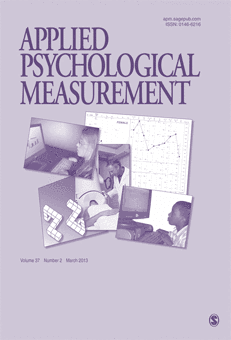
APPLIED PSYCHOLOGICAL MEASUREMENT
Scope & Guideline
Exploring Innovative Methodologies in Psychology
Introduction
Aims and Scopes
- Psychometric Theory Development:
This area encompasses the creation and refinement of psychometric models and theories, including item response theory (IRT), factor analysis, and reliability estimation methodologies. - Measurement Validity and Reliability:
Research focusing on the evaluation of construct validity, reliability, and the robustness of measurement tools in psychological testing. - Applied Measurement Techniques:
This includes practical applications of measurement models in various contexts such as educational assessments, clinical evaluations, and psychological research, often utilizing advanced statistical techniques. - Innovative Software and Tools for Psychometrics:
The journal publishes works that contribute new software packages and tools that aid in psychometric analysis, enhancing the accessibility and usability of complex measurement techniques. - Differential Item Functioning and Item Analysis:
Research aimed at identifying and addressing biases in test items, ensuring fair assessments across diverse populations.
Trending and Emerging
- Bayesian Approaches in Psychometrics:
There is an increasing trend towards the application of Bayesian methods for parameter estimation and model fitting, offering more flexible and robust solutions for psychometric analysis. - Machine Learning Techniques for Item Analysis:
The integration of machine learning methods to enhance item response analysis and detect differential item functioning is gaining traction, demonstrating the journal's responsiveness to technological advancements. - Adaptive Testing and Personalized Assessment:
Research focusing on computerized adaptive testing (CAT) is on the rise, emphasizing the need for efficient and tailored assessment approaches that can adapt to individual test-taker characteristics. - Complex Models for Cognitive Diagnosis:
Emerging themes include the development of sophisticated models for cognitive diagnosis that provide deeper insights into test-taker performance and learning pathways. - Multidimensional Item Response Theory:
The application and exploration of multidimensional IRT models are increasingly prevalent, reflecting the complexity of psychological constructs and the need for comprehensive assessment strategies.
Declining or Waning
- Traditional Classical Test Theory (CTT) Approaches:
While still foundational, research grounded solely in classical test theory methods is less frequent, as the field increasingly emphasizes modern psychometric approaches such as IRT. - Single-Dimensional Measurement Models:
Research focusing exclusively on unidimensional models is declining, with a growing recognition of the importance of multidimensional approaches to accurately capture complex psychological constructs. - Basic Reliability Estimation Techniques:
Simplistic approaches to estimating reliability, such as Cronbach's alpha without consideration of model fit or item characteristics, are becoming less common as more sophisticated techniques are developed.
Similar Journals

PSYCHOLOGICAL METHODS
Empowering Researchers with Rigorous Methodological FrameworksPsychological Methods, published by the American Psychological Association, is a leading journal in the field of psychology, recognized for its rigorous approach to the methodology of psychological research. With an ISSN of 1082-989X and an E-ISSN of 1939-1463, this esteemed journal facilitates the dissemination of innovative methods and analysis techniques that are critical for advancing psychological science. Its impressive ranking as Q1 in both the History and Philosophy of Science and Psychology (miscellaneous) categories underscores its influence, while its Scopus rank places it in the top 2 out of 97 journals in its field, reflecting its high visibility and importance among researchers, professionals, and students. Although not an open-access journal, Psychological Methods continues to serve as a vital resource for the latest advancements and discussions, aiming to enhance the quality of psychological research globally. With a publication history spanning from 1996 to 2024, it remains a cornerstone for scholars committed to elevating the methodological standards prevalent within the discipline.
EDUCATIONAL AND PSYCHOLOGICAL MEASUREMENT
Advancing the Science of AssessmentEDUCATIONAL AND PSYCHOLOGICAL MEASUREMENT, published by SAGE Publications Inc, is a premier journal serving as a vital resource for researchers and practitioners in the fields of educational and psychological assessment. With a rich history dating back to 1941, this esteemed journal encompasses a wide-ranging scope, exploring the intricacies of measurement techniques and their implications within applied mathematics, psychology, and education. Notably categorized in Q1 quartiles across various fields, including Applied Mathematics and Educational Psychology, the journal ranks impressively in Scopus, reflecting its high impact and relevance—ranked #82/635 in Applied Mathematics and #232/1543 in Education. The journal’s commitment to advancing knowledge in educational measurement equips scholars with essential insights and methodologies, making it an essential tool for advancing scholarly inquiry and practice. With no open access limitations, EDUCATIONAL AND PSYCHOLOGICAL MEASUREMENT is dedicated to disseminating quality research that influences educational practices and psychological evaluation, thus reinforcing its esteemed position within academia.
Communication Methods and Measures
Advancing communication research through innovative methodologies.Communication Methods and Measures is a leading journal published by Routledge Journals, Taylor & Francis Ltd, specializing in the field of communication. Since its inception in 2010, the journal has established itself as an influential voice in advancing the methodologies and measurement practices utilized within communication research. With an impressive Q1 ranking in the Communication category as of 2023, it plays a pivotal role in disseminating cutting-edge scholarship that bridges theory and practical application. Although it is not an Open Access journal, it provides a wealth of valuable insights, making it an essential resource for researchers, professionals, and students alike. The journal’s focus on innovative methods and rigorous measurement approaches fosters a deeper understanding of communication dynamics, contributing significantly to the growing field of study. Located in the United States and accessible globally, Communication Methods and Measures continues to serve as a fundamental platform for scholarly discourse and exploration in communication research.
Journal of Measurement and Evaluation in Education and Psychology-EPOD
Exploring New Frontiers in Educational and Psychological Evaluation.Journal of Measurement and Evaluation in Education and Psychology-EPOD is a distinguished open-access journal published by the ASSOCIATION FOR MEASUREMENT & EVALUATION IN EDUCATION & PSYCHOLOGY since 2010, based in Ankara, Turkey. Focusing on the critical intersections of education and psychology, this journal aims to disseminate valuable research that enhances assessments and evaluation methodologies across diverse educational settings. With a commitment to advancing knowledge, it explores a broad range of topics pertaining to developmental and educational psychology, making it an essential resource for researchers, professionals, and students alike. Despite its recent challenges, highlighted by its Q4 categorization in both Developmental and Educational Psychology and Education, the journal continues to provide a platform for innovative ideas and discussions crucial to shaping future educational practices. Access the latest findings and contribute to the field through this vital scholarly outlet.

Quantitative Methods for Psychology
Exploring New Frontiers in Quantitative PsychologyQuantitative Methods for Psychology, with ISSN 1913-4126 and E-ISSN 2292-1354, is a premier open-access journal published by the University of Montreal, Department of Psychology. Since its inception in 2005, this journal has served as a vital resource for the dissemination of cutting-edge research and methodological advancements in psychological science. With a focus on quantitative approaches, it welcomes submissions that explore innovative statistical techniques, data analysis methodologies, and empirical studies that enhance understanding in psychology. The journal’s commitment to accessibility ensures that researchers, practitioners, and students alike can benefit from the wealth of knowledge it offers, fostering collaboration and advancing the field. As an integral platform for sharing significant findings and best practices, Quantitative Methods for Psychology is positioned to make substantial contributions to the landscape of psychological research.
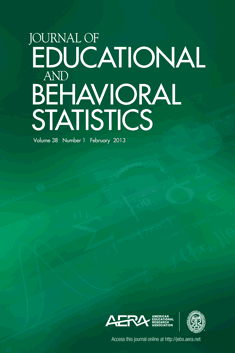
JOURNAL OF EDUCATIONAL AND BEHAVIORAL STATISTICS
Advancing the Frontiers of Educational InsightJOURNAL OF EDUCATIONAL AND BEHAVIORAL STATISTICS, published by SAGE Publications Inc, stands as a pivotal resource in the domains of education and social sciences. With an impressive impact factor reflecting its influence, it is categorized in the esteemed Q1 quartile for both Education and Social Sciences (miscellaneous), positioning it among the top-tier journals in these fields. The journal, bearing the ISSN 1076-9986 and E-ISSN 1935-1054, prides itself on disseminating rigorous research and innovative methodologies applicable to educational and behavioral statistics. Since its inception in 1996, it has continually evolved, featuring cutting-edge studies that address contemporary challenges in educational assessment and statistical techniques. Researchers, educators, and students alike will find invaluable insights within its pages, making it an essential publication for those seeking to advance their understanding and application of statistical methods in education. The journal's commitment to excellence and relevance ensures it remains a cornerstone for scholarly discourse through 2024 and beyond.
ORGANIZATIONAL RESEARCH METHODS
Shaping the Future of Organizational Studies, One Method at a Time.ORGANIZATIONAL RESEARCH METHODS is a premier academic journal published by SAGE Publications Inc, dedicated to advancing the field of organizational research through innovative methodologies and rigorous empirical studies. With an ISSN of 1094-4281 and an E-ISSN of 1552-7425, this journal has made significant contributions to the disciplines of decision sciences, management of technology and innovation, and strategy and management, holding prestigious Q1 rankings in each category for 2023. The journal's emphasis on methodological rigor and theory development makes it an essential resource for researchers, practitioners, and students alike, facilitating insights that drive effective organizational practices. With a strong impact in the academic community, as evidenced by Scopus rankings placing it in the top percentiles for its related fields, ORGANIZATIONAL RESEARCH METHODS serves as a critical platform for disseminating cutting-edge research from 1998 through 2024, empowering thought leaders to shape the future of organizational studies.
PSYCHOLOGICAL ASSESSMENT
Exploring the Depths of Psychological DiagnosticsPSYCHOLOGICAL ASSESSMENT is a prestigious journal published by the American Psychological Association that has been a cornerstone in the fields of Clinical Psychology and Psychiatry and Mental Health since its inception in 1989. With an impressive impact factor, this journal is ranked in the Q1 category for both related fields, showcasing its critical role in disseminating high-quality research and scholarly articles. The journal focuses on the development, validation, and application of psychological assessment tools, inviting contributions that enhance the understanding of mental health through rigorous methodological frameworks. As evidenced by its high Scopus rankings—66th in Clinical Psychology and 165th in Psychiatry and Mental Health—PSYCHOLOGICAL ASSESSMENT is indispensable for researchers, professionals, and students who seek to advance their knowledge and practice in psychological evaluation. While it is not an open-access journal, the insights provided are vital for anyone dedicated to the nuanced study of psychological assessment and diagnosis. For more information, visit the journal's page on the American Psychological Association's website.
JOURNAL OF PSYCHOPATHOLOGY AND BEHAVIORAL ASSESSMENT
Pioneering insights in psychopathology and assessment.JOURNAL OF PSYCHOPATHOLOGY AND BEHAVIORAL ASSESSMENT is a prominent scholarly publication dedicated to advancing the field of clinical psychology through innovative research and comprehensive assessments of psychological disorders. Published by Springer/Plenum Publishers in the United States, this journal has an established history of contributing to the academic community since its inception in 1985, continuing its mission until 2024. With an impact factor that properly reflects its academic rigor and relevance, it ranks in the Q2 category in Clinical Psychology for 2023, placing it within the top tier of academic journals in the field. Researchers, professionals, and students can expect to find a wealth of insightful articles that delve into the complexities of psychopathology and behavioral assessment, fostering a deeper understanding of mental health issues. Although open access options are not available at this time, subscribers and institutions have the privilege of accessing critical findings that could transform clinical practices and inform future research initiatives.
JOURNAL OF EDUCATIONAL MEASUREMENT
Pioneering Research in Educational MeasurementJOURNAL OF EDUCATIONAL MEASUREMENT, published by WILEY, stands as a pivotal resource in the fields of education and psychology, with a strong emphasis on the systematic evaluation of educational processes and instruments. With the ISSN 0022-0655 and E-ISSN 1745-3984, this journal has been contributing to the literature since 1964 and continues to thrive into 2024, reflecting its long-standing dedication to improving educational measurement practices. The journal holds impressive standings with 2023 category quartiles of Q1 in Education and Q2 in multiple psychology categories, demonstrating its significance in applied psychological research and educational development. Although it does not currently offer open access, its well-curated content appeals to researchers, professionals, and students seeking insights into measurement theories, practices, and innovations. With robust metrics, including a diverse range of Scopus ranks across various psychological disciplines, the JOURNAL OF EDUCATIONAL MEASUREMENT is indispensable for anyone looking to advance their knowledge and application of educational assessments and methodologies.