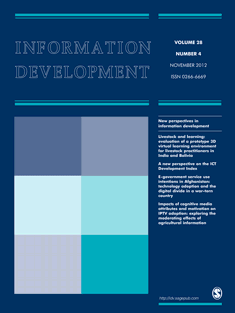
Information Development
Scope & Guideline
Championing Progress in Library and Information Development
Introduction
Aims and Scopes
- Information Behavior and Literacy:
Exploring how different populations seek, use, and share information, particularly in the context of educational and health outcomes. - Technology Adoption and Integration:
Investigating factors influencing the acceptance and implementation of ICTs in various sectors, including education, agriculture, and healthcare. - Impact of Digital Tools on Development:
Analyzing how digital innovations can facilitate improvement in services, enhance performance, and support sustainable development goals. - Open Access and Information Sharing:
Focusing on the trends and challenges of open access publishing, institutional repositories, and the sharing of indigenous knowledge. - Societal Impacts of Information Systems:
Examining the role of information systems in governance, public administration, and community development.
Trending and Emerging
- Artificial Intelligence in Development:
There is a growing interest in how AI technologies can be leveraged for educational improvement, healthcare advancements, and enhancing organizational efficiency. - Mobile Technology Utilization:
The increasing prevalence of mobile devices has prompted research into their role in education, agriculture, and healthcare, particularly in developing regions. - Digital Health and mHealth Applications:
Emerging studies focus on mobile health applications and their effectiveness in improving health outcomes and access to healthcare services. - Indigenous Knowledge and Community Engagement:
Research is increasingly addressing the importance of indigenous knowledge systems and community-based approaches to information dissemination and management. - Data Management and Open Science Practices:
There is a notable trend towards exploring practices in research data management, open science, and the implications for transparency and collaboration in academic research.
Declining or Waning
- Traditional Library Services:
As digital resources and online services gain traction, traditional library services and their evaluations are receiving less attention compared to digital innovations. - Offline Information Dissemination:
Research on non-digital methods of information dissemination, such as print media and community bulletin boards, has seen a decline as digital channels become more dominant. - Focus on Single Technology Solutions:
The emphasis on isolated technological solutions is waning as researchers increasingly advocate for integrated approaches that combine multiple technologies for holistic development. - Generalized ICT Impact Studies:
Broad studies on ICT impacts without specific context or application are less frequently published, with a shift towards more targeted investigations in specific sectors or populations. - Basic Information Literacy Programs:
Research centered around basic information literacy is decreasing as the focus shifts towards advanced digital literacy and critical information skills in response to the complexities of the digital age.
Similar Journals
JOURNAL OF INFORMATION SCIENCE
Navigating the complexities of information systems and management.JOURNAL OF INFORMATION SCIENCE (ISSN: 0165-5515; E-ISSN: 1741-6485), published by SAGE PUBLICATIONS LTD, stands as a leading academic journal in the realms of Information Systems and Library and Information Sciences. Established in 1979 and continuing through 2024, this journal has become a cornerstone for researchers, professionals, and students seeking to enhance their understanding of the rapidly evolving landscape of information management. With a commendable Q1 ranking in Library and Information Sciences and a Q2 ranking in Information Systems as of 2023, it demonstrates significant influence, evidenced by its 89th percentile ranking in Scopus for Social Sciences. Although it currently does not offer open access, the journal is committed to delivering high-quality, peer-reviewed research that addresses both theoretical and practical challenges in the field. Researchers and practitioners alike will find invaluable insights that bolster their work and contribute to the broader academic dialogue surrounding information science.
E-Ciencias de la Informacion
Cultivating Insights for a Knowledge-Driven WorldE-Ciencias de la Informacion, an esteemed journal published by the University of Costa Rica, serves as a pivotal platform for the dissemination of knowledge in the fields of information science and technology. With its Open Access policy adopted in 2011, the journal ensures that research findings are readily available to a global audience, fostering collaboration and innovation among researchers, professionals, and students alike. This accessible publication supports the advancement of theoretical and applied knowledge while encouraging rigorous academic dialogue in the rapidly evolving landscape of information sciences. Although we currently lack specific impact metrics like the HIndex, the journal's commitment to quality and integrity positions it as a crucial contributor to ongoing discussions and developments in the discipline. Located at the Centro Investigaciones & Matemática Pura & Aplicada in San Jose, Costa Rica, this journal not only showcases groundbreaking research but also aligns with the University’s mission to enhance scientific inquiry and education in Latin America and beyond.

African Journal of Library Archives and Information Science
Empowering Knowledge, Transforming Libraries.The African Journal of Library Archives and Information Science (ISSN: 0795-4778; E-ISSN: 0795-4778) is a pivotal publication in the field of Library and Information Sciences, published by ARCHLIB & INFORMATION SERVICES LTD in Nigeria. With a focus on the diverse and evolving challenges faced by libraries and information professionals in the African context, this journal serves as a platform for scholarly communication, fostering innovation and collaboration among researchers, practitioners, and academics. The journal has a notable impact factor, reflected in its Q3 ranking within the category for 2023, and is indexed in Scopus, holding a percentile rank of 22nd in its field, further validating its relevance and scholarly contribution. Running since 2008 with continual publications through to 2024, the journal aims to advance knowledge, share best practices, and highlight emerging trends in librarianship and information science across Africa and beyond. By offering open access options, it ensures wide dissemination of knowledge, making it an essential resource for those dedicated to enhancing information services and archives.

LIBRARY AND INFORMATION SCIENCE
Empowering librarianship through innovative research.LIBRARY AND INFORMATION SCIENCE is a specialized academic journal dedicated to the advancement of knowledge and scholarship in the field of library and information sciences. Published by MITA SOC LIBRARY INFORMATION SCIENCE, this esteemed journal has been a crucial platform for scholarly communication since 1980, addressing the dynamic challenges and developments in the information landscape. Although it holds a Q4 category ranking in the Library and Information Sciences according to the 2023 Scopus Ranking, the journal serves a unique niche, providing insights and fostering discussions among a diverse audience of researchers, professionals, and students. With no Open Access options currently available, its valuable research contributions are accessible through institutional subscriptions and library access. The journal aims to disseminate innovative research, case studies, and theoretical explorations that enhance our understanding of information behavior, retrieval systems, library management, and emerging technologies, thus promoting an informed society in an increasingly digital world. Given its focused scope and enduring presence, LIBRARY AND INFORMATION SCIENCE continues to be an essential resource for anyone invested in the future of libraries and information services.
Digital Library Perspectives
Innovating Education through Digital PerspectivesDigital Library Perspectives, published by Emerald Group Publishing Ltd, is a pivotal journal in the dynamic fields of Education, Information Systems, and Library and Information Sciences. With an impressive Scopus ranking that places it in the Q1 category for Library and Information Sciences and Q2 for both Education and Information Systems, this journal has established itself as a significant resource for scholars and practitioners alike. The journal's ISSN is 2059-5816 and its E-ISSN is 2054-1694, facilitating broad accessibility to cutting-edge research and innovative practices within digital library environments. Published since 2016, it continues to offer a platform for the exploration of emerging trends, challenges, and technologies affecting digital libraries and information services. Researchers, professionals, and students will find that the journal not only highlights critical advancements but also fosters discussions around best practices and future directions in the industry. While it operates under a subscription model, it remains a crucial contributor to the scholarly dialogue in this essential sector.

LIBRARY JOURNAL
Exploring the Future of Library ScienceLIBRARY JOURNAL, published by REED BUSINESS INFORMATION, is a vital periodical in the field of Library and Information Sciences, providing a rich resource for researchers, professionals, and students alike. With a history spanning from 1945 to its recent issues, this journal captures the evolving landscape of library science, offering insightful articles that address current trends, practices, and challenges within the profession. Although not an open access journal, LIBRARY JOURNAL is highly regarded for its content, which reflects the challenges faced by libraries and the critical role they play in education and community services. Despite its Scopus ranking of 159 out of 210, the journal continues to contribute significantly to discussions around information management, bibliometrics, and digital libraries, making it an essential read for those invested in the ongoing development of library services and information literacy in the digital age.
PORTAL-LIBRARIES AND THE ACADEMY
Elevating Academic Discourse in Library and Information SciencePORTAL: Libraries and the Academy is an esteemed academic journal published by Johns Hopkins University Press, focusing on the intersection of library and information science, academic practice, and scholarly communication. With an ISSN of 1531-2542 and an E-ISSN of 1530-7131, this journal offers rigorous peer-reviewed research essential for librarians, researchers, and information professionals committed to enhancing academic libraries and fostering innovative practices in higher education. It holds a strong position in its field, ranking in the 61st percentile within Social Sciences and Library and Information Sciences, and categorized as Q2 in both Development and Library and Information Sciences for 2023. Though the journal is not Open Access, its content is invaluable for anyone interested in staying abreast of the latest trends and challenges in library services and academic environments. Since its inception in 2001, PORTAL has continuously contributed to the discourse on the evolving role of libraries in academia, making it a critical resource for those striving to bridge the gap between information access and higher education pedagogy.

AIB Studi
Exploring innovative practices for a digital age.AIB Studi is a vital peer-reviewed journal published by the ASSOC ITALIANA BIBLIOTECHE-AIB, focusing on the dynamic field of Library and Information Sciences. Since its inception in 2012, the journal has embraced an Open Access model, ensuring that research is accessible to a global audience without financial barriers. Based in Italy, AIB Studi promotes scholarly discourse and innovative practices in the library sector. With an emerging reputation reflected in its 2023 Quartile Rank of Q3 in Library and Information Sciences and a current Scopus ranking of #210/280, it serves as an essential resource for professionals, researchers, and students seeking to advance their knowledge and contributions to the field. The journal publishes articles that delve into the evolving role of libraries in society, explore technological advancements, and examine information management strategies, fostering an environment of collaboration and progressive development in library sciences.
Em Questao
Cultivating Insightful Analyses in Critical Academic DomainsEm Questao is an esteemed open-access journal dedicated to the fields of library science and communication studies, published by the Universidade Federal do Rio Grande do Sul, specifically through its esteemed Faculdade de Biblioteconomia e Comunicação. Since its inception in 2003, this journal has provided a platform for researchers, professionals, and students to disseminate influential scholarly work that fosters dialogue and innovation within these critical academic domains. Em Questao strives to enhance the visibility of emerging trends and methodologies in library science and communication, making it an indispensable resource for those looking to navigate the complexities of information dissemination in today's digital landscape. With a commitment to open access, it ensures that knowledge is readily available to a global audience, contributing to the advancement of these vital fields. Researchers interested in exploring insightful analyses and fostering collaborative research will find Em Questao a valuable addition to their academic resources.
Journal of Web Librarianship
Inspiring New Paradigms in Library and Information SciencesWelcome to the Journal of Web Librarianship, an esteemed publication dedicated to the evolving landscape of library science and information technology. Published by Routledge Journals, Taylor & Francis Ltd, this journal serves as a vital platform for researchers and professionals to share innovative practices, methodologies, and research findings in the fields of Library and Information Sciences and Computer Science Applications. With an impressive impact factor reflected in its 2023 rankings—Q1 in Library and Information Sciences and Q2 in Computer Science Applications—the journal is well-positioned to influence the discourse and development within these disciplines. Since its inception in 2007, the Journal of Web Librarianship has continually contributed to the academic dialogue, ensuring a comprehensive understanding of the critical role that web technologies play in library services. Though it is not an open-access journal, it remains an invaluable resource for those dedicated to advancing the practice and theory of web librarianship. Join us in exploring the intersections of information and technology as we work towards a more informed society.