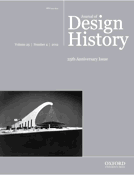
Journal of Design History
Scope & Guideline
Pioneering Critical Insights into Design History
Introduction
Aims and Scopes
- Historical Contextualization of Design:
The journal focuses on how design practices are influenced by historical events and cultural movements, providing a comprehensive understanding of the evolution of design across different periods. - Interdisciplinary Approaches:
Utilizing methodologies from art history, cultural studies, sociology, and anthropology, the journal promotes interdisciplinary research that connects design to broader societal themes. - Material Culture Studies:
There is a consistent emphasis on the study of objects and their roles in daily life, examining how material culture shapes identities and experiences in various contexts. - Global Perspectives:
The journal seeks to incorporate diverse geographical viewpoints, highlighting design histories from various cultures and challenging Eurocentric narratives. - Critical Design and Activism:
It encourages discourse around the political implications of design, including how design can challenge societal norms, address issues of inequality, and advocate for marginalized voices.
Trending and Emerging
- Ecological and Sustainable Design:
A notable increase in discussions surrounding ecological design reflects growing concerns about sustainability and environmental impacts, highlighting the relevance of design in addressing climate change. - Design and Disability:
There is an emerging focus on the intersection of design and disability, exploring how design practices can be inclusive and responsive to the needs of individuals with disabilities, thus promoting accessibility. - Political Design and Activism:
Papers examining the role of design in political contexts and its potential for activism are on the rise, showcasing how design can be a tool for social change and critique. - Cultural Identity and Representation:
Increased attention is being given to how design reflects and shapes cultural identities, particularly in post-colonial contexts, which is crucial for understanding contemporary global design practices. - Digital and Technological Influences:
The journal is also seeing a trend towards exploring the impact of digital technology on design practices, including the rise of digital design methodologies and their implications for material culture.
Declining or Waning
- Traditional Craftsmanship:
Papers focusing on traditional craftsmanship as a standalone theme have become less frequent, possibly due to a growing interest in contemporary and digital design practices. - Eurocentric Design Narratives:
There appears to be a waning interest in exclusively Eurocentric design histories, as the journal increasingly embraces a more global perspective that includes non-Western design practices. - Design and Aestheticism:
Discussions centered solely on aesthetic values of design, without considering broader social implications, are less prevalent, indicating a shift towards more critical and contextual analyses. - Fashion History as a Separate Discipline:
While fashion continues to be a significant topic, the journal has seen a decrease in papers treating fashion history in isolation, favoring integrated discussions that connect fashion with wider cultural and political themes.
Similar Journals

Sport History Review
Uncovering the Past, Shaping the Future of SportsSport History Review, published by Human Kinetics, is a well-regarded, peer-reviewed journal dedicated to the exploration and analysis of sport's historical contexts and cultural influences. With a focus on interdisciplinary research, this journal serves as an essential resource for historians, scholars, and students interested in understanding the evolution of sports and its impact on society from various perspectives. The 2023 Scopus rankings place the journal in the Q2 category within History, indicating its significant scholarly influence, while also revealing its relevance within the fields of Physical Therapy and Sports Science. Despite its non-open access status, Sport History Review maintains a high standard of academic integrity and boasts a diverse array of articles that critically engage with themes ranging from historical sport practices to contemporary issues affecting athletic culture. With an established history of publication since 1999, the journal continues to enrich the academic landscape by providing a platform for innovative research, fostering dialogue, and advancing knowledge in sports history.
JOURNAL OF INTERDISCIPLINARY HISTORY
Exploring the Nexus of History and InnovationThe JOURNAL OF INTERDISCIPLINARY HISTORY, published by MIT PRESS, serves as a pivotal platform for scholarly discourse at the intersection of history and various interdisciplinary fields. With a rich publication history dating back to 1970, the journal has continually provided a critical forum for exploring innovative historical methodologies and themes that resonate across diverse academic domains. Although it is not an Open Access journal, it remains invaluable for researchers dedicated to advancing the understanding of historical narratives and their implications within contemporary contexts. As reflected in its impressive Scopus ranks, the journal occupies a respectable position within its quartiles, holding Q3 in History and Q4 in History and Philosophy of Science. This suggests a growing recognition of its contributions among scholars in the field. Located in Cambridge, MA, USA, the journal is accessible to a global audience, fostering collaboration and dialogue among professionals, historians, and students alike. Whether you are a seasoned researcher or a budding student, the JOURNAL OF INTERDISCIPLINARY HISTORY stands as an essential resource for navigating the complexities of historical inquiry.
Historische Zeitschrift
Cultivating a Rich Legacy of Historical InquiryHistorische Zeitschrift is a prestigious academic journal dedicated to the field of history, published by WALTER DE GRUYTER GMBH. Established in 1859, the journal has a long-standing legacy of promoting scholarly discourse and research that spans pivotal eras from the 19th century to contemporary times. With an ISSN of 0018-2613 and an E-ISSN of 2196-680X, it is well-recognized in the academic community for its rigorous standards and contributions to historical scholarship. This journal is currently positioned in Quartile 3 of its category for 2023 and holds a respectable rank of #762 out of 1760 in Scopus, placing it in the 56th percentile for Arts and Humanities – History. Though not available in an open access format, Historische Zeitschrift continues to attract submissions from both emerging and established historians eager to contribute to an understanding of historical contexts and narratives. Its scope includes extensive historical analysis, discussions on methodology, and explorations of sources, making it an invaluable resource for researchers, professionals, and students alike who seek to deepen their insights into historical developments.

Vinculos de Historia
Unlocking the Secrets of Our Shared PastVinculos de Historia, published by the University of Castilla-La Mancha, is a distinguished open-access journal that has been contributing to the field of history since its inception in 2012. Based in Spain, it serves as a vital scholarly platform for historians and researchers alike, engaging with various historical methodologies and perspectives. With an impressive Q2 ranking in the 2023 Scopus Arts and Humanities Category, it ranks at #803 out of 1760 journals, placing it in the top 54th percentile of its field. The journal is committed to disseminating high-quality research articles that foster a deeper understanding of historical narratives and their implications. By providing unrestricted access to peer-reviewed content, Vinculos de Historia not only enhances scholarly discourse but also encourages collaboration among academics, professionals, and students globally. Located at FAC Letras Ciudad Real, the journal stands as a testament to the robust intellectual tradition of the University of Castilla-La Mancha.
Frontiers of History in China
Engaging with the Rich Tapestry of China's PastFrontiers of History in China is a distinguished academic journal published by Higher Education Press, focusing on the ever-evolving field of history within China and beyond. Established in 2006, this journal aims to provide a platform for high-quality, interdisciplinary research that explores historical narratives, methodologies, and implications, contributing significantly to the global discourse on historical studies. With an ISSN of 1673-3401 and an E-ISSN of 1673-3525, it holds a respectable position, classified in Q3 of the History category for 2023, and ranks within the 35th percentile among Arts and Humanities publications, reflecting its commitment to excellence. Though it is not an open-access journal, it provides wide-ranging access options to ensure visibility for researchers, professionals, and students interested in historical scholarship. The journal continues to be a vital resource for those seeking to deepen their understanding of historical developments in China, particularly as it converges up to 2024, paving the way for future scholarly discussions and discoveries.

NUOVA RIVISTA STORICA
Navigating the Rich Tapestry of HistoryNUOVA RIVISTA STORICA is a distinguished journal dedicated to the field of history, published by SOC EDITRICE DANTE ALIGHIERI SRL in Italy. With a long-standing tradition since its inception, the journal has been a pivotal platform for scholarly discourse, illuminating various historical narratives and perspectives. Though it is currently not an open-access publication, NUOVA RIVISTA STORICA provides robust access options for readers and researchers keen on exploring nuanced historical analyses. As demonstrated by its standing in the Q4 quartile of history journals and its ranking of #1425 out of 1760 within the Scopus database, it remains a valuable resource for emerging scholars and seasoned academics alike. The journal's commitment to advancing historical scholarship makes it an essential read for anyone engaged in the study of history, culture, and societal evolution.
Critical Studies in Fashion & Beauty
Exploring the Cultural Tapestry of Fashion and BeautyCritical Studies in Fashion & Beauty is a pivotal academic journal published by INTELLECT LTD, dedicated to exploring the vibrant intersections of fashion, beauty, and cultural studies. Based in the United Kingdom, this journal is notable for its influential role in the Arts and Humanities, particularly within the categories of Visual Arts and Performing Arts. With an impressive ranking in the 2023 Scopus categories—achieving Q1 status in Visual Arts and Performing Arts and Q2 in Arts and Humanities (miscellaneous)—this journal serves as a vital platform for innovative research, critical discourse, and theoretical examination of contemporary issues in the realms of aesthetics and culture. Its contributions are essential for scholars, practitioners, and students who seek to deepen their understanding of the socio-cultural dimensions of fashion and beauty. The journal, which has been publishing since 2019, is poised to influence the field significantly through its commitment to rigorous academic inquiry and interdisciplinary approaches.
EIGHTEENTH-CENTURY LIFE
Fostering Scholarly Dialogue on 18th-Century LifeEIGHTEENTH-CENTURY LIFE is a prominent academic journal published by DUKE UNIVERSITY PRESS, focusing on the interdisciplinary study of the 18th century through the lenses of Cultural Studies, History, Literature, and the Visual Arts and Performing Arts. With an established history since 1977, this journal serves as a vital platform for scholars and students to publish innovative research and critical discourse, shedding light on the complex social, political, and artistic currents of the 18th century. Despite its current ranking in the lower quartiles according to Scopus, the journal continues to foster scholarly dialogue and contribute to the understanding of this pivotal era in Western history. Its accessible yet scholarly articles make it a valuable resource for researchers, educators, and students alike, facilitating engagement with 18th-century studies from various disciplinary perspectives.

WAFFEN-UND KOSTUMKUNDE
Unveiling the Stories Behind Textile and WeaponryWAFFEN-UND KOSTUMKUNDE is a distinguished journal published by VERLAGSHAUS WERNER HOFMANN KG, focusing on the intricate study of arms and costumes within the realms of visual arts and cultural history. With its ISSN 0042-9945, this journal provides a unique interdisciplinary platform dedicated to the exploration of textile and weapon narratives, reflecting on their historical and social significance. Although it has discontinued its coverage in Scopus as of 2017, it maintains a dedicated readership within the arts and humanities community, ranking #372 out of 470 in its category with a 20th percentile. The journal aims to inspire scholarly discourse by publishing innovative research and critical analyses that deepen our understanding of material culture. Interested readers and contributors can explore a wealth of insights through its archives and ongoing contributions from experts in the field, based in Sonnefeld, Germany.
ZEITSCHRIFT FUR KUNSTGESCHICHTE
Fostering Insightful Discussions on Art and CultureZEITSCHRIFT FUR KUNSTGESCHICHTE is a prestigious journal dedicated to the study of art history, offering insightful analyses and discussions that enrich the understanding of visual arts and performing arts. Published by DEUTSCHER KUNSTVERLAG GMBH in Germany, this journal has established itself as a significant platform for researchers and professionals alike since its inception. With a print ISSN of 0044-2992 and an e-ISSN of 2569-1619, it spans a comprehensive range of topics in art history, reflecting both traditional and contemporary perspectives. Although categorized in the Q4 quartile for Visual Arts and Performing Arts, the journal contributes to a rich dialogue within its field, aiming to foster academic discourse and promote scholarly research. Its scope has evolved notably from converged years starting in 1975 and gathering strength from 2001 to 2024, and it is committed to serving as an essential resource for students, academics, and practitioners in the arts. While not offering open access, the journal maintains a rigorous peer-review process to ensure high-quality submissions that advance knowledge and stimulate critical thought.