JOURNAL OF PHILOSOPHY OF EDUCATION
Scope & Guideline
Innovating Pedagogical Practices with Philosophical Insights.
Introduction
Aims and Scopes
- Philosophical Foundations of Education:
The journal covers various philosophical approaches to education, including classical and contemporary theories, and engages with the works of philosophers like Kant, Hegel, and Freire. - Social Justice and Equity in Education:
A strong emphasis is placed on social justice, equity, and inclusion, exploring how educational practices can address systemic inequalities and promote democratic values. - Cultural and Contextual Relevance:
The journal prioritizes discussions around decolonization, cultural responsiveness, and the relevance of education in diverse contexts, especially in post-colonial settings. - Critical Pedagogy and Activism:
It supports critical pedagogy that integrates activism into educational practices, fostering a transformative approach that empowers learners to challenge societal norms. - Interdisciplinary Approaches to Educational Issues:
The journal promotes interdisciplinary research that connects philosophy with other fields such as psychology, sociology, and environmental studies, addressing complex educational challenges. - Aesthetic and Ethical Dimensions of Education:
It explores the aesthetic and ethical dimensions of education, considering how moral education, emotional intelligence, and the arts contribute to holistic learning experiences.
Trending and Emerging
- Decolonization and Indigenization of Curriculum:
There is a growing emphasis on decolonizing and indigenizing educational curricula, reflecting a broader commitment to social justice and recognition of diverse knowledge systems. - Environmental Education and Sustainability:
Recent publications highlight the importance of environmental education and sustainability, addressing the ethical implications of climate change and the role of education in fostering ecological awareness. - Critical Engagement with Technology:
The journal is increasingly exploring the implications of technology in education, including discussions on digital pedagogy, artificial intelligence, and the ethical considerations surrounding these advancements. - Emotional and Mental Health in Education:
A rising trend focuses on the emotional and mental health aspects of education, emphasizing the need for supportive environments that nurture students' well-being alongside academic achievement. - Civic Education and Democratic Engagement:
The importance of civic education and democratic engagement is gaining traction, with discussions centered on how education can promote active citizenship and political awareness among learners.
Declining or Waning
- Traditional Educational Models:
Discussions around traditional educational models, such as those rooted solely in behaviorism or standardized testing, appear to be declining as the focus shifts towards more progressive and inclusive educational practices. - Purely Theoretical Philosophical Discussions:
There seems to be a waning interest in abstract philosophical discussions that lack direct application to educational contexts, as the journal increasingly favors practical and contextually relevant inquiries. - Narrowly Defined Gender Issues:
While gender remains a relevant topic, the journal's focus on narrowly defined gender issues is decreasing in favor of broader discussions that encompass intersectionality and diverse identities.
Similar Journals

EDUCATIONAL THEORY
Fostering Scholarly Conversations in Educational TheoryEDUCATIONAL THEORY is a prestigious journal published by Wiley, focused on advancing the field of education through critical and insightful research. With an ISSN of 0013-2004 and E-ISSN 1741-5446, this journal has been a cornerstone of educational scholarship since its inception in 1951. Positioned in the second quartile (Q2) of the Education category and ranked #747 out of 1543 in Social Sciences - Education according to Scopus, it reflects a commitment to high-quality, peer-reviewed contributions that explore theoretical frameworks, methodologies, and contemporary issues in education. While not open access, it provides access options for educational institutions and researchers, facilitating a wide dissemination of knowledge. Covering converged years until 2024, EDUCATIONAL THEORY aims to engage researchers, professionals, and students alike, fostering a dialogue that enhances understanding and practice in educational theory.

JOURNAL OF DHARMA
Unraveling the Depths of Human Thought and BeliefWelcome to the JOURNAL OF DHARMA, a distinguished publication in the realms of Philosophy and Religious Studies, published by Dharmaram College, India. This journal has carved out a niche in academic scholarship, achieving notable rankings in Scopus—#374 in Religious Studies and #511 in Philosophy—demonstrating its relevance and contribution to the respective fields. With its scope encompassing a diverse range of topics from philosophical inquiry to religious discourse, the journal reflects a commitment to promoting critical dialogue and interdisciplinary research. Although it operates without an open-access model, the JOURNAL OF DHARMA invites contributions from researchers, professionals, and students keen on exploring the intricacies of human thought and spiritual practices. As it continues to evolve, the journal remains a key resource for those seeking to deepen their understanding of philosophical and religious inquiries from 2002 to 2024.
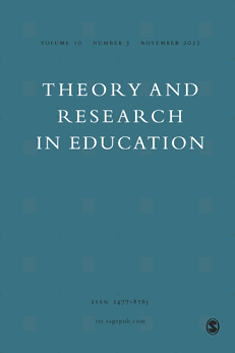
Theory and Research in Education
Transforming educational landscapes through scholarly research.Theory and Research in Education is a distinguished academic journal published by SAGE Publications Ltd, based in the United Kingdom. With an ISSN of 1477-8785 and an E-ISSN of 1741-3192, this journal primarily focuses on the intersection of educational theory and empirical research, fostering an in-depth understanding that informs educational practices and policies. Since its inception in 2003, it has been committed to disseminating high-quality research and advancing theoretical discussions within the field of education. Recognized in the Q2 category of Education journals for 2023 and ranking 800 out of 1543 in the Scopus Ranks for Social Sciences Education, it serves as a vital platform for researchers, educators, and students alike. Its inclusion in significant academic databases ensures that readers have access to pivotal analyses and innovative perspectives that shape the current educational landscape. Although not an open-access journal, its contents contribute immensely to scholarly discourse in education, making it a must-read for those engaged in or studying educational theories and methodologies.

Filosofiya-Philosophy
Fostering Critical Inquiry and InsightWelcome to Filosofiya-Philosophy, an esteemed academic journal dedicated to advancing the field of philosophical inquiry. Published by NATSIONALNO IZDATELSTVO AZ BUKI, this journal aims to foster scholarly exchange and promote critical discussions on various philosophical themes and issues, including but not limited to metaphysics, ethics, logic, and epistemology. With its commitment to rigorous research and thought-provoking analyses, Filosofiya-Philosophy seeks to engage researchers, professionals, and students alike, enriching the discourse surrounding philosophical studies. Although currently not an open-access journal, it provides valuable insights that are crucial for the continuous exploration of philosophical ideas. Based in Sofia, Bulgaria, it plays a vital role in the dissemination of philosophical knowledge, inviting submissions from around the globe to enhance its academic community and further its impact in the realm of philosophy.

Journal for Multicultural Education
Advancing multicultural understanding through education.Welcome to the Journal for Multicultural Education, an esteemed publication by Emerald Group Publishing Ltd, dedicated to advancing knowledge and practice in the dynamic fields of Cultural Studies, Education, and Linguistics. Since its inception in 2014, this journal has established itself as a leading forum for research, reflection, and discourse, addressing the multifaceted experiences of diverse cultures in educational contexts. With a commendable Scopus Rank placing it in the 87th percentile for Cultural Studies, the journal is positioned in the Q1 quartile, making it a premier outlet for scholars and practitioners looking to contribute to and engage with cutting-edge research. Our commitment to fostering an inclusive dialogue on multicultural education equips our readers with innovative strategies and insights essential for navigating today’s globalized society. While the journal operates under standard access provisions, we invite researchers, educators, and students alike to explore the rich tapestry of scholarly works published within these pages, and partake in a vibrant community dedicated to transformative education.

Sophia-Coleccion de Filosofia de la Educacion
Fostering Critical Dialogue in Arts and HumanitiesSophia - Colección de Filosofía de la Educación is a distinguished academic journal published by the Salesian Polytechnic University of Ecuador, dedicated to exploring the intersections of philosophy and education. With an ISSN of 1390-3861 and an E-ISSN of 1390-8626, this Open Access journal has been freely accessible since 2009, promoting wider dissemination of ideas within the field. It proudly contributes to the academic discourse in both the Arts and Humanities and Philosophy, holding a commendable Q2 quartile ranking in both categories as of 2023. As of the current publishing period, which spans from 2019 to 2024, the journal stands out with its Scopus rankings indicating a respectable position within the 74th percentile for Philosophy and the 58th for Arts and Humanities (miscellaneous). This makes it an essential source for researchers, professionals, and students keen on deepening their understanding of philosophical approaches to education and its practical implications.

Open Insight
Exploring the Depths of ThoughtOpen Insight is a prominent academic journal dedicated to the field of philosophy, published by the esteemed CENTRO INVESTIGACION SOCIAL AVANZADA, DIV FILOSOFIA in Mexico. Since its inception in 2017, Open Insight has been a vital platform for the dissemination of innovative philosophical discourse, bridging the gap between theoretical exploration and practical application in contemporary thought. With an ISSN of 2007-2406 and an E-ISSN of 2395-8936, this journal embraces a rigorous peer-review process and is committed to open access principles, ensuring the widest possible reach and impact of published research. Although currently positioned in the Q4 category and ranked 615 out of 806 in the Scopus Arts and Humanities (Philosophy) category, the journal actively encourages submissions that challenge conventional boundaries and inspire new avenues of inquiry. Researchers, educators, and students are invited to contribute their work, investigate philosophical dilemmas, and engage in meaningful discussions that resonate within the academic community and beyond.
PAEDAGOGICA HISTORICA
Exploring Historical Insights to Transform Teaching PracticesPAEDAGOGICA HISTORICA, a prestigious journal published by Routledge Journals, Taylor & Francis Ltd, stands at the intersection of education and history, providing a platform for innovative research that illuminates the historical dimensions of pedagogical practices. With an ISSN of 0030-9230 and an E-ISSN of 1477-674X, the journal contributes significantly to the field, reflecting its commitment to scholarly excellence, evidenced by its Scopus ranking in the 81st percentile for Arts and Humanities - History. Although categorized in Q4 in Education and Q2 in History as of 2023, PAEDAGOGICA HISTORICA remains a vital resource for understanding the evolving landscape of educational practices from a historical perspective. The journal has a rich history, covering research published from 1961 to 1985, 1990 to 1999, 2001 to 2004, and continuing to 2024, thus offering a comprehensive view of changes and trends over decades. While it does not currently offer Open Access, it provides researchers, professionals, and students with high-quality articles and insights essential for advancing knowledge in both domains. The journal's address is located in the UK, at 2-4 Park Square, Milton Park, Abingdon OX14 4RN, Oxon, England, making it a cornerstone for those passionate about the historical roots and developments in education.

Metodicki Ogledi-Methodical Review
Cultivating Scholarly Discourse Across DisciplinesMetodicki Ogledi-Methodical Review is a distinguished academic journal published by the Croatian Philosophical Society, specializing in the fields of Education and Philosophy. With an ISSN of 0353-765X and an E-ISSN of 1848-2325, the journal serves as a vital platform for scholarly discourse and research dissemination from Croatia and beyond. Although currently positioned in the Q4 category in Education and Q3 in Philosophy, Metodicki Ogledi plays a crucial role in fostering interdisciplinary dialogue, combining pedagogical insights with philosophical inquiries. It has achieved a Scopus rank of #341 out of 806 in Philosophy and #1306 out of 1543 in Education, highlighting its relevance in the academic community. The journal's ongoing commitment to publishing quality research from 2017 to 2024 ensures it remains a significant resource for researchers, educators, and students seeking to enhance their understanding of methodical practices within these fields. While the journal currently does not offer open access options, its curated articles are pivotal for advancing knowledge in educational methodologies and philosophical thought.
Critical Philosophy of Race
Exploring the intersections of identity and social justice.Welcome to the Critical Philosophy of Race, a premier academic journal published by Penn State University Press, dedicated to advancing scholarly discourse at the intersection of philosophy and racial studies. Boasting an impressive Q2 ranking in both the fields of Anthropology and Philosophy, this journal cultivates a vibrant platform for researchers and thought leaders to examine and challenge issues related to race, identity, and social justice from critical philosophical perspectives. Featuring contributions that span a diverse array of topics within these disciplines, it serves as a vital resource for professionals and students alike who are invested in understanding the complexities of race in contemporary society. With an E-ISSN of 2165-8692, the journal is committed to fostering open dialogue and disseminating high-quality research, contributing to the ongoing evolution of critical race philosophy. Explore the profound insights published between 2017 and 2024 and engage with transformative ideas that shape our understanding of race today.