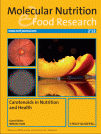
MOLECULAR NUTRITION & FOOD RESEARCH
Scope & Guideline
Leading the Charge in Food Science and Nutritional Advancements.
Introduction
Aims and Scopes
- Dietary Bioactive Compounds:
Research on how bioactive compounds in food, such as polyphenols, flavonoids, and fatty acids, affect health at the molecular level, including their mechanisms of action in various biological systems. - Gut Microbiota Interactions:
Exploration of the role of gut microbiota in modulating the effects of diet on health, including the impact of probiotics, prebiotics, and dietary fibers on gut health and systemic inflammation. - Nutritional Metabolism and Health Outcomes:
Studies examining the metabolic pathways influenced by dietary components and their implications for health conditions such as obesity, diabetes, and cardiovascular diseases. - Nutritional Interventions and Disease Prevention:
Investigations into dietary interventions aimed at preventing or treating diseases, including clinical trials and epidemiological studies. - Molecular Mechanisms of Nutrient Action:
Detailed analyses of the molecular mechanisms through which nutrients and bioactive food components exert their effects, including signaling pathways and gene expression changes.
Trending and Emerging
- Personalized Nutrition:
Research into personalized nutrition strategies based on individual genetic, microbiome, and metabolic profiles is gaining momentum, reflecting a shift towards tailored dietary interventions. - Microbiome-Related Research:
There is an increasing focus on the gut microbiome's role in health, particularly how it interacts with dietary components to influence metabolic and inflammatory pathways. - Functional Foods and Nutraceuticals:
The exploration of functional foods and nutraceuticals that provide health benefits beyond basic nutrition is trending, emphasizing the therapeutic potential of specific dietary components. - Nutritional Genomics:
Studies examining the interaction between nutrition and gene expression, including how dietary components can influence epigenetic modifications and health outcomes. - Food-Derived Peptides and Metabolites:
Emerging research on the effects of bioactive peptides and metabolites derived from food, highlighting their roles in health promotion and disease prevention.
Declining or Waning
- Traditional Nutritional Studies:
Research centered on traditional dietary patterns and their health effects appears to be decreasing, possibly as more complex molecular and microbiome interactions take precedence. - Basic Nutritional Guidelines:
There is a noticeable decline in articles focused solely on basic dietary recommendations without molecular or mechanistic insights, indicating a shift towards more integrative approaches. - Animal Studies Without Molecular Context:
Studies that focus solely on animal models without connecting findings to human health implications or molecular mechanisms are becoming less common.
Similar Journals
JOURNAL OF CLINICAL BIOCHEMISTRY AND NUTRITION
Advancing Knowledge in Biochemistry and NutritionJOURNAL OF CLINICAL BIOCHEMISTRY AND NUTRITION is a premier publication dedicated to the advancements in the fields of clinical biochemistry, nutrition, and dietary sciences. Published by the esteemed JOURNAL CLINICAL BIOCHEMISTRY & NUTRITION in Japan, this journal serves as a crucial platform for researchers and professionals to disseminate their findings and insights. With an ISSN of 0912-0009 and an E-ISSN of 1880-5086, it features a broad spectrum of original research articles, reviews, and case studies, fostering a deeper understanding of the interplay between biochemical processes and nutritional science. Notably, the journal has achieved significant rankings, placed in the Q3 and Q2 quartiles across various relevant categories, indicating its rising impact and relevance within the scientific community. Researchers will benefit from its rich repository of knowledge, while students and professionals will find it an invaluable resource for staying updated with the latest developments. Access options are available for interested readers, further contributing to the journal's objective of promoting open dialogue and research in clinical biochemistry and nutrition.
Current Developments in Nutrition
Empowering research that transforms nutrition practices.Current Developments in Nutrition is a prominent open-access journal published by Elsevier Science Inc, specializing in the field of nutritional science. With an ISSN of 2475-2991, this journal has been contributing valuable insights to the scientific community since its inception in 2017, and continues to shape research narratives through 2024. It boasts impressive rankings in the 2023 quartiles, achieving Q1 in Food Science and Q2 in both Medicine (miscellaneous) and Nutrition and Dietetics, highlighting its critical role in advancing knowledge in these areas. The journal is particularly noted for its commitment to disseminating cutting-edge research that influences dietary practices and public health policies. With Scopus rankings placing it in the 75th percentile in Medicine and the 68th percentile in Food Science, Current Developments in Nutrition serves as an essential resource for researchers, healthcare professionals, and students who seek to stay at the forefront of nutrition science. Its open-access model ensures that groundbreaking studies are available to a global audience, further enhancing collaboration and innovation across disciplines.
BRITISH JOURNAL OF NUTRITION
Pioneering Insights for a Healthier FutureThe British Journal of Nutrition, a premier publication in the field of nutrition and dietetics, is brought to you by Cambridge University Press. Established in 1947, this journal has consistently provided a platform for groundbreaking research and innovation in the domain of nutrition, boasting an impressive converged timeline extending to 2024. Recognized for its high academic standards, it proudly holds a Q1 ranking in Medicine (miscellaneous) and a Q2 ranking in Nutrition and Dietetics as of 2023, reflecting its impact and relevance in the scientific community. With a Scopus rank of 75 out of 398 in Medicine and 38 out of 140 in Nutrition and Dietetics, the journal remains a vital resource for researchers, professionals, and students seeking to enhance their knowledge and understanding of nutritional science. While the journal is not open access, it offers a wealth of valuable insights, making it an essential addition to any academic collection focused on health and nutrition.

Functional Foods in Health and Disease
Transforming Research on Functional Foods and WellnessFunctional Foods in Health and Disease is a respected peer-reviewed journal published by FUNCTIONAL FOOD CENTER INC, dedicated to advancing research in the fields of biochemistry, food science, medicine, and nutrition. Since its inception in 2011, this journal has provided a platform for innovative studies that connect the impact of functional foods on health and disease outcomes. With a focus on interdisciplinary research, it aims to disseminate knowledge that enhances the understanding of how specific food components can influence health and well-being. The journal is indexed with an ISSN of 2160-3855 and annually ranked in several categories, including Q4 in Biochemistry and Q3 in Food Science, Medicine, and Nutrition and Dietetics for 2023. As an open access publication, it ensures that research is widely accessible, which is crucial for fostering collaboration and discussion within the scientific community. This journal is a vital resource for researchers, practitioners, and students seeking to explore the dynamic role of functional foods in health promotion and disease prevention.
Nutrition Research and Practice
Connecting science and practice for global nutrition.Nutrition Research and Practice is a prominent journal dedicated to advancing the field of nutrition and dietetics, published by the esteemed Korean Nutrition Society. With a focus on high-quality research and practical applications, this journal serves as a vital platform for scholars and professionals to disseminate new findings in the interdisciplinary realms of food science and nutrition. The journal boasts an impressive 2023 impact factor, categorizing it in the Q2 quartile in Food Science and Q3 in Nutrition and Dietetics, illustrating its significant reach and impact among peers. Despite being a non-open access publication, it continues to draw attention with its rigorous peer-review process, ensuring that only the most relevant and innovative contributions are shared. With coverage from 2010 to 2024, the journal not only supports a wealth of research but also aims to influence dietary practices and policies in South Korea and globally. Located in the heart of Seoul, Nutrition Research and Practice is an essential resource for researchers, practitioners, and students seeking to deepen their understanding of nutrition and improve public health outcomes.
Nutrition & Dietetics
Innovating Dietary Solutions for Modern ChallengesNutrition & Dietetics is a premier peer-reviewed journal published by WILEY that serves as a key resource for researchers, professionals, and students in the fields of nutrition, dietetics, and public health. With its ISSN 1446-6368 and E-ISSN 1747-0080, the journal focuses on disseminating high-quality research that addresses contemporary issues in food science, dietary practices, and nutritional health. Ranked in the Q2 category in both Nutrition and Dietetics and Public Health for the year 2023, it enjoys an impressive standing within its scientific community, reflected in Scopus ranks placing it in the top percentile of its categories. Although not an Open Access journal, readers can access a wealth of knowledge from studies converging from 2006 to 2024. The journal's commitment to advancing evidence-based practices makes it indispensable for those engaged in bridging the gap between nutrition science and practical application, while it continues to evolve alongside emerging research and global health trends.
FOOD AND AGRICULTURAL IMMUNOLOGY
Connecting Immunology and Agriculture for a Sustainable FutureFOOD AND AGRICULTURAL IMMUNOLOGY, published by Taylor & Francis Ltd, is a distinguished journal dedicated to the intersection of immunology and agricultural sciences, providing valuable insights in areas such as food safety, plant health, and disease resistance since its inception in 1989. Operating as an Open Access journal since 2017, it offers researchers and professionals unrestricted access to groundbreaking studies and reviews that advance the understanding of immunological responses in agricultural contexts. With its current quartile rankings of Q2 in Agronomy and Crop Science and Q3 in Food Science, as well as Q4 in Immunology, the journal has established itself as a vital resource for those aiming to enhance the quality and safety of food production through innovative research. By leveraging its impressive Scopus rankings across various categories, the journal promotes interdisciplinary collaboration and knowledge dissemination pertinent to both scientists and policymakers engaged in the agricultural and food sectors.
ANNALS OF NUTRITION AND METABOLISM
Exploring the Interplay of Diet, Health, and DiseaseANNALS OF NUTRITION AND METABOLISM is a prestigious academic journal dedicated to advancing the fields of nutrition and metabolism, published by KARGER, a renowned publisher known for its commitment to high-quality research dissemination. Founded in 1959, this journal has established itself as a crucial resource for researchers and practitioners alike, spanning an extensive range of topics that highlight the interplay between diet, health, and disease. Currently seated in Q2 categorically both in Medicine (Miscellaneous) and Nutrition and Dietetics, the journal ranks impressively within the Scopus metrics, showcasing its relevance and impact—positioned at the 80th percentile in Medicine and the 71st percentile in Nutrition. Though not open access, the journal ensures broad accessibility through various academic databases. By focusing on innovative research findings and clinical insights, the ANNALS OF NUTRITION AND METABOLISM aims to foster a deeper understanding of nutritional science, making it an indispensable platform for academics, healthcare professionals, and students alike to enhance their knowledge and contribute to ongoing discussions in this vital field.
Annual Review of Nutrition
Advancing Knowledge in Nutrition and DieteticsThe Annual Review of Nutrition, published by Annual Reviews, serves as a cornerstone for researchers and professionals in the fields of Nutrition and Dietetics. Established in 1981 and converging towards its 2024 edition, this esteemed journal holds a prestigious Q1 rank in both Medicine (Miscellaneous) and Nutrition and Dietetics, showcasing its significant impact and influence within the academic community. With an impressive Scopus ranking positioning it in the top tier at #3 out of 140 in Nutrition and Dietetics (98th percentile) and #14 out of 398 in Medicine (96th percentile), the journal continues to drive innovation and knowledge dissemination in nutritional science. Although not Open Access, the Annual Review of Nutrition is essential for students, researchers, and practitioners seeking comprehensive and cutting-edge reviews that synthesize the rapidly evolving landscape of nutrition research, thereby fostering informed decisions and practices in health and wellness.
Nutrition and Metabolic Insights
Innovating dietary science for a healthier tomorrow.Nutrition and Metabolic Insights is a distinguished open-access journal published by SAGE Publications Ltd, dedicated to advancing the fields of nutrition, metabolic processes, and dietary sciences. Since its inception in 2008, this journal has carved a niche for itself within the academic community, offering a platform for rigorous research and innovative findings. With a focus on multidisciplinary approaches, it publishes articles that explore vital aspects of Endocrinology, Diabetes and Metabolism, Food Science, and Nutrition and Dietetics, earning recognition with a 2023 Q2 ranking in Food Science and Q3 rankings in other critical categories. Researchers and professionals can access cutting-edge research that not only contributes to academic discourse but also informs clinical practice and public health discussions. By facilitating the dissemination of knowledge, Nutrition and Metabolic Insights plays a crucial role in improving health outcomes worldwide, making it an essential resource for students, researchers, and health professionals alike.