European Journal of Training and Development
Scope & Guideline
Bridging theory and practice in training excellence.
Introduction
Aims and Scopes
- Human Resource Development (HRD) Practices:
The journal explores various HRD practices, including training design, implementation, and evaluation, emphasizing how these practices can enhance employee performance and organizational effectiveness. - Organizational Learning and Development:
Research on organizational learning processes and their impact on employee development and organizational change is central. The journal encourages studies that examine how organizations learn and adapt to changing environments. - Employee Engagement and Well-being:
The journal covers themes related to employee engagement, motivation, and well-being, highlighting the role of HRD in fostering a positive work environment and enhancing employee satisfaction. - Diversity and Inclusion in Training:
A consistent focus is placed on diversity and inclusion within organizational training programs, exploring how these elements contribute to a more equitable workplace. - Innovative Learning Technologies:
The use of innovative technologies in training, such as virtual reality and digital coaching, is a core area of interest, reflecting the journal's commitment to exploring cutting-edge methods in HRD. - Global Perspectives on HRD:
The journal promotes research that includes global perspectives on HRD, examining how cultural, economic, and social factors influence training and development practices across different regions.
Trending and Emerging
- Sustainable Development Goals (SDGs) in HRD:
There is a growing trend towards integrating the United Nations' Sustainable Development Goals into HRD practices, highlighting the role of training in promoting sustainability within organizations. - Digital Transformation and Learning Technologies:
The journal increasingly features research on the impact of digital transformation on training and learning, including the use of artificial intelligence, virtual reality, and other advanced technologies. - Coaching and Mentoring Practices:
An uptick in studies exploring coaching and mentoring as key components of employee development reflects a broader recognition of their importance in fostering individual and organizational growth. - Resilience and Adaptability in the Workforce:
Research focusing on employee resilience and adaptability, particularly in the context of rapid changes like those brought about by the COVID-19 pandemic, is becoming more prominent. - Interdisciplinary Approaches to HRD:
There is an emerging trend towards interdisciplinary research in HRD, combining insights from psychology, sociology, and business studies to address complex organizational challenges.
Declining or Waning
- Traditional Training Methods:
There is a noticeable decline in research focusing on traditional training methods, such as classroom-based instruction, as newer, technology-driven approaches gain traction. - Focus on Hierarchical Leadership Models:
Research centered on traditional hierarchical leadership models is waning, with an emerging emphasis on collaborative and inclusive leadership styles that promote employee engagement. - Sector-Specific Training Initiatives:
The journal has seen a decrease in studies focused on sector-specific training initiatives, likely as broader, more integrative approaches to HRD become more prevalent. - Single-Dimensional Employee Development Programs:
There is a reduction in papers that analyze single-dimensional employee development programs, suggesting a shift towards more holistic approaches that encompass multiple facets of employee growth. - Static Career Development Models:
Research on static career development models is diminishing, giving way to dynamic frameworks that consider the impact of changing job markets and individual career trajectories.
Similar Journals

Organizatsionnaya Psikologiya
Shaping the Future of Human Resource ManagementOrganizatsionnaya Psikologiya is a pivotal academic journal published by the NATIONAL RESEARCH UNIVERSITY HIGHER SCHOOL OF ECONOMICS in the Russian Federation, dedicated to advancing the field of applied psychology, organizational behavior, and social psychology. With an ISSN of 2312-5942, this journal serves as a platform for innovative research and discourse, particularly within its scope encompassing organizational contexts and human resource management. Despite currently being classified in the Q4 quartile across its relevant categories as of 2023, it remains committed to fostering impactful scholarship that contributes to the theoretical and practical facets of psychology. Access options are not explicitly available, emphasizing the need for institutional affiliations to obtain published works. Organizatsionnaya Psikologiya aims to cultivate an engaging community of researchers, practitioners, and students, providing valuable insights that can facilitate real-world applications and enrich academic debates in the field.
HUMAN RESOURCE MANAGEMENT REVIEW
Illuminating Best Practices in Employee RelationsHUMAN RESOURCE MANAGEMENT REVIEW is a prestigious academic journal published by ELSEVIER, dedicated to advancing the field of human resource management and organizational behavior since its inception in 1991. With an impactful blend of theory and practical applications, this journal holds a distinguished position in the academic community, currently boasting a Q1 ranking in both Applied Psychology and Organizational Behavior and Human Resource Management as of 2023. Spanning a broad spectrum of topics within the realm of human resources, the journal facilitates knowledge dissemination among researchers, professionals, and students alike. Notably, it ranks 4th out of 230 in the field of Organizational Behavior and Human Resource Management, and 5th out of 249 in Applied Psychology, reflecting its pivotal role in shaping contemporary practices and theories. Although the journal does not currently offer an open-access format, it remains a crucial resource for those engaged in the dynamic and evolving study of workforce management and employee relations. By fostering innovative research and encouraging rigorous discourse, the HUMAN RESOURCE MANAGEMENT REVIEW continues to be an essential platform for generating fresh insights and advancing best practices within the industry.
Management Research Review
Driving Excellence in Management Research and Practice.Management Research Review, published by Emerald Group Publishing Ltd, stands as a premier journal in the field of Business, Management, and Accounting, offering a scholarly platform for innovative research and practical insights since its inception in 2009. With an impressive Q1 ranking in its category for 2023 and a commendable Scopus ranking placing it at the 76th percentile among 218 journals, this publication is dedicated to advancing the understanding of management disciplines through rigorous analysis and cross-disciplinary approaches. Although not an Open Access journal, it maintains a commitment to accessibility by providing detailed abstracts and summaries to enhance research visibility. The journal solicits contributions that explore contemporary issues in management, creating a rich resource for researchers, professionals, and students seeking to deepen their knowledge and drive change in the business landscape. With a scope that integrates theoretical advancements and practical applications, Management Research Review is essential reading for anyone looking to make an impact in the evolving field of management.
ACADEMY OF MANAGEMENT JOURNAL
Elevating Management Scholarship to New HeightsAcademy of Management Journal, published by Academy of Management, is a prestigious and influential journal dedicated to the field of management, catering to researchers, practitioners, and students alike. With an impressive impact factor, this journal has established itself as a vital resource for cutting-edge research in areas such as Business and International Management, Management of Technology and Innovation, and Strategy and Management. As a leading outlet in its field, it consistently ranks in the Q1 category across several classifications, underscoring its commitment to high-quality scholarship and thought leadership. Although it operates on a subscription model, the journal's extensive reach and rigorous peer-review process ensure that published works significantly contribute to the understanding and advancement of management practices and theories. With a history spanning from 1975 to 2024, the Academy of Management Journal remains a cornerstone for anyone seeking to deepen their knowledge and engage with the latest findings in management research.
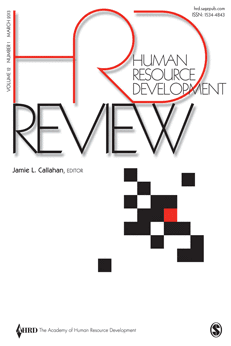
Human Resource Development Review
Bridging Theory and Practice in Human Resource DevelopmentHuman Resource Development Review, published by SAGE Publications Inc, is a premier journal in the field of organizational behavior and human resource management. With a strong Q1 ranking in the 2023 category quartiles and an impressive 90th percentile placement in Scopus rankings, this journal serves as a vital platform for the dissemination of cutting-edge research, innovative practices, and theoretical advancements in human resource development. The journal aims to foster scholarly dialogue and practical insights among researchers, practitioners, and students alike, thereby playing a crucial role in shaping the future of human resource practices. Although not an open-access publication, Human Resource Development Review maintains a commitment to high-quality, peer-reviewed content that addresses the dynamic challenges faced by organizations today. With its comprehensive scope ranging from 2002 to 2024, the journal continues to be an essential resource for anyone seeking to deepen their understanding of human resource dynamics within various organizational contexts.
Journal of Workplace Learning
Transforming Learning in the WorkplaceJournal of Workplace Learning is a leading academic journal published by Emerald Group Publishing Ltd, specializing in the intersecting realms of workplace learning, organizational behavior, and human resource management. Established in 1997, the journal has established a strong reputation, evident in its Q2 ranking across multiple categories, including Development, Organizational Behavior and Human Resource Management, and Social Psychology as of 2023. It provides an essential platform for researchers, practitioners, and policymakers to disseminate empirical studies, theoretical frameworks, and practical insights aimed at enhancing learning in diverse workplace settings. The journal is indexed in major databases, affirming its global reach and impact, making it a vital resource for those looking to stay at the forefront of workplace education and development practices. Although it does not currently offer open access, the valuable contributions published in its pages are pivotal for advancing knowledge and practices in today’s complex organizational landscapes.
INDUSTRIAL AND COMMERCIAL TRAINING
Transforming Knowledge into Action for Tomorrow's WorkforceINDUSTRIAL AND COMMERCIAL TRAINING is a prestigious academic journal published by Emerald Group Publishing Ltd, focusing on the intersection of business, education, and human resource management. Established in 1969 and continuing through to 2024, the journal provides a vital platform for researchers and practitioners to disseminate innovative ideas and practices in training within the industrial and commercial sectors. With a strong commitment to advancing knowledge in the field, it holds noteworthy Q2 rankings in Business, Management and Accounting and Education, as well as a solid standing in the Organizational Behavior and Human Resource Management category. Although it does not offer open access, the journal's rigorous peer-review process ensures high-quality contributions that are invaluable for those aiming to enhance their expertise in professional training modalities. Leveraging its significant impact factor and Scopus rankings, INDUSTRIAL AND COMMERCIAL TRAINING serves as an essential resource for academics, industry leaders, and students alike, fostering a deeper understanding of effective training strategies in today’s dynamic business environment.
JOURNAL OF MANAGEMENT DEVELOPMENT
Driving progress in management through scholarly exploration.JOURNAL OF MANAGEMENT DEVELOPMENT, published by Emerald Group Publishing Ltd, stands at the forefront of scholarly discourse within the realms of Business and Management. With ISSNs 0262-1711 and 1758-7492 (E-ISSN), this prestigious journal has been dedicated to advancing the knowledge base in management theories and practices since its inception in 1982. The journal's formidable impact is reflected in its 2023 rankings, holding a Q1 classification in both Business, Management and Accounting (miscellaneous) and History, along with a Q2 classification in Organizational Behavior and Human Resource Management, demonstrating its broad interdisciplinary appeal. With a Scopus ranking of #23 out of 189 in its primary category, the journal is considered a key resource for researchers, professionals, and students alike, providing insight into innovative management strategies and developmental methodologies. By fostering a diverse range of qualitative and quantitative research, the JOURNAL OF MANAGEMENT DEVELOPMENT continues to serve as an indispensable tool for anyone looking to enhance their understanding of management development trends and practices globally.

Journal of Organizational Effectiveness-People and Performance
Advancing Knowledge for Organizational SuccessThe Journal of Organizational Effectiveness-People and Performance, published by Emerald Group Publishing Ltd, stands as a leading platform in the field of Organizational Behavior and Human Resource Management. With an ISSN of 2051-6614 and an E-ISSN of 2051-6622, this journal has made significant strides since its inception in 2014, currently accumulating a valuable H-index that reflects its scholarly impact. Recognized as a Q2 journal in the 2023 rankings, it holds a commendable position at rank #71/230 in its category, with a percentile ranking of 69. The journal critically explores the intersection of people and performance within organizations, aiming to disseminate high-quality research and practical insights that drive effective organizational strategies. Researchers, practitioners, and students alike will find a wealth of resources and groundbreaking studies aimed at enhancing workforce dynamics and overall organizational effectiveness. The journal is dedicated to fostering knowledge that empowers individuals and organizations globally, making it an essential read for anyone vested in understanding the complexities of human resource practices and organizational success.
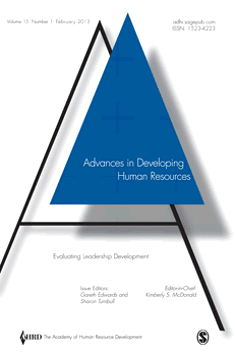
Advances in Developing Human Resources
Pioneering Advances in Human Capital ManagementAdvances in Developing Human Resources is a leading academic journal published by SAGE Publications Inc., specializing in the fields of Organizational Behavior and Human Resource Management. With an ISSN of 1523-4223 and E-ISSN 1552-3055, this journal has established itself as a vital resource for both practitioners and scholars interested in the development and management of human capital. It proudly occupies a prestigious Q2 category ranking in the 2023 Scopus category for Organizational Behavior and Human Resource Management, reflecting its position in the top 25% of journals within this domain as well as a remarkable 52nd rank out of 230 in the field. Since its inception in 1999, the journal has provided a platform for innovative research, empirical studies, and practical applications that address contemporary challenges in human resource development. Though it is not an open-access journal, it offers ample opportunities for engagement and knowledge sharing among researchers, professionals, and students alike, contributing significantly to the advancement of best practices in human resource management. The journal's ongoing commitment to publishing high-quality research positions it as an indispensable resource for anyone aiming to stay at the forefront of advancements in the field.