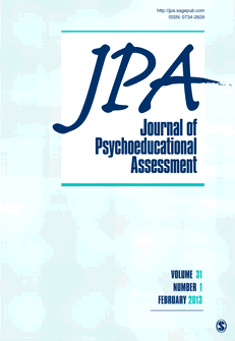
JOURNAL OF PSYCHOEDUCATIONAL ASSESSMENT
Scope & Guideline
Unveiling new perspectives in psychoeducational assessment.
Introduction
Aims and Scopes
- Psychometric Evaluation and Validation:
The journal emphasizes the psychometric properties of assessment tools, including reliability, validity, and measurement invariance, ensuring that these tools are robust and applicable across different cultural and demographic contexts. - Assessment of Emotional and Behavioral Constructs:
Research published in the journal frequently explores emotional and behavioral assessments, such as anxiety, perfectionism, self-efficacy, and social-emotional learning, reflecting the importance of these constructs in educational settings. - Development of Culturally Relevant Assessment Tools:
The journal promotes the creation and validation of assessment instruments that are culturally sensitive and appropriate for diverse populations, addressing the need for inclusivity in educational assessment. - Utilization of Innovative Methodologies:
The journal showcases studies that employ both traditional statistical methods and modern techniques, such as machine learning and Rasch analysis, to enhance the understanding and application of psychoeducational assessments. - Focus on Educational Outcomes and Interventions:
There is a core focus on how psychoeducational assessments can influence educational outcomes, including interventions aimed at improving student well-being and academic success.
Trending and Emerging
- Social-Emotional Learning Assessments:
There is a growing emphasis on the assessment of social-emotional learning (SEL) competencies, highlighting the importance of emotional intelligence and interpersonal skills in educational contexts. - Culturally Responsive Assessment Practices:
Recent publications increasingly focus on the development and validation of assessment tools that are culturally responsive, addressing the diverse backgrounds of students and promoting equity in educational assessment. - Integration of Technology in Assessment:
Emerging studies explore the use of technology in psychoeducational assessments, including computerized adaptive testing and online assessments, reflecting the digital transformation of education. - Focus on Well-Being and Mental Health:
Research examining the intersection of academic performance and mental health, including constructs such as well-being, resilience, and coping strategies, is gaining traction as schools prioritize holistic approaches to education. - Predictive Analytics in Educational Outcomes:
There is an increasing application of predictive analytics and machine learning techniques to identify factors that contribute to student success and to tailor interventions based on assessment data.
Declining or Waning
- General Intelligence Assessments:
There has been a noticeable decrease in the frequency of studies focusing on traditional intelligence assessments, such as IQ tests, as the field shifts towards more holistic and multi-dimensional approaches to understanding cognitive abilities. - Standardized Testing Critiques:
Research critiquing standardized testing practices has waned, possibly as the dialogue around assessment has evolved to focus more on formative and alternative assessment methods rather than solely critiquing existing standardized measures. - Behavioral Assessment of Specific Disorders:
The publication of studies specifically addressing behavioral assessments for singular disorders, such as ADHD or autism, has decreased. This may indicate a shift towards more integrated approaches that consider co-occurring conditions and broader behavioral health frameworks.
Similar Journals
EDUCATIONAL AND PSYCHOLOGICAL MEASUREMENT
Elevating Standards in Educational and Psychological AssessmentEDUCATIONAL AND PSYCHOLOGICAL MEASUREMENT, published by SAGE Publications Inc, is a premier journal serving as a vital resource for researchers and practitioners in the fields of educational and psychological assessment. With a rich history dating back to 1941, this esteemed journal encompasses a wide-ranging scope, exploring the intricacies of measurement techniques and their implications within applied mathematics, psychology, and education. Notably categorized in Q1 quartiles across various fields, including Applied Mathematics and Educational Psychology, the journal ranks impressively in Scopus, reflecting its high impact and relevance—ranked #82/635 in Applied Mathematics and #232/1543 in Education. The journal’s commitment to advancing knowledge in educational measurement equips scholars with essential insights and methodologies, making it an essential tool for advancing scholarly inquiry and practice. With no open access limitations, EDUCATIONAL AND PSYCHOLOGICAL MEASUREMENT is dedicated to disseminating quality research that influences educational practices and psychological evaluation, thus reinforcing its esteemed position within academia.
Enfance
Championing Multidisciplinary Perspectives on ChildhoodEnfance, established in 1949 and published by PRESSES UNIV FRANCE, is a distinguished academic journal specializing in the multidisciplinary study of childhood and development. With its ISSN 0013-7545 and E-ISSN 1969-6981, it serves as a vital platform for researchers, educators, and practitioners interested in the complexities of child development, education, and health. While not open access, Enfance has carved its niche within the arts and humanities as well as social sciences, as reflected in its 2023 category quartiles and Scopus rankings. These accolades underscore its relevance, particularly in developmental and educational psychology, education, and pediatrics. The journal's commitment to advancing understanding within these fields through rigorous, peer-reviewed research makes it an essential resource for those dedicated to improving the wellbeing and development of children globally. Situated in Paris, France, Enfance continues to be at the forefront of innovative discussions in the study of childhood, making significant contributions to both academic and practical applications.

Education Sciences
Exploring the Intersection of Knowledge and PracticeEducation Sciences, published by MDPI, is a renowned open-access journal based in Switzerland, committed to disseminating groundbreaking research across a wide array of interdisciplinary fields related to education. Since its inception in 2011, the journal has fostered scholarly discourse, presenting peer-reviewed articles that contribute to the advancement of knowledge in crucial areas such as Computer Science Applications, Developmental and Educational Psychology, Physical Therapy, and Public Administration, achieving impressive rankings within Scopus, including 81st percentile in Education and 79th percentile in Physical Therapy. With a dedication to accessibility and inclusivity, Education Sciences promotes the free exchange of ideas and findings, ensuring that educators, researchers, and policy-makers can readily access innovative studies that inform practices and policies in education and health professions. As it converges towards 2024, this journal stands as a critical platform for anyone invested in understanding and enhancing educational practices globally.
PSYCHOLOGICAL ASSESSMENT
Transforming Understanding through Rigorous AssessmentPSYCHOLOGICAL ASSESSMENT is a prestigious journal published by the American Psychological Association that has been a cornerstone in the fields of Clinical Psychology and Psychiatry and Mental Health since its inception in 1989. With an impressive impact factor, this journal is ranked in the Q1 category for both related fields, showcasing its critical role in disseminating high-quality research and scholarly articles. The journal focuses on the development, validation, and application of psychological assessment tools, inviting contributions that enhance the understanding of mental health through rigorous methodological frameworks. As evidenced by its high Scopus rankings—66th in Clinical Psychology and 165th in Psychiatry and Mental Health—PSYCHOLOGICAL ASSESSMENT is indispensable for researchers, professionals, and students who seek to advance their knowledge and practice in psychological evaluation. While it is not an open-access journal, the insights provided are vital for anyone dedicated to the nuanced study of psychological assessment and diagnosis. For more information, visit the journal's page on the American Psychological Association's website.
JOURNAL OF EXPERIMENTAL EDUCATION
Unveiling the complexities of learning through experimental inquiry.Journal of Experimental Education, published by Routledge Journals, Taylor & Francis Ltd, is a prestigious platform dedicated to advancing the field of educational research. With an impressive history spanning from 1932 to 2024, this journal covers significant developments in Developmental and Educational Psychology and Education, achieving a Q1 ranking in both categories for 2023. The journal is recognized for its rigorous peer-reviewed articles that explore innovative experimental methodologies and empirical studies that shape contemporary practices in education. Current Scopus rankings further establish its credibility, placing it in the top percentiles among its peers. While it is not an open-access journal, the insights offered through its publications are invaluable for researchers, educators, and students seeking to deepen their understanding of educational phenomena and improve pedagogical approaches. By fostering a community dedicated to research excellence, the Journal of Experimental Education serves as an essential resource for those committed to the advancement of education.
JOURNAL OF PERSONALITY ASSESSMENT
Illuminating the Path to Better Mental Health AssessmentJOURNAL OF PERSONALITY ASSESSMENT is a leading scholarly publication dedicated to advancing the field of personality evaluation and psychological assessment. Published by Routledge Journals, Taylor & Francis Ltd, this prestigious journal has been serving the academic community since 1971, consistently pushing the boundaries of research through rigorous peer-reviewed articles. With an impressive Q1 categorization across multiple disciplines, including Clinical Psychology, Psychiatry and Mental Health, and Health, Toxicology and Mutagenesis, it ranks among the top journals in its field, reflecting a Scopus Rank of #41/311 in Clinical Psychology and #106/567 in Psychiatry. The year 2024 marks a continued commitment to excellence in psychological assessment, making this journal an essential resource for researchers, practitioners, and students who strive to understand and improve personality assessment methodologies. Although not an open-access journal, the insightful articles and findings published within serve as vital tools for navigating the complexities of human behavior and mental health.

REVISTA LATINOAMERICANA DE PSICOLOGIA
Cultivating Interdisciplinary Conversations in PsychologyREVISTA LATINOAMERICANA DE PSICOLOGIA, published by the Foundation Advancement Psychology, serves as a prominent platform for the dissemination of innovative research and critical discourse in the fields of psychology and social sciences. Established in Colombia in the early 1980s, this journal has been crucial in reflecting the diverse psychological landscapes of Latin America and beyond. With an impact factor indicating its growing influence in the field—ranking in the 3rd quartile for Psychology (miscellaneous) and the 2nd quartile for Social Sciences (miscellaneous) as of 2023—it highlights significant research contributions and promotes interdisciplinary dialogues. Notably, the journal facilitates open access to its content, fostering a wider audience reach and enabling essential knowledge sharing among researchers, practitioners, and students. For those keen on exploring contemporary psychological issues and social phenomena, REVISTA LATINOAMERICANA DE PSICOLOGIA stands as an invaluable resource, ready to inspire further investigation and academic collaboration.
International Journal of Testing
Advancing Testing Methodologies for a Brighter FutureThe International Journal of Testing, published by Routledge Journals, Taylor & Francis Ltd, stands as a pivotal source of knowledge in the realms of education, modeling and simulation, and social psychology. With an ISSN of 1530-5058 and an E-ISSN of 1532-7574, this esteemed journal is recognized for its commitment to advancing the understanding of testing methodologies and their applications across diverse fields. Currently classified in the Q1 category for both Education and Modeling and Simulation, and Q2 for Social Psychology, it maintains a significant impact, ranking 434th among 1543 journals in Educational Social Sciences. The journal fosters high-quality research discussions, providing a platform for researchers, professionals, and students to share innovative insights and findings. Although it is not open access, the journal ensures that groundbreaking studies are disseminated widely to contribute to ongoing academic discourse until 2024 and beyond. With its headquarters in the United Kingdom at 2-4 Park Square, Milton Park, Abingdon OX14 4RN, Oxon, England, the International Journal of Testing continues to be an invaluable resource for anyone involved in testing theory and practice.
PSYCHOMETRIKA
Bridging theory and practice in the behavioral sciences.PSYCHOMETRIKA, an esteemed journal published by Springer, serves as a premier platform for advancing the field of psychometrics and quantitative psychology. Since its inception in 1936, the journal has maintained its commitment to disseminating high-quality research, making significant contributions to both applied mathematics and psychology, reflected in its distinguished Q1 ranking in relevant categories as of 2023. With an impressive Scopus ranking, positioned at #117 in Applied Mathematics and #62 in General Psychology, it occupies a critical niche for scholars aiming to explore the interplay between statistical methods and psychological measurement. Although not open access, PSYCHOMETRIKA provides a rigorous peer-reviewed environment that fosters innovative research, methodologies, and theories while offering valuable insights relevant to researchers, professionals, and students alike. Prepared to bridge theoretical knowledge with practical application, this journal is a vital resource for those looking to deepen their understanding of psychometric principles and advance their scholarly endeavors in the behavioral sciences.
EUROPEAN JOURNAL OF PSYCHOLOGICAL ASSESSMENT
Shaping the Future of Applied Psychology Through Rigorous AssessmentWelcome to the European Journal of Psychological Assessment, a prestigious publication in the field of applied psychology, published by Hogrefe Publishing Corp. With a strong emphasis on advancing the methods and practices of psychological assessment, this journal has established itself as a crucial resource for researchers, practitioners, and students alike. Since its inception in 1996, it has built a reputation for quality and innovation, reflected by its impressive Q1 ranking in the applied psychology category, signifying its critical role in shaping the future of the discipline. The journal's impactful contributions – ranked #62 out of 249 within its field and indexed in Scopus at the 75th percentile – make it an essential reading for anyone interested in the latest assessment techniques and research findings. Although not an open-access journal, it continues to reach audiences through institutional subscriptions and provides a wealth of knowledge aimed at enhancing psychological practice and research.