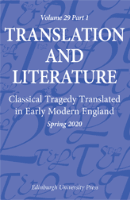
Translation and Literature
Scope & Guideline
Illuminating the Art of Translation in Literature
Introduction
Aims and Scopes
- Literary Translation Studies:
The journal examines the processes, theories, and practices involved in translating literary texts, highlighting the challenges and nuances of rendering literary works from one language to another. - Cultural Intertextuality:
It explores how translations influence and are influenced by cultural contexts, examining the interplay between source and target cultures and how this dynamic shapes literary interpretation. - Historical Perspectives on Translation:
The journal delves into the historical evolution of translation practices, analyzing significant translations throughout history and their impact on literature and cultural exchange. - Gender and Translation:
A core area of focus is the examination of how gender dynamics affect translation practices and the representation of gender in translated texts, reflecting on the role of translators as cultural mediators. - Adaptation and Reception:
The journal also looks at adaptations of literary works into other forms, such as theatre, film, and poetry, and how these adaptations are received in different cultural contexts. - Theoretical Frameworks:
It engages with various theoretical approaches to translation, including postcolonial theory, feminist theory, and ecocriticism, to analyze the implications of translation in contemporary literature.
Trending and Emerging
- Transcultural and Global Perspectives:
Recent publications emphasize transcultural approaches to translation, examining how texts navigate and reshape cultural boundaries in an increasingly interconnected world. - Translation and Digital Humanities:
There is a rising interest in how digital technologies impact translation practices, including the use of digital archives and tools for collaborative translation projects. - Intermediality and Adaptation:
An increasing number of articles focus on the adaptation of literary texts across different media, such as film and theatre, analyzing the implications of these adaptations for both translation and reception. - Ethical Dimensions of Translation:
Emerging discussions center on the ethical responsibilities of translators, particularly in contexts involving marginalized voices and cultural representation. - Translation and Social Justice:
The journal has begun to explore the role of translation in promoting social justice, examining how translation practices can challenge power dynamics and facilitate marginalized narratives.
Declining or Waning
- Traditional Canonical Texts:
There has been a decrease in publications focusing solely on traditional canonical texts, such as classical works from authors like Homer and Virgil, indicating a shift towards contemporary and diverse literary voices. - Purely Descriptive Translation Studies:
Works that primarily offer descriptive accounts of translation processes without theoretical engagement have become less frequent, as the journal increasingly favors articles that incorporate theoretical frameworks and critical analysis. - Language-Specific Translation Issues:
Discussions centered exclusively on translation issues relevant to specific languages have diminished, suggesting a broader trend towards comparative studies that transcend linguistic boundaries. - Translation as a Mechanism of Cultural Preservation:
Themes focusing on translation as a tool for preserving cultural heritage have waned, possibly overshadowed by discussions on translation's role in cultural negotiation and transformation. - Translation and National Identity:
The exploration of translation's connection to national identity has seen a decline, reflecting a growing interest in transnational and global perspectives on translation.
Similar Journals

Libri & Liberi
Navigating the Multifaceted World of Young LiteratureLibri & Liberi (ISSN: 1848-3488, E-ISSN: 1848-5871) is a prominent academic journal published by the Croatian Association of Researchers in Children's Literature based in Croatia. Established to focus on the multifaceted world of children's literature and cultural studies, this journal plays a critical role in promoting scholarly dialogue and research within these disciplines. With a commendable trajectory since its inception in 2015, it has positioned itself within the Q2 and Q3 quartiles for Literature and Literary Theory and Cultural Studies respectively, according to the latest rankings. Although currently not operating as an open-access platform, it adheres to rigorous peer-review standards that bolster its credibility among academics. Libri & Liberi stands out as an essential resource for researchers, professionals, and students alike, fostering a diverse body of knowledge that enhances our understanding of literature's influence on culture and society.
Forum-Revue Internationale d Interpretation et de Traduction-International Journal of Interpretation and Translation
Elevating Scholarly Discourse in Language Arts.Forum-Revue Internationale d’Interprétation et de Traduction - International Journal of Interpretation and Translation is a prestigious peer-reviewed journal published by John Benjamins Publishing Co, renowned for its contributions to the fields of linguistics and literary theory. With an ISSN of 1598-7647 and an E-ISSN of 2451-909X, this journal provides a vital platform for researchers, professionals, and students to disseminate and engage with innovative research findings and theoretical developments in interpretation and translation studies. As of 2023, it holds a respectable Q3 ranking in Linguistics and Language and a Q2 in Literature and Literary Theory, underscoring its growing influence within academia, reflected by its Scopus rankings. The journal encompasses a diverse array of perspectives and methodologies to enhance the understanding of translation practices and their implications in contemporary society. Although the journal operates within a limited open access framework, its commitment to high-quality scholarship makes it an essential resource for those seeking to contribute to and stay abreast of advancements in this dynamic field. Established to foster interdisciplinary dialogue, the journal invites submission from a wide range of scholarly approaches and encourages collaborative discourse among linguists, translators, and literary theorists.

Interdisciplinary Studies of Literature
Fostering Innovative Connections in Literary StudiesInterdisciplinary Studies of Literature is a premier academic journal dedicated to advancing the field of literature and literary theory, published by KNOWLEDGE HUB PUBL CO LTD in China. Since its inception in 2017, this journal has consistently offered a vibrant platform for scholarly discourse, hailing from a prestigious Q1 ranking in the Literature and Literary Theory category, reflecting its commitment to high-quality research. With a Scopus rank of #455 out of 1106 in the Arts and Humanities category and a standing in the 58th percentile, this journal embraces diversity in literary studies while fostering interdisciplinary connections to critical theories and practices. Academics, researchers, and students alike will find valuable insights and innovative perspectives within its pages, making it an essential resource for those engaged in literary analysis and theory. Engaging with this journal not only enriches understanding but also promotes the evolution of literary discourse globally.

Acta Universitatis Lodziensis Folia Litteraria Romanica
Championing Quality Research in Linguistics and LiteratureActa Universitatis Lodziensis Folia Litteraria Romanica is a distinguished open-access journal published by LODZ UNIV PRESS since 2016, dedicated to advancing scholarship in the realms of Linguistics and Literature and Literary Theory. With a strong commitment to disseminating high-quality research, the journal serves as a vital platform for scholars and practitioners aiming to explore the complexities of language and literary studies. It is positioned within Q4 in Linguistics and Language and Q3 in Literature and Literary Theory, evidencing its growing influence in these fields. The journal's inclusion in the Scopus rankings, with notable placements in both the Arts and Humanities and Social Sciences categories, underscores its relevance and engagement with contemporary discourse. Located in Poland, the journal encourages contributions from a diverse range of voices and perspectives, promoting scholarly dialogue and innovation, while adhering to an open-access format for enhanced accessibility. Researchers, professionals, and students will find Acta Universitatis Lodziensis Folia Litteraria Romanica an invaluable resource for their academic pursuits.

Skandinavskaya Filologiya
Cultivating Scholarly Discourse on Scandinavian Cultures.Skandinavskaya Filologiya is a distinguished academic journal published by St Petersburg University Press that specializes in Scandinavian philology and linguistics. With its ISSN 0202-2397 and E-ISSN 2618-9518, this journal serves as a vital platform for scholarly articles that explore the intricate languages, literature, and cultural nuances of the Scandinavian region. The journal seeks to promote interdisciplinary research and foster collaboration among linguists, literary scholars, and cultural researchers interested in the rich heritage and contemporary developments within Scandinavian studies. Although the journal operates without open access, it is committed to enhancing academic discourse and providing a valuable resource for students, professionals, and researchers. Located in the vibrant city of St Petersburg, Russia, the journal aims to bridge the gap between Eastern and Western scholarship in Scandinavian philology, making it a significant contributor to the field.
TRANSLATION REVIEW
Navigating the Complexities of Language and Literature.TRANSLATION REVIEW is an esteemed academic journal dedicated to advancing the field of translation studies, encompassing critical analysis and theoretical explorations that inform contemporary practices in linguistics and literature. Published by Routledge Journals, Taylor & Francis Ltd, this journal has earned a respectable reputation within the scholarly community, evident from its current categorization in the Q3 quartile in Linguistics and Language and Q2 in Literature and Literary Theory. With issues spanning from 1978 to the present, TRANSLATION REVIEW reflects a rich legacy of scholarly discourse while also engaging with emerging trends in translation theory and pedagogy. The journal's Scopus rankings place it within the top 30% percentile of Arts and Humanities research, providing a significant platform for researchers and professionals to disseminate their findings. As a non-open access journal based in the United Kingdom, it welcomes contributions that offer new insights and foster dialogue around translation's multifaceted impact in a global context. Scholars, practitioners, and advanced students will find this journal an invaluable resource for both theoretical frameworks and practical applications in translation studies.
Babel-Revue Internationale de la Traduction-International Journal of Translation
Connecting Scholars and Practitioners in Translation TheoryBabel - Revue Internationale de la Traduction - International Journal of Translation, published by John Benjamins Publishing Co, is a leading scholarly journal that has established itself as a critical platform for research in the fields of translation studies, linguistics, and communication. Since its inception in 1955, Babel has provided a forum for academic discourse and has adapted through converged years to continuously reflect the evolving landscape of translation theory and practice. The journal is recognized for its high impact, achieving a Q1 ranking in Linguistics and Language and Q2 in Communication, making it relevant for both researchers and practitioners seeking to contribute to this dynamic area of study. With significant Scopus rankings in various categories, Babel is instrumental in promoting innovative research and fostering multidisciplinary dialogue. Although it does not offer open access, the journal is accessible through numerous academic institutions worldwide, ensuring that vital insights into translation practices and theories are disseminated effectively. Researchers, professionals, and students alike will find a wealth of knowledge and groundbreaking perspectives within its pages, making Babel an essential resource in the field.

Trans-Revista de Traductologia
Navigating the Intersections of Language and CultureTrans-Revista de Traductologia, an esteemed journal in the realm of Translation Studies and Linguistics, is published by the University of Malaga's Faculty of Philosophy and Letters. With an Open Access model since 2015, it facilitates the global dissemination of research and findings, supporting the academic community and enhancing visibility for scholars. The journal spans research from 2012 to 2023 and has achieved a commendable Q2 ranking in the Linguistics and Language category for 2023, signifying its growing influence within the field. Its Scopus rankings reflect its competitive edge, positioned at #484 in Arts and Humanities as well as #565 in Social Sciences, as it continues to foster a platform for innovative and interdisciplinary investigation in language dynamics, translation practices, and cultural exchanges. Scholars, professionals, and students alike will find a rich resource within its pages to explore both theoretical frameworks and practical applications in translation.

LEA-Lingue e Letterature d Oriente e d Occidente
Unlocking the Essence of Global Literary TraditionsLEA-Lingue e Letterature d Oriente e d Occidente is an esteemed academic journal published by FIRENZE UNIV PRESS that specializes in the multifaceted exploration of linguistics and literature across Eastern and Western traditions. With its ISSN 1824-4920 and E-ISSN 1824-484X, this Open Access journal has been committed to democratizing knowledge since 2012, allowing researchers, scholars, and students unfettered access to a wealth of scholarly articles and critical studies. Recognized in the Q4 tier for both Linguistics and Language and Literature and Literary Theory in the 2023 category quartiles, LEA strives to bridge cultural and linguistic boundaries while fostering a deeper understanding of literary theory. Operating from its base in Florence, Italy, the journal serves as a vibrant platform for innovative research and discourse, particularly for those dedicated to comparative studies and interdisciplinary approaches in the humanities. Despite its current rankings on Scopus, LEA is poised for growth and aims to enhance its impact in the academic community by publishing cutting-edge research that interrogates linguistic and literary intersections.

Studi Slavistici
Advancing Interdisciplinary Dialogue in Slavic StudiesStudi Slavistici is an esteemed academic journal published by FIRENZE UNIV PRESS, focusing on the rich and diverse fields of Cultural Studies, Linguistics and Language, and Literature and Literary Theory. Since its initiation in 2004, it operates under an Open Access model, providing unrestricted access to its contents and fostering a wider dissemination of research. Based in Italy, this journal serves as a vital platform for scholars and researchers engaged in Slavic studies and beyond, encouraging interdisciplinary dialogue and innovative approaches. With its current Quartile rankings in the Q4 category across various domains, it plays a significant role in shaping dialogues within the academic community while offering insights into contemporary and historical perspectives. By maintaining an inclusive vision and engaging with critical issues, Studi Slavistici remains dedicated to advancing knowledge and scholarship in these intricate fields.